The Waterloo Express March 6, 1879
How the Indians Hunt the Bison
Before the horse came into use Indians were obliged to chase the bison on foot, and even at that present day there are many celebrated hunters who are able to run down a bison on foot and kill it with a lance. The mode however, which is generally adopted in the chase by mounted hunters, a chase which offers the greatest results, and exhibits the wildest enthusiasm and excitement. Armed merely with tiny and flint headed arrows, the native hunter mounts his horse, and goes off in chase of the bison. When he comes up with the animals, he selects one, usually of fat and well conditioned cow, presses his horse to her, and prepares his bow and arrow. The well-trained horse needs no gilding, but keeps close to the right shoulder of the bison, and a little behind it, so that it may not run upon the horns of the animal if it should happen to stop suddenly and turn its head. This plan, moreover, just bring the rider into the proper position to deliver his arrow in the most deadly manner, i.e., directing that just behind the shoulder. When an arrow is discharged by a practiced hand, it often passes entirely through the bison-he falls mortally wounded, and, tenacious of life as the animal is, soon breathes is last. Leaving the arrow in the wound in order to mark the owner of the dead animal, the successful archer dashes on in pursuit of another animal, and does not cease until he has expanded all his store of arrows. It is the pride of the native hunter to kill a bison with every arrow, and not shoot twice at the same animal. The young hunters are fierce and anxious rivals in this sport, knowing that the results of the day’s hunt will be the talk of the whole village, and that on their success or failure will much depend the estimation in which they are held.
Even in those parts of the country where the bow has been almost entirely superseded by firearms, it is equally a point of honor to kill the bison with a single shot and to claim a slain bison for every bullet. In such cases the hunter takes little pains in loading his gun. He carries his powder loose in his pocket or bag, scoops hastily a random quantity into the gun, drops upon it, without any wadding, a bullet wetted in the mouth, and the loading is complete. The muzzle of the gun is uppermost until the moment for firing when the gun is dropped, aimed and fired simultaneously without being brought to the shoulder.
THE DANCE OF SERPENTS.
If Lieutenant John Bourke is not mistaken, in the report addressed by him to General Sheridan in 1881, he is the first white man who has been present at a “serpent dance ” of the Moquis Indians. The first act or figure in this dance is begun after the high priest has taken his stand before the sacred rock, which is a crag some 30 feet high, shaped somewhat like a human figure. The performers separate into two bands, one formed of the singers and players, while the other is composed of 48 men and children. Half of these latter hold either in their hands, or more often in their mouths, large snakes, mostly rattlesnakes, and all of a venomous kind, the other 24 being employed in fanning these creatures with eagles’ feathers. After being carried round in a long circle, each snake is consigned to his sacred box and covered up therein with a bison’s skin. The performers then advance in a double procession towards the priests, and are by them sprinkled with sacred water by means of a plume of eagle feathers clipped in i. An accompaniment; to this solemnity is played by an assistant holding a peculiar instrument, which, when shaken, gives out the sound of falling rain. In the meantime prayers and offerings are made to the Great Spirit to propitiate him and induce him to send the rain in due season. The second figure is not very dissimilar to the first, but the third is the most striking and curious. A large number of serpents are brought out from the sacred house and thrown on the ground in a circular space which has been first covered by the squaws with maize flour. As they wriggle on the ground a signal is given, and several young men, the most active of the tribe, rush quickly into the midst of them, seizing as many as they can, and carrying them off at full speed to a distance, where they put them down and run back instantly to receive the attentions of the squaws, who administer the proper antidotes for the bites with which the men are, of course, covered. In all probability, the Moquis sachems follow the example of Indian snake charmers, by extracting the poison fangs of their pets.- -‘ Globe.’
Manitoba Free Press
Winnipeg, Manitoba, Canada Dec 20 1890
The leather, though sometimes exported, was generally reserved for home use, and contributed largely to domestic comfort. Out of it the plains Indian made his moccasins and other articles of clothing, his saddles, and above all his portable and comfortable lodge, for comfortable it was in winter, with its lining and carpeting of soft buffalo robes, and it’s bright fire, round which the legends of the tribe were handed down to the youngsters in the long winter nights. Indeed the Buffalo skin lodge was in general use 20 years ago even in the settlements, and was often preferred in summer to the house. The same style of lodge is still in use in the Northwest; but it is now made of calico instead of leather. On the plains the Buffalo dung called “Buffalo chips” by the hunters furnished, in summer, the Indian and the plains hunters fuel, and it’s sinews, which lay immediately under the back fat, along the spine from the sirloin forward, supplied tough and durable thread and glue. The last, but not the least, important product of the Buffalo was shaganappi, or as it was often called ”Northwest iron.” The word in common use is a corruption of the Cree compound pesaaganappi (”shred in a circle”) , and the common sort was simply a long strip cut concentrically from the hide of an old bull. But the twisted lines, which were used for bridal lines, tethers, etc. were taken from the romp of the animal, where the hide was uniform in thickness. These lines, like the others, were taken from the hide in continuous concentric rings, which were afterwards greased and exposed to the sun, pounded to suppleness with the mallet, or better still, chewed and then braided. They were exceedingly strong and durable. Shaganappi was in fact, until recently, an invaluable and omnipresent article in the Northwest. It was much stronger and more durable than the cordage made from domestic hide, and was largely employed in making cart and double harness for cattle. For lashing there was nothing equal to it. First wetted, and then wrapped around a broken wheel, or shaft, it contracted in drying, to a grip as firm as iron; and indeed, has been said, this is the name it often went by. Such were the principal benefits which the Buffalo conferred upon the Indians, half breeds and older settlers of the Northwest, and which covered most of their primary needs. It seems that yesterday when they were in the full enjoyment of them; and it is not surprising, therefore, that a generation “to the manner born” should look back with regret to the past and heave many a sigh at thought of its primitive happiness and abundance. So strong is this feeling that I verily believe if today such a miracle could happen as the sudden appearance of an immense herd between the two Saskatchewans the reaper would be left in the swath, and the ripened grain would cry in vain for harvesters.
In conclusion Mr. Mair urges the government to save these animals from extinction. He points out the successful nature of the crossing experiments with domestic cattle made by private parties and seen in this a means of new usefulness of this animal. He advocates the setting a part of a special national Park in the foothills of the Rockies for their breeding of the animals.
Stories of the hunts on the plains, facts as to the habits of the animal are growing fainter as the old hunters follow the bison into the darkness of the past. While there is yet time, Mr. Mair thinks, and effort should be made to collect from these sources all the information possible; and has requested the assistance of the press. The Free Press will be glad to publish anything of interest dealing with bison.
The Times
Greater London, England Dec 9 1890
The Ghost Dance(extract)
In one of the dances’ an unfortunate Indian, who had enjoyed the coveted vision, when he had recovered consciousness cried as if his heart would break. He had seen the “Messiah,” who told him to return to earth because he had not brought along his wife and child. The child had died two years before and the impossibility of obeying the command put him into the most complete despair. In a telegram from Pine Ridge it is related that in a recent dance one of the warriors was to go into a trance for four days, and then return to life as a buffalo. The tribe was then to kill the buffalo, and every Indian who did not eat a piece would turn into a dog. The buck who was to be transformed into the buffalo and thus be eaten is said to have offered himself a willing sacrifice. These untutored savages are full of superstitions and believe anything “medicine man” tells them. At the Cheyenne Agency recently one of these prophets announced that on the previous day he had been visited by several persons who had been a long time dead, and who brought him a piece of buffalo meat. The Indians love buffalo meat but have seen none of it for several years. The prophet told them he would feed them with the buffalo meat that had been brought to him. .The following night a circle was formed, and the prophet stepped into the center with a dish full of cooked meat. There was a dance, and then one after another the dancers filed up and each was given a piece of the meat. Although they were many, and the pieces few, yet there were enough to go round. The “medicine man” was a magician and up in all the tricks of sleight of hand, yet he attributed it all to the coming of the red man’s “Messiah.” The craze seems to have spread throughout the Western plains, and the “ghost dance” goes on in a hundred places, the Sioux having carried it even over the northern border into Canada./
Pittsburg Dispatch Dec 13 1891
HOW MEN REMEMBER.
Cords Tally Sticks That Recorded
Histories on Birch Bark Paintings on Skins. [written for the dispatch]
As straight as a reed it would seem more appropriate for this Indian to go about gathering scalps, instead of merely counting them, but he is entirely peaceful and carries in lieu of pencils, note books and blanks, three small cords. Whatever other questions he may ask and however much he may know about possessions and mortgages, if any, he is only going to find out now many braves, squaws and children there are in the tribe. These he records by tying knots in the proper cord; some of these cords are in the United States National Museum.
Census taking among the Comanche Indians only reached so far as to get the total number, this being represented by a bundle of short lengths of arrow reed tied around with a piece of red cotton. Indians however knew how to tally by means of sticks, and notched records are known everywhere. The Eskimo draws sometimes very graphic outlines on a piece of ivory, picturing each animal he has slain. Often, by way of diversion, he scratches on the smooth ivory hunting scenes, pictures of ships, villages, etc., in a masterly manner. Most of his village life also can be read from his ivory drill and bag handles and animal carvings, in which resemble those found in the ancient caves of France. There is a roster of a Sioux band in the National Museum. The warriors are known by different pictures of animals, birds, etc.
The Census of Red Cloud.
Red Cloud’s census record is a remarkable specimen of Indian pictorial writing in which every man is named by rudely drawn figures expressing his name. Two hundred and eighty-nine Indians are named, and apparently the system would answer for any number. There is every reason to believe that the Indian, if left alone, would have invented an alphabet as was done in Phoenicia.

LONE DOG
There is also an interesting winter count on a buffalo robe, being a complete record of the events happening in a Sioux camp, for 70 winters, beginning with the year 1800. It is well painted on the skin, and can be read with ease by those familiar with this kind of writing. A
more or less accurate drawing means an Indian named “Left-handed-big-nose” Each winter was called by the principal event, for instance, the “White-buffalo-killed-by-the-Crows-wlnter,” “Many-sick-winter,” “Tree-fell-on-woman-who-was-cutting-wood-winter,” and many other chronicles.
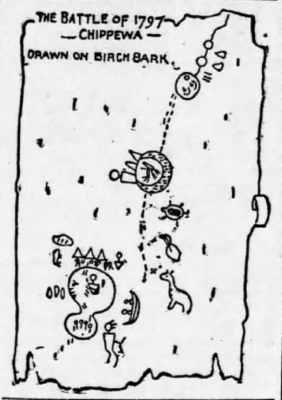
The birch bark records of the Chippewa Indians collected by Dr. W. J. Hoffman are being prepared for display at the Columbian Exposition. They consist of accounts of the origin of the world, battle records, love letters, songs, etc., expressed in queer figures scratched in the bark, and are remarkable specimens of how men remember. – Walter Hough.
Somerset Herald
Somerset Pennsylvania Nov 17 1897
Much has been written of Indian uprisings and outrages, but there is a story to be told on the other side which often shows not only justice in the Indian action but the most violent outrage on the part of the white settlers in provoking it. Here is a tale told by Scout Allison, an employee of the government in the West, that throws some light on Indian affairs:
Gold was discovered in the Black Hills in 1874, an l regardless of Indian ownership, white men from all parts of the United States rushed to the hills in eager search of the precious metal. The Indians entered a strong protest and appealed to the United States authorities to expel the miners from their reservation. Many were driven out by troops, but in spite of all opposition the spring of 1876 found the new gold fields literally alive with white men and mines giving up gold at the rate of thousands of dollars per day, while every trail leading to the Black Hills across the reservation became a public highway over which supplies were hauled into the mines. One of the principal routes to the Black Hills was over the Bad River trail, through the very heart of the great Sioux reservation in South Dakota. Fort Pierre at the mouth of Bad River was the starting point and base of supplies. Thirty-five miles above Fort Pierre was situated the Cheyenne River Indian agency, on the west bank of the Missouri river, around which were clustered about 5,000 friendly Indians. Sixty-five miles below Fort Pierre the Lower Brule agency was located, also on the west bank of the Missouri, where about 2,500 friendly Sioux received their rations. Indians passing from one agency to the other frequently came in contact with miners and wagon trains on the Bad River trail, but the Indians, being inclined to peaceful methods, and hoping that the government would eventually protect them in their rights, avoided contact as much as possible, waiting their opportunity and crossing the trail where no white man was visible.
About the middle of April, 1876, seven lodges of Minnikanyeju Sioux, who hail been visiting at the Lower Brule agency, were on their way home to the Cheyenne River reservation, when one of their number, a young warrior, was taken violently ill and died while they were encamped on the bank of the Bad river.
Following the usual Indian custom in such cases, the body of the dead warrior was washed and painted as if for a festival, dressed in his finest savage attire and then wrapped in a new woolen blanket, his old mother having first brought his bow and arrows and placed them tenderly by his side. Then the blanket and dressed deer skins were carefully wrapped around the body and fastened with leather thongs. Lastly, the finest and biggest buffalo robe in camp is wrapped with the fur inside around the dead warrior and securely fastened with a long stout lariat. Four forked posts were then set upright in the ground on a little mound a few rods north of the Black Hills trail, on which a scaffold was erected about eight feet from the ground. On this scaffold the body was placed secure from burrowing animals and after the usual funeral rites the grief-stricken friends went sorrowing to their homes at the Cheyenne agency. The mourning red men had been gone perhaps not more than six hours when a party of gold hunters, fourteen in number, with a span of mules and a wagon to haul their supplies, came to the place where the dead warrior was laid to rest The whites saw the Indian grave; the first one they had ever seen. and the last and only one they ever saw. They turned the mules out of the beaten track and drove to the little mound and halted by the side of the scaffold. They walked round and round the strange object, looking up and examining it from every side. At length one of them said: “Say, boys, that looks like a good robe around that redskin; somebody bring an axe from the wagon and we’ll see how they fix up a dead injen, anyway.” The axe is brought, and in a moment the posts are cut through and the scaffold, with its gruesome tenant, falls to the ground. The lariat is loosened, and two men (?) seize the end of the robe and unwind it from the body. It is, indeed, a good robe. They shake it in the wind and then throw it into their wagon. “We’ll have use for that robe,” they say.
The removal of the robe brought to view the dressed deerskins’. “Just what we want,” they said, “to make whiplashes,” and the deerskins followed the buffalo robe into the wagon. And then the blanket, which was a brand new one. It wouldn’t do to leave that. So into the wagon it went to keep company with the rest of the funeral furniture.
Next their attention is given to the almost naked body of the dead warrior. One of them seizes the bow and arrows. “I’ll keep them for my little boy,” said be. Another takes the bear claw necklace. He will take that home for his wife. And thus the body is entirely denuded. The moccasins are taken by one, the silver armlets by another, the garters, with little bells attached to them, are taken by another, and, spurning the naked body with their feet, they go on their way rejoicing at their rich find. It portends good luck when they reach the Hills.
About noon the following day the little band of Indians reached their homes, where they imparted the sad news of the death of the young brave to his friends and relatives. Among the latter was a brother, who, after learning the exact locality of the grave, mounted his horse, saying that he would go and look upon the silent form of his brother and weep for him. Before sunset he was drawing near the little mound, but saw no scaffold standing there and wondered if he had mistaken his directions. No, there is something there, and he rides closer to see what it is. One brief glance at the ruins and he knows the whole story. The posts with the marks of the axe, and the poles which formed the scaffold are there. The tracks of the wagon and the mules show plainly in the soft earth, and all around are the footprints of white men. But where is the dead warrior? Scattered about are fragments of the skeleton stripped of the flesh, and down yonder by the river is a score of coyotes, snarling and fighting over something which looks very much like a portion of the dead Indian’s body. The wolves and coyotes had finished the work which the white vandals had begun.
No tear started from the eye of the dead warrior’s brother as he sat there on his pony and contemplated the scene, but giving utterance to that savage growl which no white men can imitate or describe, he turned his horse’s head toward his home and flew away with the speed of a frightened deer.
It was midnight when he reached his camp, but before daylight, mounted on a fresh horse and followed by fifty stalwart braves, he was on the trail of the fourteen men who committed the outrage. They never used that buffalo robe, nor did they make whip ashes of the deerskins. The bow and arrows never reached the little boy. Every one of the fourteen was killed, providing a big feast for the wolves. But the newspapers just rang with the news of another Indian outrage. They never knew the primary cause. Boston Herald.
The Pittsburg Press
Pittsburg, Pennsylvania June 26, 1905
OLD INDIAN PIPES
Some of Them of Very Curious Stuff
it needs scarcely be told that in the pipes of long ago each feather appended to the stem represented an enemy slain. If one doubted the record of the war eagle feathers the warrior then showed the scalps of the enemy, which were kept as a sort of a sacred proof of his word. Such pipes were used only on occasions of peace and war. Speaking roughly the best pipes of Eastern tribes were in molded clay, the best of the Western tribes in Slate Pipestone taken from the famous quarry West of the Mississippi. Before the great Buffalo and antelope hunts, when herds of game were driven into a pound, or an enclosed area of snares, it was customary for the Indians to whiff that incense of propitiation to the spirits of the animals about to be slain, explaining that only the desire for food compelled the Indians to kill, and that the hunt was that will of the Master of Life or ‘Master of the Roaring Winds, “ who would compensate the animals in the next world. The pipes used for the ceremony usually show the figure of a man in conference with the figure of an animal. Others show the figures of Indians with locked hands. This typifies of bowel of friendship to be terminated only by death. It was usually between men; but sometimes between a man and a woman, in which case the Platonic bound not only precluded but forbade the very possibility of marriage. After that who shall say that the stolid Indian has no vein of sentiment in his nature?
One of the most curious pipes I have seen I bought from a Cree on a reservation East of the refugee Sioux. It is in the shape of a war hatchet, of a metal which I do not know, though I suspect it is galena mixed with clay, the edge been sharp enough, but the back of the acts being a bowl and the handle a pipe stem. The odd lines in Indian carbines and Walden work are not without meaning. Fighting Mistah could read a legend where we saw nothing but bizarre markings. There were the circular lines, hollow down, meaning clouds; the cross, meaning the coming of the priest; the tree, a type of peace with its branches overshadowing the nations; the wavy line, signifying water; the arrow, war. The ordinary Indian can read a tribal song or Chronicle from obscure drawings on the face of a rock, or crazy colored work on a scraped Buffalo skin.- Agnes C. Laut, in June Outing.
The Houston Post Houston, Texas 21 Jan 1917
“At the time of its discovery by Columbus this continent had only one domesticated animal the dog. In most instances, the ancestors of the Indian dogs appear to have been the native coyotes or gray wolves, but the descriptions of some dogs found by the early explorers indicate very different and unknown ancestry. Unfortunately these strange dogs became extinct at an early period, and thus left unsolvable the riddle of their origin.”/
Intertribal Buffalo Council
ITBC is a non-profit 501 (c) (3) tribal organization that has a membership of 57 tribes with a collective herd of over 15,000 bison. Membership of ITBC remains open. ITBC is committed to reestablishing buffalo herds on Indian lands in a manner that promotes cultural enhancement, spiritual revitalization, ecological restoration, and economic development. ITBC is governed by a Board of Directors, which is comprised of one tribal representative from each member tribe. The role of the ITBC, as established by its membership, is to act as a facilitator in coordinating education and training programs, developing marketing strategies, coordinating the transfer of surplus buffalo from national parks to tribal lands, and providing technical assistance to its membership in developing sound management plans that will help each tribal herd become a successful and self-sufficient operation.
Public • 5 Collaborators • 9,618 views
Created on Aug 12, 2011 • By Biagio • Updated Jul 12, 2012/ The Intertribal Bison Council was formed in 1990 to assist tribes in returning buffalo to Indian country and now has a collective herd of more than 15,000 bison divided among 57 tribes in the western United States up to Alaska and over to the Great Lakes area of Michigan. The ITBC realizes, however, with only so much time and so little resources, they must limit their focus to what happens on reservations. They want to utilize and restore the bison not only for health and cultural measures, but for economic reasons as well. “At one time they were our entire economy anyway,” said Mike Fox, a Gros Ventre and ITBC member. He oversees the Fort Belknap Indian Reservation’s 400 head of bison in northern Montana. “There’s also a spiritual connection with bison that you don’t have with cattle. This is something we may never be able to explain to non-Indians.”
Indian Country //Many Thanks to Terrain.org for for allowing us to print the following article
Guest Editorial – 1999
by Carla Rae Brings Plenty, Intertribal Bison Cooperative Restoring the Bison, Restoring the Spirit
They gathered in the Sacred Black Hills of South Dakota on a cold February day in 1991. With only four days’ notice, nineteen tribes from all four directions braved the harsh Dakota winter to attend. Lakota representatives from most of the reservations in South Dakota were there, as were the Crow, Shoshone-Bannock, Gros Ventre / Assinoboine and Blackfoot Nations of Montana. Various Pueblo representatives from New Mexico pulled in, and the Winnebago, traditionally called Ho Chunk, from both Nebraska and Wisconsin came. Choctaw Nation of Oklahoma, and some as far west as the Round Valley of California, arrived, as well. Some of these tribes have historically been enemies, but now they unite for a common mission: “To restore bison to Indian Nations in a manner that is compatible with their spiritual and cultural beliefs and practices.” And this is the mission of the Intertribal Bison Cooperative, an organization comprised of 42 American Indian tribes with a collective herd of over 8,000 bison. ITBC is a non-profit 501(c)(3) tribal organization and is committed to reestablishing bison herds on Indian lands in a manner that promotes cultural enhancement, spiritual revitalization, ecological restoration, and economic development. ITBC is governed by a Board of Directors, comprised of one tribal representative from each member tribe. The role of the ITBC, as established by its membership, is to act as a facilitator in coordinating education and training programs, develop marketing strategies, coordinate the transfer of surplus American buffalo–also known as bison–from national parks to tribal lands, and provide technical assistance to its membership. The ITBC works collaboratively with members to develop sound management plans that enable tribal herds to become successful and self-sufficient operations. The bison has always held great meaning for American Indian people. To Indian people, bison represent their spirit, reminding them of how they once lived free and in harmony with nature.
Millions of wild buffalo once roamed North America, grazing the plains and prairies and populating the mountains.
For more than 10,000 years, the indigenous people of this continent hunted buffalo. Historical documents dating to just after
Columbus’s landfall describe the animal’s importance to the people dwelling west of the Mississippi. Recent scholarship reiterates the buffalo’s dominance in the religion, philosophy, and economy of Native Americans. Woven into the fabric of Native American life for millennia, bison were, and remain, the central figure of their culture. But at the dawn of the 19th Century, a host of changes conspired to redefine the role of the buffalo in relation to mankind, nearly causing the animal’s complete extermination. Along the way these developments corrupted the natural scheme upon which Native American traditions so depend.
Fur traders began to trickle onto the Plains early in the 1800s, soon after Lewis and Clark reported the availability of furs and hides along North Dakota’s Missouri River. Around 1830, Blackfoot country on the upper Missouri opened to white trappers, and slaughter of bison for commercial purposes escalated. The first railroad to invade buffalo territory, the Kansas Pacific, claimed vast tracts of valuable grazing land. Demand and subsequent consumption of buffalo increased exponentially as trains delivered meat to eastern butchers and hides to far-flung tanners. Before long, entrepreneurial resourcefulness among white trappers and hunters gave way to indulgent excess. Recognizing the inextricable link between Native Americans and buffalo, the U.S. Army encouraged the animals’ total destruction, as a military tactic, to starve Native Americans into surrender. Once the bison disappeared, the Army reasoned, tribes would have to abandon their traditional ways or die. The extermination of the buffalo is likely the first example in history of an attempt–and a successful one, at that–to eliminate a species for the purpose of achieving a political objective. By 1880 it was clear that bison were doomed. Men with guns tracked down buffalo even in areas that should have offered natural and political refuge. Poachers infiltrated Yellowstone Park in droves despite regulations prohibiting hunting on park grounds. Lax punishment for the offense, combined with the enticing profitability of a successful hunt, conspired against the majestic animals. When an 1894 inventory in Yellowstone reported only twenty live remaining buffalo, Congress rushed to pass the National Park Protective Act, which imposed stiff fines or imprisonment for buffalo poaching. The U.S. Army now enforced the law in Yellowstone. As the Yellowstone herd struggled for survival, unprotected buffalo outside of Yellowstone National Park were destroyed. In Lost Park, Colorado, poachers exterminated four buffalo in 1897, likely the last unprotected free-ranging herd in the country. Without the bison, the independent life of the Indian people could no longer be maintained. The Indian spirit, along with that of the bison, suffered an enormous loss. The destruction of buffalo herds and the associated devastation to the tribes disrupted the self-sufficient lifestyle of Indian people more than all other federal policies to date. To reestablish healthy bison populations on tribal lands is to reestablish hope for Indian people. Members of the Intertribal Bison Cooperative understand that reintroduction of the bison to tribal lands will help heal the spirit of both the Indian people and the bison. Carla Rae Brings Plenty, a member of the Cheyenne River Sioux Tribe, is the Intertribal Bison Cooperative’s Cultural Education Coordinator. She has been with ITBC since 1993, and is currently coordinating the development of a comprehensive elementary and secondary education curriculum concerning all aspects of the North American buffalo.
/The Buffalo (great read)
Chapter: The Southern Plains: Apache and Comanche,
by David Dary published 1995 of the University of Oklahoma,
(great read and Many thanks to the university for their loan)
In 1541 a small body of Spanish soldiers with a large following of Mexican Indians, all under the command of Francisco Coronado, set out from the Pueblo villages along the Rio Grande to explore the plains country to the East. After the Spanish had crossed the Pecos River they soon found themselves in buffalo country, and from then on, during three months of travel over more than thousand miles, there was not a single day that they did not see a herd.
As they moved eastward along the Canadian River and near the Texas border, they crossed a curious trail. Many small poles had been dragged over the ground, leaving furrows in the dust. The Spanish followed the trail and soon came to a camp of buffalo hunting Indians with their skin tipis set up for the night, the first such structures the Spanish had ever seen. The furrows had been made by the butts of the tipi poles as they were dragged along by dogs.
The Indians were friendly and showed no fear or surprise at the appearance of a body of mounted men in armor: they had heard reports of the Spanish from the Pueblo Indians along the Pecos. The Spanish were the more surprised. They had never seen Indians like these, and Coronado’s scribe, Pedro de Castaneda, recorded this strange ways of these people:
These Indians subsist entirely on cattle, for they neither plant nor harvest maize. With the skins they build their houses; with the skins they clothe and shoe themselves: from the skins they make ropes and also obtain wool. From the sinews they make thread, with which they sew their clothing and likewise their tents. From the bones they shape awls, and the dung they use for firewood, since there is no other fuel in all that land. The bladders serve as jugs and drinking vessels. They sustain themselves on the flesh of the animals, eating it slightly roasted…. and sometimes uncooked. Taking it in their teeth, they pull with one hand; with the other they hold a large flint knife and cut off mouthfuls, swallowing it half chewed, like birds. They eat raw fat without warming it, and drink the blood just as it comes from the cattle…. They have no other food.
They are gentle people, not cruel, faithful in their friendship, and skilled in the use of signs. They dry their meat in the sun, cutting it into thin slices, and when it is dry they cook it in a pot, which they always manage to have with them. When they put a handful in the pot, the mash soon fills it, since it swells to great size.
When the Indians kill a cow, they clean a large intestine, fill it with blood, and hang it around their necks, to drink when they are thirsty. Cutting open the belly of an animal, they squeeze out the chewed grass and drink the juice, saying it contains the substance of the stomach.
They cut open the cow at the back and pull off the hide at the joints, using up flint the size of a finger, tied to a small stick, doing this as handily as if they used a fine knife. They sharpen the flints on their own teeth, and it is remarkable to see how quickly they do it.
They tan the hides well, dressing skins to take to the Pueblos to sell since they go to spend the winter there. For their tents they fasten the poles at the top and spread them apart at the base, and cover them with tanned and greased hides.
They love their dogs like beast of burden and make light pack saddles for them like ours, cinching them with leather straps. The dogs go about with sores on their backs like pack animals. When the Indians go hunting they load them with provisions, and when they move – for they have no permanent residence anywhere for they follow the cattle to obtain food – the dogs transport their houses for them. In addition to what they carry on their backs, they transport the poles for the tents, dragging them fastened to their saddles. The load may be from thirty to fifty pounds depending on the dog.
These seminomadic buffalo hunters were members of the Apache tribe, which at that time consisted of a great many small bands occupying a wide strip of the Great Plains from the Platte River in the north to the Texas Panhandle, and from the foothills of the Rockies east ward about 200 miles into Nebraska and Kansas. The southern bands were usually seminomadic, and they did not change their way of life appreciably in the next ninety years. Here is a report by Fray Alonso de Benavides on the same bands about 1628.
By these cattle, then, all of these Vaquero Apaches sustain themselves, for which they go craftily to their watering places, and hide themselves in the trails, painted with red earth, and stained with the blood of that same earth; and stretched in the deep trails which the cattle have made, when they pass they employ the arrows they carry. And as these are dull cattle, though very savage and swift, when they feel themselves wounded they let themselves fall after a few paces. And afterward the Indians skin them and carry off the hides, the tongues, and tenderloins and sinews to sew with, and to make strings for their bows. The hides they tan in two ways; some leave the hair on them and they remained like plush velvet, and serve as a bed and as a cloak. Others they tan without the hair, and thin them down, of which they make their tents and other things after their usage. And with these hides they trade through all the land and gain their living…. These Indians then go forth through the neighboring provinces to trade and traffic with these hides. At which point I cannot refrain from telling one thing, somewhat credible, however ridiculous. And it is that when these Indians go to trade and traffic, the entire rancherias go, with their wives and children, who lived in tents made of these skins of buffalo, very thin and tanned; and the tents they carry loaded on pack trains of dogs, harnessed up with their little pack saddles; and the dogs are medium sized. And they are accustomed to take 500 dogs in one pack train, one in front of the other, and the people carry their merchandise loaded, which they barter for cotton cloth and for other things which they lack.
The Apaches were the southern prong of the large Athapascan migration. The other Athapascan groups had remained in Alaska and northern Canada and might have pushed the Apaches south, or the Apaches may have moved on their own accord. They reached the plains country about A.D. 1300 and many small, scattered bands of roving hunters, whose survival depended on securing game almost daily. The bands were usually about twenty people or less, as it would be difficult to kill enough game each day to feed a larger number except in a very good hunting country.
Such small bands could have passed through the northern tribes by keeping in the wide open spaces between the scattered villages. There is no tradition of either the Apache or the northern tribes of any important fighting along their line of travel.
On open plains the Apache found game animals new to them, particularly the buffalo , and had to adjust their hunting practices to deal with these huge beast. When they reach the Platte River and began to occupy the land, they could live in larger units, with buffalo supplying the food. Many of them settled in little villages in sheltered spots along streams, where they built warm earth covered lodges, grew small gardens patches of corn, beans, squash, and sunflowers, and made crude pottery. They copied these new skills from people just to the east, who had come across the Mississippi from the Ohio River a short time before.
Some of the Apache bands that continued south into the Texas Panhandle did not settle down, but roamed the high plains following the buffalo herds. They were the people described by the early Spanish travelers.
When Pueblo Indians in the Rio Grande Valley ran away from their Spanish masters, they went to the Apache villages for refuge, sometimes going as far as the Arkansas River to be safe from pursuit. There they found more settled Apaches and taught them improved methods of raising crops, building houses, and making pottery. Both Spanish records of the time and the presence of many distinctively Pueblo pottery pieces show that an appreciable number of Pueblos did join the Apaches and had a strong influence on their cultural development.
The Pueblos also brought along a few horses and taught the Apaches how to use them. The rapid culture and economic progress of the Apaches during the latter half of the 17th century was cut short and the very existence of the tribe threatened by large-scale attacks to powerful hostile tribes, one to the west, the other to the east. The Comanches began to move down from the Colorado foothills, while the Osage came across the plains from the Missouri woodlands. Each tribe seem determined to wipe out the Apaches and take over their land.
The Osages were greatly feared, for they had just begun to secure guns from the French traders, while the Apaches, well to the west, had no chance to buy guns of their own. The Comanches came in large war parties, their raids made more effective once they had secured horses. As the Apaches began to weaken under these two attacks, the Pawnees descended on them from the north. The remnants of the tribe had no hope of escaping destruction except in flight to the south. They fled deep into Texas. The land they vacated was overrun quickly by the victors, with the Comanches claiming about two thirds of it. The Comanches were part of a large Uto-Aztecan migration that had come from Asia over a period of several hundred years. They passed through Alaska into Canada and south just to the east of the Rockies. The vanguard of this migration, the Aztecs, reached the Mexican plateau by 1300, while the stragglers, the Shoshoni, spread out from central Alberta southward across Montana, where they split into two prongs, one going across the mountains into southern Idaho, the others staying east of the Rockies and occupying eastern Wyoming. The latter group split again, part of them remaining in Wyoming to become the Wind River Shoshoni, the remainder proceeding southeastward into eastern Colorado and becoming the Comanches, who held the foothills of the Rockies from the northern Colorado line to the Arkansas River.
The Comanches were of average height compared to the Indian population as a whole, but they were much shorter than their neighboring tribes, the Crow, Arapahoe, Cheyenne, Osage, and Kiowa, all of whom were slimmer and had longer legs. The Comanches had powerful bodies mounted on stubby legs, which were a handicap to them on the open plains when they were chased by their long legged neighbors. They had a hard time holding their own on the plains until they secured horses. Then they found that short legs can be more of an asset than a liability to a rider.
The Comanches begin their eastward movement into the plains by attacking the small permanent Apache villages along the streams and southwestern Nebraska and western Kansas. The Apaches were at a great disadvantage in this fighting, for the enemy always knew where to find them and could mount a surprise attack with superior forces against any one Apache village. The hit-and-run raider has always had this obvious advantage against of farming people. The Comanche attacks were more deadly than the usual Indian fights, for they were determined to wipe out each village, killing off all the men, taking captive the women and children, and burning the lodges. Even if the initial attack failed, some of the defenders would be killed and the village could be further weakened by successive raids until it was helpless. And while several Comanche bands could unite for a few days to mount a large-scale attack against a single Apache village, the Apaches could not prepare an adequate defense, for they could not organize and maintain a permanent army to hunt out the raiders and keep them out of the country. This fundamental vulnerability of small permanent settlements against fierce nomads has been demonstrated many times in many different countries.
Modern excavations at the sites of the destroyed Apache villages show that most of them were burned and plundered in the 17th century, just when the villagers were making good progress in farming and pottery making. This is also the period when both the Apaches in the Comanches began using horses.
The Comanches probably had secured some horses before the Pueblo Revolt of 1680 and had greatly increase their herds in the next decade from the confiscated Spanish herds. In 1705 Spanish reports from Santa Fe mentioned the Comanches as mounted raiders, and in 1706 they were reported to be stealing horses from the Apaches who lived in north eastern New Mexico, south of Raton Pass.
Once the stubby-legged Comanches had climbed on their horses and learn to ride, they were soon rated with the finest horsemen of the world, the Don Cossacks. Visitors to the Indian camps were struck by the great contrast between a Comanche on foot and the same man on horseback.
George Catlin, on his visit to the tribe in the 1830s, described the Comanches: and their movements they are heavy and ungraceful; and on their feet one of the most unattractive and slovenly-looking races of the Indians I have ever seen…. I am ready without hesitation to pronounce the Comanches as the most extraordinary horseman that I’ve ever seen and I doubt very much whether any people in the world can surpass them. The Comanche on his feet is out of his element and comparatively almost awkward, but the moment they mount their horses, they seem at once metaphorphosed, and surprise the spectator with the ease and grace of their movements.
After the Comanches secured horses to ride, they did almost no walking. A prominent man would order his wife or daughter to fetch his force so he could ride over to a friends tipi a hundred yards away. From the lack of exercise, Comanche men became fat and lazy, a condition seldom found among hunting tribes.
This constant use of the horse by the Comanche in his great dependence on the animal indicate the profound changes this new servant made in his daily life, but these were changes of degree rather than of kind. The Comanche now live better, with ample reserves of food and clothing. He had more leisure time and greater security from his enemies. From being a skulker in the foothills, he became a dashing mounted warrior of the plains.
After 1700 the mounted Comanches no longer feared their long legged enemies of the plains unless they had guns. The tribe moved boldly out from their little foothill retreats, conquering and displacing the Apaches to the east. They strove constantly to enlarge their hunting grounds, partly from arrogance, partly to provide more room for their increased population. Their families were larger, and they were adding hundreds of captive women and children from enemy tribes.
And their expansion attempts, the Comanches had to fight a number of long wars against their neighbors, the Apache, Ute, Pawnee, Osage, Tonkawa, and even the Navaho far to the west across the Rockies. Later they added two new tribes to the list – the Cheyenne and Arapahoe, who moved in from the north. The Comanches seem to enjoy fighting, and never ceased their attack’s until the last of the tribe was penned in on a small reservation by the U.S. Army in 1875.
The Comanches were cruel and relentless towards their enemies, even by Indian standards, and were mean to one another in petty ways. Although they gloried in war in value more honors above all else, their older men, even the great fighters of former years, were insulted and abused by the young people, with the tactic approval of the whole camp.
The Comanche hated restraint of any kind. He refused to tolerate the camp police customary in other Plains tribes. The only exception was in the communal buffalo hunts, when one man was chosen as leader, for the duration of that hunt only, with the authority to line up the men near the herd and give the signal to charge at the moment he chose. Aside from this one bowing to temporary authority, the tribe relied entirely on social disapproval to restrain its members social lapses.
These fierce, cruel, headstrong men made up a great, fighting force that in many ways was reminiscent of the Mongol horde of Ghengis Khan. They were at their best when fighting on horseback on terrain that permitted them to dash about at full speed, but when they had to dismount to attack the Apaches in the mountains of New Mexico, the Comanches were sometimes badly beaten.
When the LaSalle established his short-lived colony on the Texas coast in 1684, the Spanish authorities in Mexico became alarmed. They responded in time by putting in a colony of their own at San Antonio in 1715. Soon the Spanish in a new colony were having trouble with the Apaches who were moving south under the pressure of Comanche attacks. At the same time Jicarilla Apaches, who were being forced westward into New Mexico, petitioned the Spanish at Santa Fe to help them against the Comanches. The Spanish decided they could help, for some of the Jicarillas were baptized Christians.
In 1717 while some of the Comanches were still living part of each year in little farming villages on the upper Arkansas, the Spanish governor amassed a large force of men, disguise them as Indians, and staged a surprise attack on these villages, capturing about 700 men, women, and children. The captives were first taken to Spain, then sent as slaves to Cuba, where they soon died. This was the only real success the Spanish soldiers had against the Comanches in a century of trouble, and it led to a peace agreement between the two sides.
The Apaches in Texas also decided to make peace with the Spanish and to ask them for help. The Spanish agreed to take the Apaches in and settle them at a new mission to be built expressly for them at San Saba, about 100 miles north of the Spanish settlements. The Apaches were a little slow in becoming Christians, and the mission soon was under heavy attack by the Comanches who had followed the Apaches south. In 1758 the Comanches killed all the mission workers. When the Spanish retaliated by sending an army against them the next summer, the Comanches defeated the soldiers at the Red River and forced them to retreat.
Emboldened by their success, the Comanches visited the San Antonio colony each year to pick up some horses and other plunder. Sometimes they even paraded up and down streets of the little settlements. Spanish defense against the Indian raids was ineffective, and the Comanche problem still had not been solved when the Spanish finally surrendered the colony in 1821.
During this period beginning in 1717, the Comanches carried on a war with their kinsman, the Utes, who lived in the mountains on the northwestern Comanche border. This constant hostility led the Utes to bestow the name Comanche on the aggressors, translating it as “the people who fight us all the time.” While the Comanches were never able to mount an effective attack against the Utes in the mountains, they were able to prevent the tribe from moving out into the buffalo country in becoming nomadic hunters. There Utes managed to hunt some buffalo each year, but they were always in danger of an attack, so they killed their meat as quickly as possible dashed back to safety in the mountains.
The Apache tribes that had retreated to New Mexico under the pressure of the Comanche hostility had become fierce mountain people after half a century of hardship. They rated the farms along the Rio Grande each year, and were considered a serious problem by the authorities. In 1786 a new viceroy decided the Spanish should make a new treaty with the Comanches and enlist their help against the Apaches.
The Comanches were pleased, they wanted to trade with the New Mexico people, especially for guns and ammunition. As part of the treaty the Spanish built them a village on the Arkansas River, but the Comanches never settled there. They did remain on rather friendly terms with the New Mexicans, and turn their attacks against Texas.
By the use of horses, the Comanches, in the course of a century, changed from a week aggregation of small, scattered bands on the subsistence level in the Colorado foothills to a powerful nomadic people living off the buffalo herds in the plains. This was a voluntary movement on their part, and they never expressed any regret at leading their old home. By 1800 they claimed the domain that reached from the Arkansas River on the north to Central Texas on the south, and from the Rockies eastward about 300 miles. Other tribes composed of small hunting bands existing at subsistence level followed much the same pattern as the Comanches. Among these were the Crow, Wind River Shoshone, Arapahoe, Assiniboine, and Blackfeet. They to became true nomads, pausing in their travels only to take shelter during the winter months.
George Catlin, visiting a crow village on the Yellowstone River in the 1830s, observed the difficulties of spending the winter in even though large, improved tipis:
These lodges are taken down in a few minutes by the squaws… and easily transported over the plains… to procure and dress their skins… and also for the purpose of killing and drying meat; making pemmican in preserving the morrow–fat for their winter quarters; which are generally taken up in some heavy-timbered bottom, deeply embedded within the surrounding bluffs, which break the wins and make their long winter months tolerable. They sometimes erect their skin lodges within the timber and dwell within them during the winter months; but most frequently cut logs and make rude cabins, in which they can live much warmer and better protected from the assaults of their enemies.
Jan 2021
Working or “dressing” an animal hide was a strenuous job. A woman spent several days preparing the bison hide for use, and the process changed little over the years. First the wet hide was stretched taut and pegged to the ground. The woman then took all the flesh off the hide with a straight, toothed tool known as a flesher. Then, they shaved it to a uniform thickness with an “L” shaped antler or wood scraper. Hides with the hair still on them were used as blankets or coats. If the hair was to be removed, the hide was laced of cooked brains that softened the hide. Finally the hide was pulled, twisted, rubbed, and wrung tight in a vertical frame and the hair shaved off with the scraper. The woman then applied a pate out until it was absolutely dry. At this point the robe was snow white and very soft. For most of their history, bison were killed by the tribes for their needs. But as trade with Europeans became more important, they began killing bison and took only their hides and tongues to exchange for trade goods. By the 1840s, the number of hides prepared for trade was far greater than those used by the Indians themselves. One estimate is that Native Americans were eating only four out of every 100 bison they killed. In 1839, the American Fur Company bought 45,000 buffalo robes and 67,000 the next year, representing a staggering amount of labor by Indian hide workers./
Dressing bison hides
Sioux Encamped on the Upper Missouri,
Dressing Buffalo Meat and Robes [Detail] (1832) by George Catlin,
oil on fabric: canvas mounted on aluminum
11 1/4 x 14 1/2 in. (28.6 x 36.6 cm.)
Source – Smithsonian American Art Museum
Gift of Mrs. Joseph Harrison, Jr. 1985.66.377
Buffalo Chase, Bulls Making Battle with Men and Horses (1832-1833) by George Catlin,
oil on fabric: canvas mounted on aluminum 24 x 29 in. (60.9 x 73.7 cm.).
Source – Smithsonian American Art Museum Gift of Mrs. Joseph Harrison, Jr., 1985.66.413

Early_Localization_Native_Americans_USA.pdf (more zoomable version)
Paleo-Indians
The Lithic peoples or Paleo-Indians are the earliest known settlers of the Americas. The period’s name derives from the appearance of “lithic flaked” stone tools. Evidence suggests big-animal hunters crossed the Bering Strait from Asia (Eurasia) into North America over a land and ice bridge (Beringia), that existed between 45,000 BCE–12,000 BCE (47,000 – 14,000 years ago).[2] Small isolated groups of hunter-gatherers migrated alongside herds of large herbivores far into Alaska. From 16,500 BCE – 13,500 BCE (18,500 – 15,500 years ago), ice-free corridors developed along the Pacific coast and valleys of North America.
This allowed animals, followed by humans, to migrate south into the interior. The people went on foot or used primitive boats along the coastline. The precise dates and routes of the peopling of the New World are subject to ongoing debate. Source
First Americans Endured 20,000-Year Layover – Jennifer Viegas, Discovery News”. Retrieved 2009-11-18. “Archaeological evidence, in fact, recognizes that people started to leave Beringia for the New World around 40,000 years ago, but rapid expansion into North America did not occur until about 15,000 years ago, when the ice had literally broken.” page 2
H. Trawick Ward; R. P. Stephen Davis (1999). Time before history: the archaeology of North Carolina. UNC Press Books. p. 2. ISBN 978-0-8078-4780-0. Retrieved 29 November 2011 From our vertical files in the historical department: source Natives “Rawhide Buttes – The Sioux for these buttes is ‘Tahalo Paha’. ‘Tahalo’ means rawhide, and ‘Paha’ is the Sioux word for ‘buttes’ or ‘hills’. The Indians had at one time killed a great number of buffalo, skinned them, and left a great pile of rawhides at the foot of one of the buttes, and when they returned the rawhides were gone, evidently stolen by white trappers.”/
/
/
/
/