American Founding Father
George Washington’s Buffalo (President) – (February 22, 1732 – December 14, 1799) was an American Founding Father, military officer, and politician who served as the first president of the United States from 1789 to 1797.
During the autumn of 1770, George Washington embarked on a journey accompanied by his companion Dr. James Craik and a retinue of three servants. The excursion, which lasted nine weeks and a single day, was undertaken to survey the territories he was granted as a reward for his military contributions in the French and Indian War.
Friday 26th– At the mouth of this Creek (the name of wch. I coud not learn except that it was calld by some Bulls Creek from one Bull that hunted on it) is a bottom of good Land, tho rather two much mixd with Beach. Opposite to this Island the Indians showd us a Buffalo Path, the Tracks of which we see.
He being one of the Indians that went with me to the French in 1753. He expressd a satisfaction in seeing me and treated us with great kindness, giving us a Quarter of very fine Buffalo.
Buffaloes use[d to be] according to the Indians Acct. Six Miles below this comes in a small Creek (Probably Oldtown Creek, which flows into the Ohio from the west.) on the west side at the end of a small naked Island, and just above another pavement of Rocks. This Creek comes thro a Bottom of fine Land, & opposite to it (on the East side the River) appears to be large bottom of very fine Land also.
Novr. 2d. We proceeded up the River with the Canoe about 4 Miles more, & then incampd & went a Hunting; killd 5 Buffaloes & 308 wounded some others—three deer &ca. This Country abounds in Buffalo & wild game of all kinds; as also in all kinds of wild fowl, the<re> being in the Bottoms a great many small grassy Ponds or Lakes which are full of Swans, Geese, & Ducks of different kinds.
The spot he recommends for a House lyes very high commanding a prospect of a great deal of level Land below on the Creek—the Ground about it very rich & a fine spring in the middle of it about which many Buffaloes use & have made great Roads.
Monday 19th.The Lands down the Ohio grow more & more level as you approach the Falls, and about 150 Miles below them, the Country appears quite Flat, & exceeding rich. On the Shawna River (which comes into the Ohio 400 Miles below the Falls2 & about 318 1100 from Pittsburg) up which he had hunted 300 & more Miles the Lands are exceeding Level, rich, fine, but a good deal intermixed with Cain or Reed, which mig<ht> render them difficult to clear; that game of all kinds was to be found here in the greatest abundance, especially Buffalo—that from Fort Chartres to Pittsburg by Land, is co<m>puted 800 Miles; & in travelling th<ro> the Country from that place he f<ound> the Soil very rich—the Ground exceeding level to O. Post3 (a French s<ettle>ment) & from Opost to the Lower Sha<w>na Town on Scioto equally flat—that he passd through large Planes 30 Miles in length without a Tree except little Islands of Wood—th<at> in these Planes thousands & 10,000<s> of Buffalo may be seen feeding.
Big Buffalo Lick is not noted by Hutchins. GW is possibly referring to Salt Lick Creek, flowing into the Ohio near this point, but more likely he confused the creek with Licking River, entering the Ohio opposite Cincinnati. It was then called the Great Salt Lick and was “remarkable for fine Land. Plenty of Buffaloes, Salt Springs, White Clay, and Limestone”
Washington had been interested in raising buffalo as early as 1775. Just before he left Mount Vernon to travel to the Second Continental Congress, Washington wrote to James Cleveland, who was overseeing his lands on the Ohio, “After you have got a place Inclosed, try and buy me all the Buffaloe Calves you can get and make them as gentle as possible. I would not stick at any reasonable price for them, especially the Cow Calves, but I should like at least two Bull Calves for fear of Accidents as I am very anxious to raise a Breed of them.”(-Instructions for James Cleveland, 10 January 1775“)
Thirteen years later, Washington learned from his friend Dr. David Stuart that a man named Andrew Lewis, Jr., was thinking about giving Washington a “Buffaloe calf…if it would be acceptable.” Washington wrote back to say that “it would be very much so, as I had been endeavouring for sometime to get a pair (male and female with a view of propagating the Breed for the drought).” (“George Washington to Andrew Lewis, Jr., 1 February 1788,” )
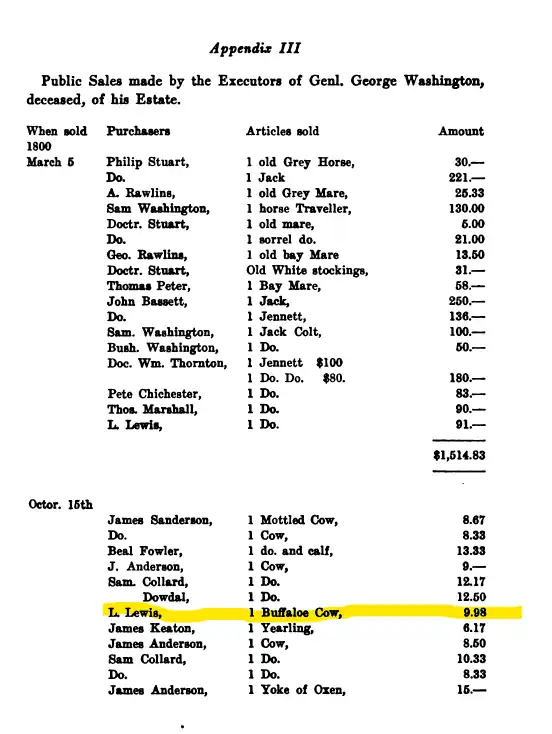
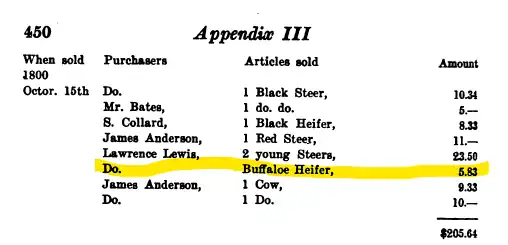
In October 1800, there was a sale of livestock from Washington’s estate. Included was one buffalo cow and one buffalo heifer, both sold to Lawrence Lewis. This is the only known record of buffalo at Mount Vernon. The sale took place ten months after Washington’s death and it is unclear when the buffalo arrived at the estate.
A History of the New York Swamp
The tanners did not remain very long at the Collect pond. About 1790 they began to cluster around the swamp. James Brooks and Jacob Lorillard, who had formerly tanned in Centre and in Magazine streets, appear in the directory of 1800 as located in Jacob street. George Washington once lived on the border of the Swamp. In 1798, having taken the oath of office as first President of the United States on the spot where his statue now stands in Wall street, he took up his official residence in the large mansion at No. 3 Cherry street, near Frankfort street. There was Republican simplicity in this parade. “That George Washington,” said an excited foreigner. “Why, where is his guard?” “Here,” said the citizen addressed, tapping his breast significantly; “Every American is his guard.”
In the evening the “Republican Court” was held in Cherry street. Mrs. Washington, surrounded by the first ladies of the land, received. The ladies dressed in white satin and silks shot with silver thread. The men wore silk small clothes (knicker-bockers), silk stockings and pumps. Their coats were faced with yellow silk or buckskin. Military men wore uniforms, boots and swords. These receptions were select, elegant and courtly.
Visitors to the Executive Mansion had to pass the Swamp, for it was the northernmost boundary
of the city. All beyond was pasture, or at best, farms and forest. To most of them the view of tanneries, with the vats laid down in parallel rows was an unwonted sight. Not so to all. General Anthony Wayne was familiar with the pungent odor of bark, for the “hero of Stony Point” was a tanner in Pennsylvania. General William Sutton, of Salem, Mass., owned a tannery which was owned by the Sutton family up to about 1870, and Colonel Oliver Spencer and Colonel Matthias Ogden, of Newark, N. J., were tanners and brave officers in the Revolution. Alexander H. Read was a general in the Army and served on Washington’s staff. He was a tanner at Wardsboro, Vt., and brought up five sons to the trade.