Dick Rock of Henry’s Lake
Born back East in either 1846 or ’47, Rock came West as a young man and roamed through Wyoming, Montana, the Dakotas and Idaho. About 1871 he established a homestead in southeastern Idaho Territory. He married about fives years later. He said he knew what he wanted when he moved there. To build the place up and have a place to save and house the wild animals. He built up his ranch during the summers, while continuing to serve as a guide and buffalo skinner the rest of the year. Rocky Mountain Dick partnered in the wild game business with hunter/trapper “Yellowstone Vic Smith,” and they hired men to build the corrals. Eventually the two parted company, possibly around the end of 1890, though they remained friends.
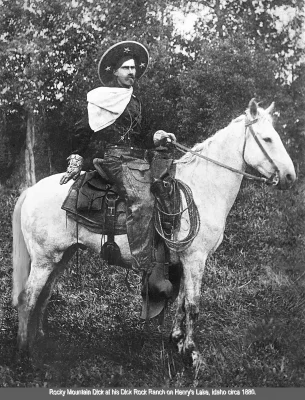
The Anaconda Standard
Anaconda Montana June 21 1891
Some Bison Left Yet
Dick Rock of Henry’s Lake, who was in the city recently, explodes the idea so frequently published of late, to the effect that the buffalo of the plains and bison of the mountains have all been killed off. Dick killed one large buffalo in Idaho last fall. The Courier has always maintained that there were bison yet in the National Park, and Mr. Rock, who is among the best posted hunters in the west, confirms our belief by stating emphatically that he knows of one band which has not been out of the Park for several years. Bozeman Courier.
During the Yellowstone Park advancement on poaching, Dick Rock was named as one to watch. They never caught him , but all believed he was involved.
One frequent target of the Henry’s Lake poachers was elk. After killing an elk in the park, the poachers would butcher the animal, taking only the best cut of meat (the “saddle”) back to the village with them. Once at Henry’s Lake, the poachers would box the meat or cover it in burlap and then ship it via stagecoach to nearby mining camps such as Virginia City disguised as “beef or domesticated elk.” (The McMinns’ neighbor, Dick Rock, owned a number of domesticated elk, providing a convenient cover for the steady shipments of elk meat from the village.) Another of the poachers’ favorite targets was buffalo. The risks involved in killing a buffalo in the park were such that poachers seldom took the time to butcher the animals for their meat but would smuggle the heads and hides out, as these could be sold for several hundred dollars on the trophy market. In addition, during the spring some of the residents of Henry’s Lake would try to capture buffalo calves, which they would then corral in remote locales outside the park. Once the buffalo were full grown, the poachers would arrange for the sale of the animals’ heads to one of the not overly scrupulous taxidermists with whom they did business.
One of the many anonymous letters received by the park authorities: “
Dick Rock of Henry’s Lake Idaho has in his possession three young Buffalo calves supposed to have been caught in the Park,” read another note, signed “A citizen.”
I would hate to think he was involved after reading his comments about the care and protection for our wildlife.
Deseret News
Salt Lake City Utah Dec 6 1900
Idaho’s Game Warden
Mr Arbuckle Pays a Visit to Salt Lake City
How He Does in Idaho
C. H. Arbuckle game and fish warden for the State of Idaho came In from the north this morning and registered at the Kenyon. Mr. Arbuckle holds the distinction of being the first game warden appointed for the State he represents, and has held that office with due diligence during the past two years.
When seen this morning he stated that there were lots of improvements needed yet in Idaho before he could consider that his work was of any material benefit. In course of further conversation he said:
”Idaho can essentially be said to be the frontier State of the Union. At the present time I guess we have more game than possibly any other State in America, but if it is not protected it will all be exterminated. Naturally I am considerably handicapped in the matter: the Indians give considerable trouble hunting for hides while some of the parties which come in from the East on hunting expeditions kill game ruthlessly. In my opinion the system of deputy wardens in vogue is a failure. They get no recompense for their trouble with the exception of a percentage on the fine paid in case of conviction. In a great number of cases to a deputy is not going to stir up trouble among his neighbors. I shall suggest in my report to the legislature when it fits into session that the protection of fish and game in Idaho shall be made self supporting after the fashion in vogue in the State of Maine which in my opinion has the finest set of game laws in the country. I will suggest that all deputies receive a stated salary and expenses. That there be a license put into effect, say $1 for residents and $50 for non residents In the State. After all is said and done it is the eastern people who came out west on a hunting expedition who kill off the game. I will also suggest that the open season for shooting elks be made shorter. At the present time it extends from September 1 to December 1 and when the snow is deep shooting elk is just like getting into a herd of cows and shooting them down for all the sport there is in it.
It would not perhaps be in good taste to reproduce the stories he tells regarding trout and river salmon that are to be encountered in the region of Lake Henry, while his account of the elk, mountain goat, and sheep that amble around Fremont county, asking to he shot are enough to bring tears to the eyes of the natural sportsman. He states that the resident are beginning to sense the fact that game is not now so plentiful as it used to be in the halcyon days now past, and are taking steps to protect the animals from onslaughts of strangers, and especially preserving the occasional moose that are to be found.
Prominent in this direction is Mr. Richard Rock who is now operating a game preserve on a small scale and had some buffalo, elk, mountain goats and deer in an enclosure, secure from the rifle of the indefatigable tourist with murder in his heart.
The Courier-Journal
Louisville Kentucky Aug 12, 1900
IDAHOS WILD ANIMAL FARM
Richard W. Rock, of Idaho, to the only man in the United State who makes a business of raising wild animals for the market on a large scale. Mr. Rock, who is known throughout the far West as “Rocky Mountain Dick.” has a ranch of 2000 acres in Fremont county. Idaho, and there he and his wife live the year round, their only companions being a number of hired hands and a large and varied collection of wild and semi-wild animals.
So far as breeding is concerned Mr. Rock pays no attention to small animals. The only one to be seen on his place are buffalo, elk, moose, deer, mountain goats .and brown, black and grizzly bears.
At present there are 120 head of wild animals in the corrals, some of which were taken in a wild state, but. the greater number of which were bred on the premises. There are fifty-two head of buffalo, including some of the finest specimens of this noble and now almost extinct animal in existence. In the collection are also two mountain goats, a dozen head of elk, about the same number of black bear and three grizzlies, two of which are of enormous size. Mr. Rock takes great pride in his black-tailed deer, and of these, he has a splendid bunch. With the exception of the buffaloes, the moose are the biggest animals on the ranch, one bull weighing 1,300 pounds.
Several of the cow moose have been trained to harness, and are driven to a two-wheeled jumper without the slightest trouble. Some of the big bison, also, have been mad tractable and even companionable. One of the herd, a huge fellow, formerly unusually vicious, is now exceedingly amiable, so much so that he permits Mr. Rock to ride astride his back from one end of the ranch to the other. The name of this remarkable and useful animal to “William Jennings Bryan.” …
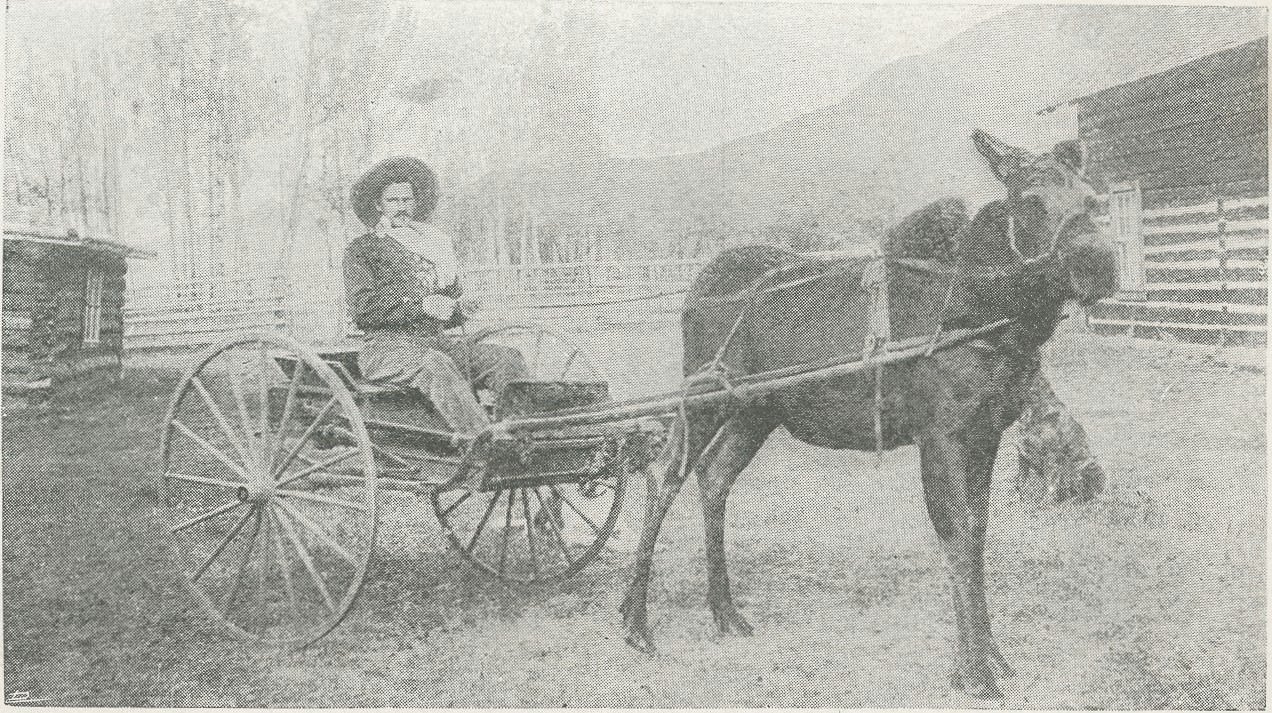
“Rocky Mountain Dick” was in New York recently to inspect a herd, of elk which, he had previously placed in Prospect Park, and speaking to me of the fascinating business in which he is now engaged, he said: “To be sure there’s money in it but if it were not for the glorious climate we have out in Idaho and my fondness for the sort of life we lead out there, I reckon I’d be somewhere back East. It’s the same way with Mrs. Rock. Ohio suits her well enough to visit once in every few years, but for steady living give her Idaho every time, and a range just about like ours, twenty miles from nowhere and as pretty as a picture.”
The Hancock Democrat
Greenfield Indiana Feb 21, 1901
A WILD ANIMAL FARM.
Twenty miles from the town of Bozeman, Idaho, is an establishment devoted entirely to the raising of wild animals. The stock is made up exclusively of the wildest, rarest and most ferocious creatures. This animal farm is owned and operated by Mr. Richard W. Rock, who has spent all his life in the West. As trader, hunter, scout and animal fancier he has been the hero of remarkable exploits. Thirty years ago he was a valued scout for Generals Gibbon, Hayden and Howard. He is now the only man in the United States who raises wild animals on a large scale. Many of the big animals find their way from the ranch of “Rocky Mountain Dick,” as he is called, to Eastern zoological collections, and some of the rarer specimens have been sent to Europe. He has fifty-two buffalo, three grizzly bears, sixty elk and large
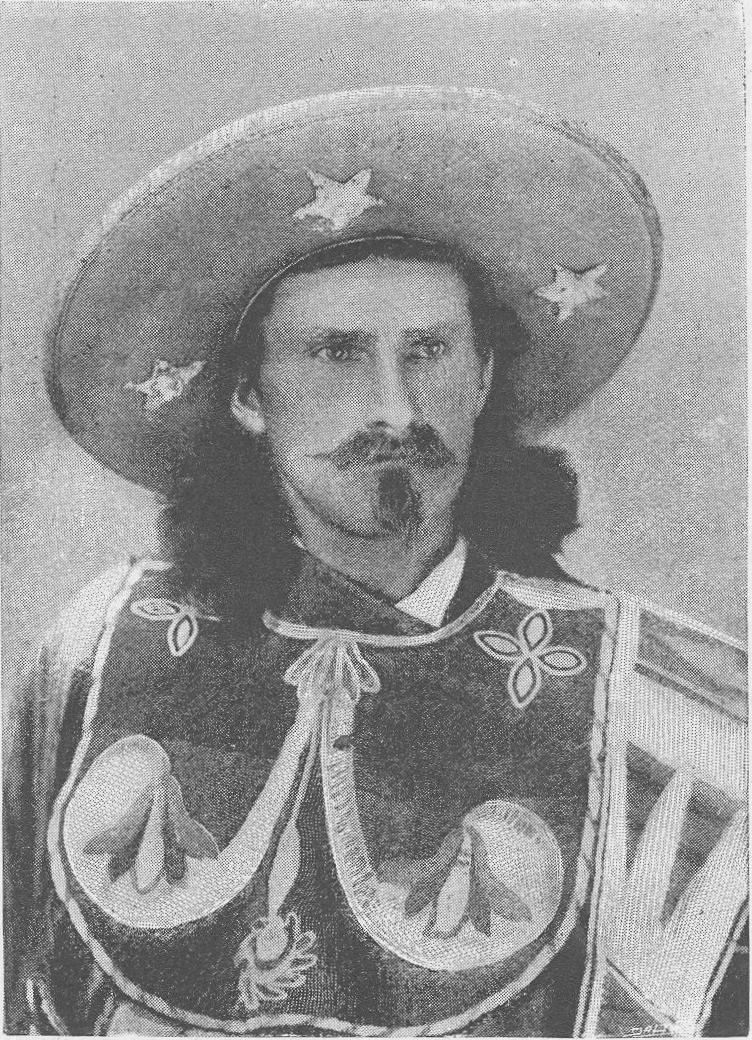
numbers of moose, deer and Rocky Mountain sheep and several black and brown bears. These animals are caught with a lasso when the snow is on the ground, secured and hauled to the ranch on sleds. There they have large quarters, but are securely confined. A few have been born in captivity. Mr Rock has trained a moose to the harness, and it is a common sight to see him drive into Bozeman with his wife in their cart drawn by “Nellie Bly”
The Wide World Magazine (extract)
November 1900- April 1901
Mr. Rock has devoted considerable attention to the breeding of the buffalo, and has fifty-two head, including some grand specimens of this almost extinct animal.
“These are the pride of my collection,” he said, pointing to the splendid herd, “not only because of their great size and fine condition, but because I am an intense admirer of the species.
I am hoping that someday Uncle Sam will arise to an appreciation of the criminal folly of having permitted the indiscriminate slaughter of the vast herds of buffaloes that once roamed the Western plains in countless thousands, and that he will make one last effort to save the buffalo from absolute extinction.
“I am always glad to add a buffalo to my collection and seldom sell any. Given sufficient space and solitude (for they are very nervous) buffaloes propagate rapidly. I want to secure as many as possible in order to form a nucleus. Then, in case the Government ever does decide to set apart a portion of its millions of idle acres for the use and cultivation of the buffalo, I will be able to furnish the herd necessary for the start.
“The question of doing something to save the buffalo is an issue of vital importance, and action must be prompt to be of use. It is recognized and generally admitted that the species in America is practically extinct, and at the present rate of destruction in a few short years the buffalo will be a curiosity known only to zoological gardens, museums, and circuses.
“How scarce they are may be understood from the effort of the Smithsonian Institution in 1886 to secure a herd for the national collection. In spite of the fact that some of the most noted scouts and buffalo-hunters in the West‘ were secured, and almost fabulous prices offered for fine specimens, it required months of the hardest kind of searching through the wildernesses of Yellowstone Park, Montana, and Texas to capture a scant twenty. Yet it is only a comparatively few years since these animals roamed the Western part of the United States in hundreds of thousands. In fact, it might truthfully be said that, at the smallest possible computation, there were at least two million of them west of the Rocky Mountains and north of Texas alone. Apart from purely sentimental considerations, there is every practical reason why something should be done to save the bison.

“Of all wild American animals the most valuable is the buffalo, and the most easily bred. He is the only furbearing animal whose flesh is really valuable, because the bison may be crossed with domestic cattle. The robe of the buffalo is most valuable as a garment, because it makes a seamless coat, while the skin of the seal must be pieced interminably.
“When the Creator brought into existence the mid-continent of North America, with its raging storms, howling blizzards, and scorching siroccos, and made the great American desert, where the water and the grass are but scant, He also brought into existence the only animal in the world perfected for living there— the American bison. No doubt it took untold ages to bring up this wonderful animal and to fit him for existence in his peculiar home. How dreadful, then, it is to realize that through the cupidity and wastefulness of mankind millions of buffaloes have been in a short time—thirty years—almost exterminated!
“The buffalo, despite his power and great size, is extremely nervous and likes plenty of room and immunity from molestation at the hands of human beings. Uncle Sam has millions of acres of unoccupied land admirably adapted to the purpose.
“ Down in New Mexico, there are thirty-three million acres of unoccupied land. Around the foothills of the Guadalupe Mountains nothing lives at present, but here is an ideal place for raising a great herd of buffaloes, for the buffalo grass and the gramma grass grow plentifully, and there is a sufficiency of shade. I am certain that if a fair-sized section were devoted to buffalo raising, under the systematic care of trained experts, the results would be more than commensurate with the outlay. In speaking thus I am quoting from my own experience, for my own herd has multiplied, and all the animals are in excellent condition. What I have been able to do so successfully on a small scale, the Government, with all its resources, should be able to do in a big way.”
“Is the capture of a full-grown buffalo alive at very difficult matter?”
“Exceedingly so,” was the prompt reply, “although there are animals that give more trouble. The instinct of the buffalo surpasses that of the shrewdest ranchman—because for ages he maintained himself where the cattle of the ranchmen are now dying.
“The buffalo is not difficult to trail, because he has certain habits which are always rigorously ‘ ., _followed out. The herd rise at dawn and commence to graze. When filled, they start for the trail, led usually by an old cow, who gives the signal for starting by sounding a grunt not unlike that of a hog, only much louder. The remainder of the herd drop in behind, following exactly in her footprints until they reach the path which leads them to their drinking-place. This path never exceeds 12in. in width. It is the same path along which the ancestors of these buffaloes have traveled for countless ages.
“Finding the trail of a bison is one thing, but getting him safely fastened to the sledge and headed for the ranch is something very different. The buffalo is quick to scent danger, but, owing to his bulk, he is not a very quick traveler. Mounted on a good horse the hunter can readily overtake his game. At close quarters, when enraged, the buffalo is a dangerous customer. He can deal a nasty cut with his short, wicked horns; and with head lowered as a ram he can land with terrific force, in regular catapult fashion, a blow from which neither man nor beast could ever recover.
Once lassoed and thrown on his back, however, he is easily managed and can be readily handled. In captivity, buffaloes usually prove very tractable, and can even be made companionable by kind treatment.” In proof of this statement, Mr. Rock proceeded to leap on the back of a huge fellow, which carried him around the yard several times, without manifesting the slightest uneasiness or resentment.
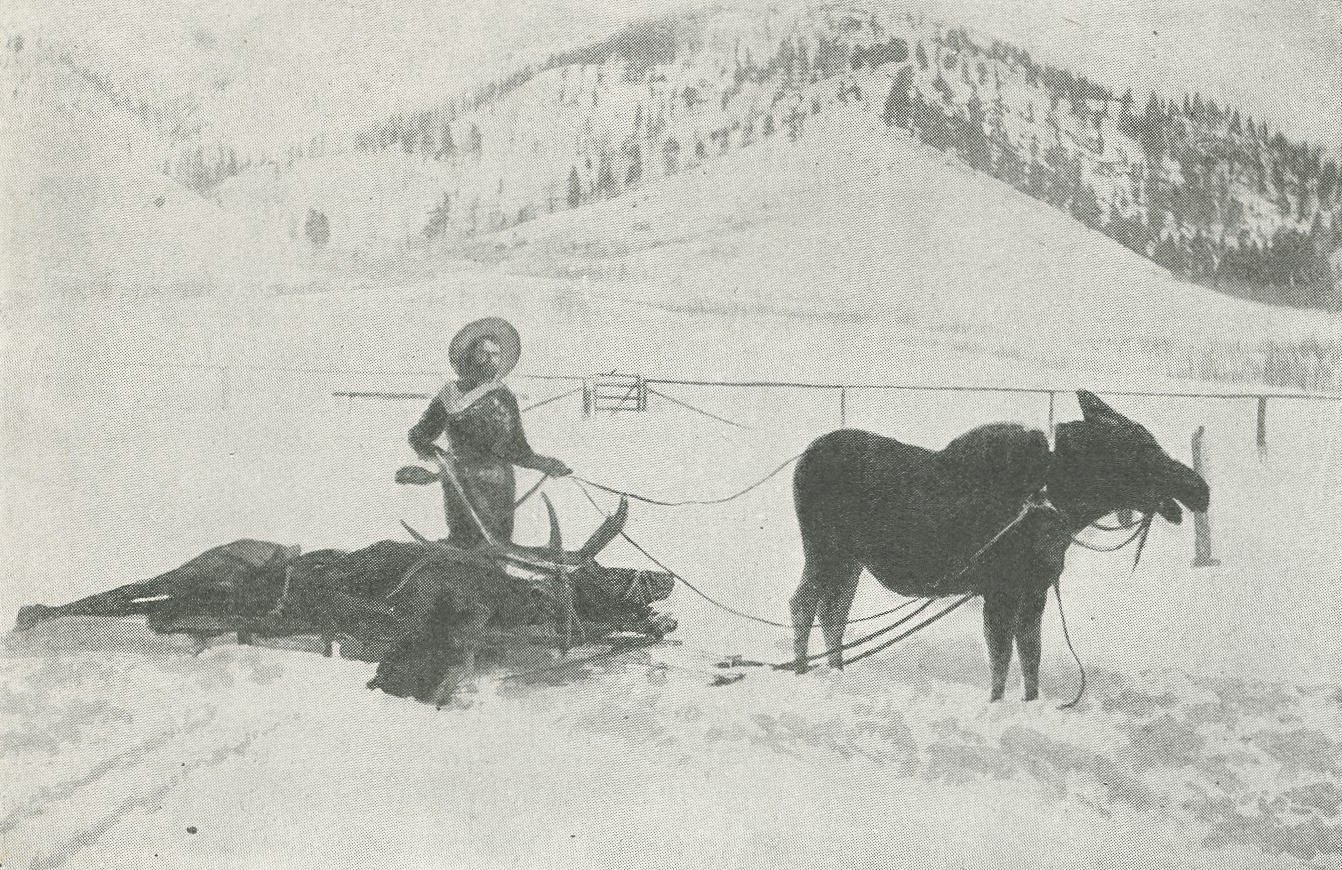
“The moose is also susceptible to the effects of good treatment, and I have one which I have trained to harness and frequently drive harnessed to a two-wheeled jumper. We have named her ‘Nelly Bly,’ and so tame has she become that she follows Mrs. Rock all over the ranch, eats from her hand, and in the morning even comes right up to the window to be fed. ‘Nelly Bly’ weighs thirteen hundred pounds and is very powerful. In my hunts after big game I frequently hitch her to my sledge instead of the dogs, and in this way she has brought to the ranch many a large animal.”
Mr. Rock then pointed out his two mountain goats, the finest known specimens of the species in captivity; his sixty head of antlered, fleet-footed elk; three wicked~ looking grizzlies, including the one just captured, and as fine a bunch of black-tailed deer as was ever assembled together.
“Every one of these animals, excepting the younger ones which have been born on the ranch,” said Mr. Rock, “I have captured in their native haunts and dragged here on sledges over the snow.”
“ How long has it taken you to get this collection together?”
“Over seven years,” he responded. “The best time to work is in the early winter. Then the great Western snows cover the ground often to a depth of two or three feet. Even the fleetest of animals cannot develop speed in this encumbrance. Their sharp hoofs stick heavily in the snow, whereas the trapper on his snow-shoes and with his light, quick dogs can travel at a considerable pace. When cornered in a heavy snow bank the game is handicapped seriously in its effort at self-defense. It flounders helplessly around in the snow, in a trice the lasso does its work, strong ropes fasten it to the sledge, and my collection of wild animals is augmented by one.”
“Have you never been injured in any of these exciting battles?”
“Oh, yes, several times, and I have had a hundred narrow squeaks, but have always managed to survive with my full complement of bones. Once a fierce bull buffalo knocked me down and so stunned me that, although I was fully conscious of my peril, I could not move or raise my hand to defend myself. Just as the maddened bison was about to finish the job by trampling me to pieces one of my brave dogs, barking furiously, leaped courageously at the mighty giant and succeeded in burying his sharp teeth in the buffalo’s soft, sensitive nose. Bellowing with pain the monster turned on the dog bent on annihilating him, but of course the agile dog leaped away. The instant’s delay was my salvation. Raising myself on my elbow I just managed to draw my revolver, and at close range shot the big fellow straight through the heart. Of course my collection lost an addition, but as I saved my life I don’t suppose I should complain.”
“ Why did you settle down in this desolate, inaccessible spot?”
“Principally in order to gain the privacy so essential to these wild animals. If located near a frequented place they would die of fright before they could become accustomed to the crowds and noise. I came here first with only a pack and a saddle horse, having ridden through the Rockies and other mountain ranges over one thousand miles from Galveston, in Texas. As soon as I saw this spot I felt my ideal had been attained, pitched my tent, built a cabin, and as soon as I had everything comfortable brought my wife on. Then securing the necessary dogs and making suitable corrals to hold game, I waited for the December snows in order to make my initial venture in my new career. With hard work and almost indescribable exposure, I had succeeded by spring in securing seventy-five elk, three moose, ten deer, seven antelopes, and three mountain sheep.
“I have raised several buffaloes on the ranch and also one moose. The elk seem hardy and contented in their new environment, and breed as rapidly as when in their native state. Deer, moose, and antelope are of a restless, nervous nature, and do not multiply so readily as the elk. Since 1894 I have sold 350 head of elk alone to zoological gardens and public and private parks in the East, as well as many other varieties of animals.
“To be sure, there’s money in it,” concluded “Dick,” “but with me the getting of money is only an incidental motive, as it were. If it were not for my attachment to this glorious climate and my fondness for the independent, outdoor life I lead here I reckon I’d be back East. Same way with Mrs. Rock, Ohio suits her well enough to visit it once in a while; but for steady living give her Idaho every time and a ranch just about like this one, twenty miles from nowhere and as pretty as a picture.”
The Anaconda Standard
Anaconda Montana March 30, 1902
Dick Rock, the Famous Guide and Scout, and His Life
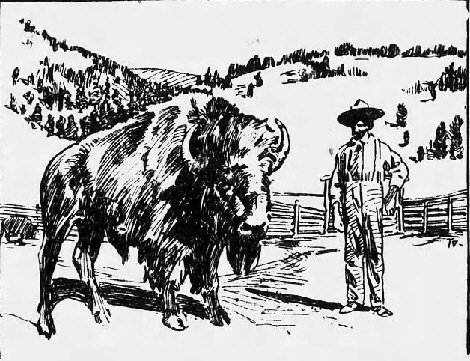
“Rocky Mountain Dick,” as Richard Rock was familiarly known to thousands of pioneers, frontiersmen and tourists, was one of the picturesque characters of the West. His death and the manner of it was a surprise to every person who knew “Dick’ and was familiar with his brave and fearless nature. No one had expected for him such an unmerited end as being gored to death by a pet buffalo bull. His wild and adventurous life as Indian fighter, scout and trapper had earned for him the right to a peaceful ending of his career. He was but 55 years of age, and his strong and robust constitution prophesied a long life. Rock was a native of New York state, but he came West when a very young man. His love of adventure and stirring experiences brought him to Wyoming, Idaho and Montana during the Indian campaigns under Custer, Miles and other noted fighters. For years he was engaged in hunting and trapping in the Snake river country, and his reputation as a daring man and as one familiar with the entire Indian country came to the attention of the war department, and his services were sought as scout for the soldiers who were engaged in fighting Indians. He did splendid service for General Custer and is credited with warning that noted but ill-fated fighter against engaging in the battle which cost his life. “Rocky Mountain Dick’ served under General Miles, and in his time was associated with nearly all of the noted men of early western history. He rode the trait with Calamity Jane, Jim Bridger and other noted scouts, and had a personal acquaintance with Captain Bonneville, General Miles, Major Reno. General Custer, Buffalo Bill, Wild Bill, Sitting Bull American Horse and many of the noted Indians and Indian fighters.
When the usefulness of the scout passed, ‘Rocky Mountain Dick” located on the east side of Henry’s lake, a picturesque spot which he had often passed and admired during his active career. There he built a home and devoted his time to hunting and trapping and entertaining tourists and piloting parties of hunters. He settled there about 1871 or 1872, and was married about five years later. His home became a way station for tourists who entered the National park from the west, being situated 60 miles from Monida and 12 miles from Riverside, the edge of the park and right at the mouth of Targhe pass. The station is the end of the stage line from Monida. and the camping ground for many tourists every-season. To these and to hunting parties of “Rocky Mountain Dick” furnished supplies of provisions and “tanglefoot.” He also made a business of furnishing wild animals for zoos and summer gardens in all parts of the country. Only a few months ago he sold a pair of Rocky mountain goats to an eastern zoological garden for $1,200. At the time of his death he had collected one of the finest assortments of wild animals in the West, comprising four buffaloes, two cattloes, eight elk, two of the finest specimens of Rocky Mountain goats ever seen in captivity, which he had caught in the Bitter Root mountains when they were kids, a number of swan and a flock of wild geese. Among the buffaloes is the bull which Rock had named “Lindsay,” and which he had raised from a calf. Lindsay was his pet, and he frequently played with him in the corral. He had no fear of the animal, though many persons often expressed the fear that the bull would one day kill him, and the prediction came true last Saturday morning.
Rock will also be remembered by many people as the owner and driver of the famous pacing moose, “Nellie Bly,” which he exhibited in Butte during the year of the world’s fair at Chicago. He took the animal to the exposition, where it received much attention. Rock matched the moose against any horse, and always won easily in the race. “Rocky Mountain Dick” was a splendid specimen of physical manhood. He stood 6 feet 4 inches in height, and was built on good proportions. He was straight as an Indian, wore -his -his hair long and cultivated the military mustache and goatee. Many stories are told of his prowess and endurance as a scout and hunter. He was an expert on snowshoes and skis, upon which his ordinary gait was 16 miles an hour. Some years ago it was a common exploit for him to run down game in the snow, which he did for sport only. His home at Henry’s lake is filled with trophies of the chase, consisting of moose, elk, deer, buffalo and bear’ heads and furs. He had six big and powerful dogs, which always followed him on the hunt and pulled a big sled or toboggan upon which the game was loaded. Rock was a strange and commanding figure in appearance. Some people expressed a fear of him. They did not like his cold and piercing gray eye and his disinclination to make friends with every man. He was in his dislikes, but those who succeeded in winning his friendship say he was just as strong in his likes.
The picturesque old frontiersman will be missed by the park tourist and by every one who has ever visited the Henry’s lake country. The greeting and query put to all returning hunters and tourists, “Did you see Dick?’ and “How Is Dick?”, will be asked no more.