Also see: Col Dodge – 1873 – Adobe Walls – April 1933
When Dodge City Was Wild and Wooly
By E. A. Brininstoll

This photograph of a street scene in Dodge City, in Ford County, depicts three of the town’s buildings. The building on the left was the first dance hall in Dodge City. The second building was a grocery and general store, and the third building, also a general store. Visible are a crowd of men standing in the street, and two horse-drawn wagons loaded with buffalo hides. Dodge City is located on the Santa Fe Trail in western Kansas.
Creator: Knight, J. Lee
One of the most noted- and notorious of the many “Cow towns” which sprang up in Southwestern Kansas during palmy days of the Texas cattle drives, was Dodge City, or “Wicked Dodge,” as it was more appropriately known in those lawless days, when the ability to shoot straight and quick was man’s chief desirability. The town was laid out in 1872, being named for Col. Richard Irving Dodge, a distinguished army officer of the old Plains’ days, well remembered by all “old-timers” as the author of a volume entitled “Our Wild Indians ,” which is considered an authority on the customs and manners of the Plains’ tribes.
The president of the company was Robert M. Wright , later one of Dodge City’s most prominent merchants. While Major E. B. Kirk, quartermaster at old Fort Dodge , was secretary and treasurer. The town proper was laid out about five miles west of the fort, of which Col.Dodge was then Commandant, and was located the north bank of the Arkansas River. When the Santa Fe railroad reached Dodge in its westward march of progress, in September, 1872, it was practically the terminus of the road for several months, during which time it was the main rendezvous for freighters, buffalo hunters, cattlemen, soldiers , cowpunchers, government teamsters , mule whackers, and last- and far from least gamblers, “bad” men lewd women and the riff- raff of the prairies, all following in the wake of the iron rails across the Plains.
In those wild days there was no law or order in Dodge City . Such an evidence of civilization would have been hooted out of existence. Dodge was “wide open,” day and night- at night, when the bark of the six shooter was more often the chief musical entertainment. The nearest point where justice could be legally administered , was Hays City, 95 miles to the northeast, where all the differences of mankind were settled-all which were not promptly settled by rifle or six- shooter on the spot !
Of the sort of justice dispensed at Hays City, the foregoing is a fair sample : A couple of Irish section hands engaged in a heated argument, using spike hammer and shovels as weapons, rather than fists. The shovel- wielder finally battered in the skull of his opponent. There were no witnesses to this frontier tragedy, but the slayer gave himself up. He told a good story of the fight , and an investigation by several citizens resulted in a decision that it was a case of self defense. However, the Irishman was placed on the stand, and the following colloquy ensued between judge and prisoner:
“Prisoner at the bar, are you guilty or not guilty ?”
“Oi’m guilty, yer honor,” came the prompt and somewhat startling reply.
“Shut your darned mouth,” retorted the court. “I discharge you for want of evidence !”
Hardly had the railroad reached Dodge -which was long before a depot could be built-(the first railroad business being transacted in a box car) -when business started up with a grand rush. Dozens of cars were daily shipped east, loaded with buffalo hides and meat, while scores of freight cars arrived loaded with flour, grain and all sorts of merchandise for the bustling little frontier city. Those were the palmy days indeed ! Business was SO brisk that everybody literally coined money. At first, hunting the buffalo was the chief vocation, and it was nothing uncommon for a good hunter to average $ 100 a day at this occupation. The smallest coin in use was a quarter, no matter whether one wanted a paper of pins , a shave or a drink. Along the rough, uneven wooden sidewalks tanned and weather- stained buffalo hunters rubbed elbows with husky cowpunchers from Texas, buckskin-clad frontier characters and government soldiers, saloons, gambling- hells and brothels resounded with the discordant music of cracked and screechy violins , wheezy pianos and the latest popular songs of the day, to the accompaniment of the crack of six -guns and the yells of roistering humanity.

Being among the last of the frontier towns , Dodge acquired great fame ( ? ) . The railroad was being rapidly pushed westward, and everybody followed the railroad, as it was the popular thing to do- in fact, there was nothing else to follow. When the frontier passed, the buffalo and Indian went also . People of all sorts and conditions came to Dodge the good, the bad, the worse – than -bad. Some landed out of mere curiosity, to see what a frontier town looked like. Others came with an eye to business-chief of whom was the cattleman. For many years Dodge City was the chief point where cattle going to the northern markets were classed and passed on; where bargains were closed and new contracts made. And with the stockman came, as a matter of course, the cowboy. Dodge was also a sort of “resting spot” for herds bound up the trail for the Montana country and the northwest markets and Indian agencies . It was the spot where the restless and reckless cow-puncher worked off the surplus exuberance with which his skin had been permeated for many weary, dreary, monotonous weeks on the way “up the trail” from the Texas cow country, where the great herds were gathered . At Dodge the generous and good- natured cattlemen generally paid their cow-hands about $25 of their wages. Having accumulated this, the hilarious “cow waddie” promptly obtained leave of absence for a day and night, rode a lathering pony into town, indulged in the luxury of a shave and perhaps a bath, bought a supply of cartridges and a few necessities, then promptly started in to have a ” real good time.” The poker table was the chief attraction, and when the cowboy arose, he sometimes was a few dollars richer, but more often poorer for his little “sitin.” The freighter came to Dodge because there were great consignments of goods to be hauled from the “end of track” nearly 400 miles, to supply three military posts, as well as for all the frontier towns and settlements which were far removed from the railroad. The gambler and professional “bad man” came to ply their vocations, and for what excitement there was to be found-and Dodge City supplied this in copious quantities!
All forms of gambling were indulged in . Chuck-a-luck, poker, faro, roulette, monte, the shell game and every device where the unwary tender foot could be shorn of his wealth . Nothing was done behind closed doors or with shutters pulled down. Everything was wide open, with the accent on the “wide .” It was one continuous round of excitement , hilarity quarreling, shooting, fighting, singing and care- free abandon. The dance houses were arranged at convenient distances and were supplied with all the trappings, paraphernalia-and girls-which constituted institutions of that character. Nor were the different forms of amusement confined to the strictly sporting people. According to one authority “men of every grade assembled to join in the dance. There were nice men with white neckties, cattle dealers wearing good clothes, the ‘sport’ with the smooth tongue, and also the cowboy, booted and spurred, as he came from the trail, his hard earnings in his pocket, to join in the wild revel.”
It is said that even the mayor indulged in the giddy dance with “the girls,” his cigar in one corner of his mouth and his hat tilted at a dangerous angle. In its early days, Dodge City boasted a “dead-line.” This was an imaginary line running east and west, south of the railroad track. It was not considered polite nor safe to pass that line after 9 p. m., owing to the character of certain “citizens” who haunted the south side. And any unwary “pilgrim” who passed the dead- line after the hour named, took his life in his hands.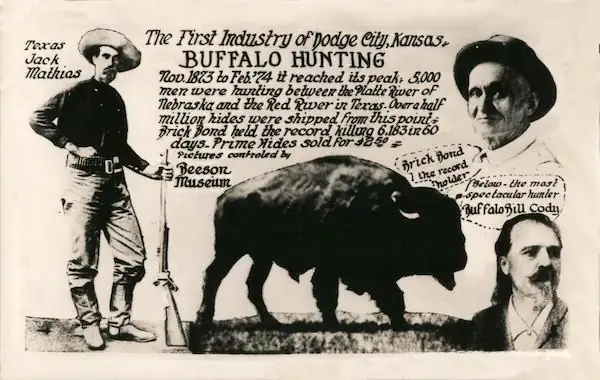
One of Dodge City’s most famous “tourist sights” was “Boot Hill.” This was the uncanny spot where certain gentlemen, owing to their slowness “on the draw,” were carefully deposited for their last long sleep. There was not a grave on “Boot Hill” in which the occupant had not come to his death “with his boots on,” hence the fitting title to Dodge’s cemetery, mortuary, graveyard or whatever you may choose to call it. “Boot Hill” began to be rapidly populated right away after the stakes were driven for the town sites . The first real big “killing” took place in a dance hall conducted by one Tom Sherman. A row started between some gamblers and soldiers from the fort. After the smoke of battle had cleared, four or five dead men decorated the immediate foreground, while several wounded were endeavoring to drag themselves into the safety – zone as fast as their condition would permit. Throughout the winter of 1872, “having a man for breakfast” became quite the thing, and was of such common occurrance that when the spring grasses of 1873 were peeping forth, twenty- five men who had died with their boots on, decorated grassy mounds on “Boot Hill .” Today one of Dodge City’s largest and most ornate school buildings occupies the site of this former “mortuary.”
Along the main street of this lively municipality of frontier wickedness were large barrels of water, ostensibly for fire purposes . However, they were more often used as breast- works from behind which many a thrilling duel with six shooters was fought, and they served as most excellent protection to the men behind them.
“So numerous were the killings in those early days,” said an old Dodge resident to the writer, “that it was simply impossible to keep track of them , or even to recollect the number.”
The first “calaboose” in Dodge City was an old well , some fifteen feet in depth, in which “drunks” were lowered at the end of a rope and soused up and down until they became sober. Occasionally several hard – boiled citizens were Occupying these somewhat moist quarters simultaneously.
The many killings in Dodge soon aroused such a storm of indignation among the better element, that the latter were compelled to organize a Vigilance Committee, and for a time this new order of things worked like a charm, and life and property again became fairly safe. But shortly a great many hard characters began creeping into the organization, until they overshadowed the better element. They took matters into their own hands, and committed so many grave crimes that the better class quit the organization, and with the aid of the good people of the community, arose in righteous indignation and put a stop to such proceedings.
The gamblers resorted to many and divers ways to dodge the city tax imposed upon them, whereat, in 1882, it was decreed that “all paste – board artists in this city practicing their profession after the first of next May, will be required to contribute $10 a month toward sustaining the city government , or else take a walk, and Judge Burns will see that this is rigidly enforced.”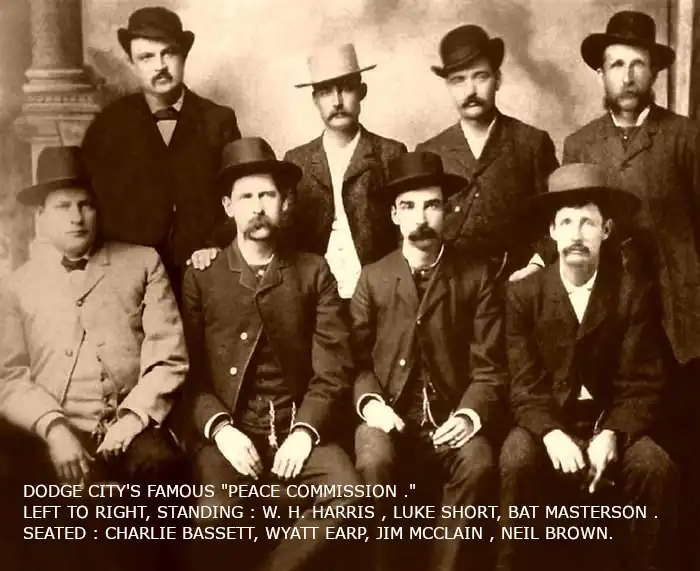
Dodge City produced the greatest array of gun- fighters of any frontier city in all the West. It had a “Peace Commission” consisting of such famous gun artists as “Bat” Masterson and his brother Jim, Wyatt Earp , Luke Short, Charlie Bassett, Neil Brown and W. H. Harris. All these men were remarkable revolver shots and gunfighters of the highest order, and when one of this contingent “threw down” on a man , it generally meant that “Boot Hill” had gained another quiet inhabitant who would bother mankind no longer. These men were trained in all the art and wiles of gunfighting; they did not know what fear was, were well inured to hardship and danger of all sorts. “Wild Bill” Hickok was another famous gun-man of the early days of Dodge.
When such men as “Bat” Masterson or Wyatt Earp were occupying positions as peace officers, there was no “shooting up” of Dodge. Strict orders were issued that when cowboys entered the town for a “jamboree,” they must first check their guns at the general store of Beverly & Wright, where a receipt was given for each, and where every man could claim his weapon when he rode out of town to his respective cow camp . It is said that on many an occasion as many as a hundred and fifty six- shooters would be thus receipted for in a single night. Naturally, if a cowboy became envolved in a quarrel of any serious dimensions, his first move would be to reach for his “smoke- pole”; but when his gun was not forthcoming , there could be no shooting. No man was allowed his weapon back until perfectly sober.
Many times the high officials of the Santa Fe railroad objected to having gunfighters as peace officers . The mayor of the town was appealed to to “get in a class of nice quiet gentlemen of a younger element, who will look after the welfare of Dodge and enforce its laws.” Promptly went back the answer: “You have got to fight the devil with fire. If we put in a tenderfoot for marshal , he would be run out of town in a hurry. We must have men who are trained expert shots who can step to the front when needed, irrespective of danger.”
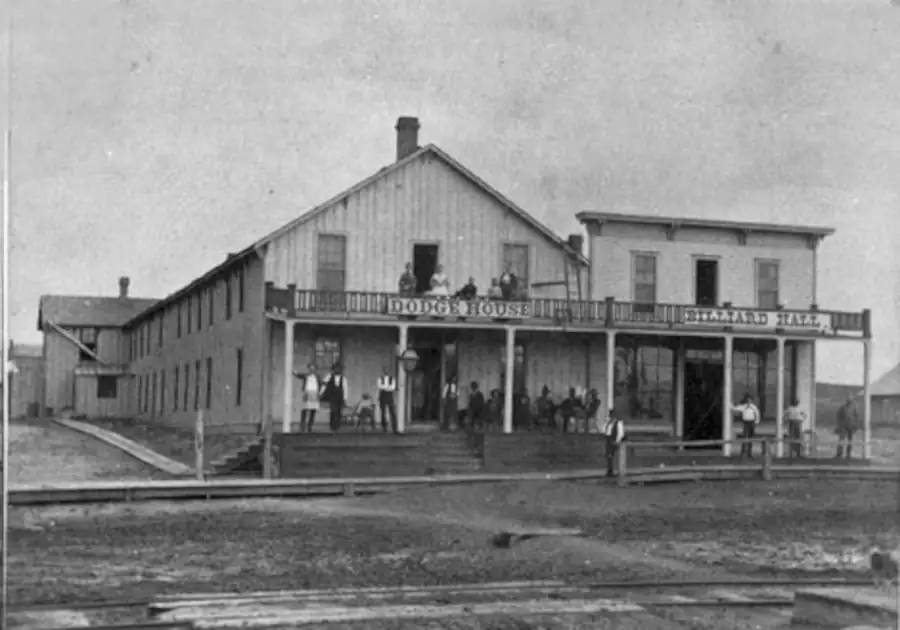
But Dodge had its share of good people. The religious element was there, just the same as everywhere else on the frontier, doing good and striving for the betterment of the community in which they had cast their lot. The first divine service in Dodge was held in the dining room of the “Dodge House ,” the sermon being delivered by the Rev. Timothy Hill of Kansas City. The reverend gentleman, we are sorry to chronicle, had but a small audience. A horse race was in progress on the main street, and all the men and boys were congregated there. But the church-going element “prevailed mightly” and eventually were the important factor in bringing order out of chaos.
Dodge City had its hotels. Needless to say, they were of the frontier sort. In one of the leading hostelries the following “Hotell Rooles” were conspicuously posted:
“This house will be considered strikly intemprit.
“None but the brave deserve the fare.
“Persons owing board bills will be bored for bills .
“Sheets will be changed nightly once in six months-oftener if necessary.
“Boarders are expected to pull off their boots if they can do so .
“Beds furnished with or without bedbugs.”
The police court of Dodge was unique. “Any person caught throwing turnips, old cigar butts, beets or quids of tobacco at this court will be immediately arranged before this tribunal of justice,” savagely announced “hizzoner” one morning. Then hitching his six-shooter around in front, where it would be handy, he calmly announced :
“Trot out the wicked and unfortunate and let the cotillion commence .”
A divorce proceeding was on once in Dodge City. When the case went to the jury the “twelve good men and true” refused to grant the woman a decree. “Would you like to poll the jury, madam ?” queried the judge. Glaring over her spectacles at the men in the jury box, she exclaimed : “That’s what I would, your honor. Bring on the pole!
Among Dodge’s citizens was a lawyer, who, while well up in his profession , was greatly addicted to the cup that inebriates. He finally became such a “bum” as to neglect his family and spend all his money for liquor. Then “the gang” of Dodge resolved that it was high time to cure the unfortunate attorney. Waiting one day until he was in a drunken stupor, in one of the numerous saloons, they procured a coffin , attired the man in a conventional shroud, powdered his features a ghastly white, tied his jaws together with a towel, placed him in the coffin and carried it to one of the prominent places of amusement, where the attorney “lay in state” to all passersby, many of whom thought he was really dead. When the poor attorney finally aroused himself from his drunken stupor and noted his surroundings, he took one look in the mirror behind the bar and fled, followed by the shouts and laughter of his tormentors. It is said, however, that the “cure” was completely effective, and the man never again was known to take a drink, and eventually became an influential citizen.
The country about Dodge City at that time was the greatest game section on the Western Hemisphere. Buffalo, literally by the million, abounded on every hand, while great droves of antelope, deer, elk and wild horses covered the prairies. Gray wolves and coyotes by the thousand were to be seen, while prairie dogs in limitless numbers honeycombed the ground in every direction . The Arkansas River and its adjacent streams, ponds and lakes were alive with wild fowl of every description, and killing a hundred ducks a day was nothing worth bragging about. Wild turkeys and quail were countless . It will thus be seen that Southwestern Kansas in that early day was a veritable hunter’s paradise . Col. “Brick” Pond, one of Dodge’s old – timers, boasted that during the buffalo days, he, on one occasion , killed 1500 in seven days -and said he had to be on the lookout for hostile Indians every minute of the time!
Robert M. Wright and Charles Rath, pioneer merchants of Dodge, and probably the leading business men in the seventies, shipped over two hundred thousand buffalo hides from Dodge the first winter the Santa Fe railroad reached that point. At one time these enterprising partners had over forty thousand buffalo hides stacked within their corral awaiting shipment. The hide shipping business assumed tremendous proportions in the early days of Dodge, just as the bone shipping industry did later after the buffalo range was denuded of its shaggy inhabitants.
In the spring of 1878 the Denver & Rio Grande and the Santa Fe railroads were fighting to gain possession of the Grand Canyon of the Colorado . As a matter of course, the Santa Fe officials went to Dodge City in their quest for gun-fighters. Nowhere, in those wild days , could a beter conglomeration of these “trigger- quick” artists be found. Dodge City bred bold, reckless scrappers, who took pride and delight in their calling. Said the Dodge City Times : “We’ll ‘bet a ten-cent note they will clear the track of every obstruction. ” And they did!
“Bat” Masterson, probably the best known of these gun-men, in his later years was connected with the New York Telegraph. He dropped dead at his desk there October 25th, 1921, mourned by all his associates, both new and old. One of Dodge’s leading citizens, in recounting “Bat’s” many virtues said :
” Bat’ Masterson was a gentleman by instinct . He was a man of pleasant manners, good address and mild disposition,, until aroused, and then, for God’s sake, look out ! He was a leader of men and a born general, always accomplishing whatever he undertook. He had much natural ability, and if he had got started right would have been occupying a seat in the United States Senate, instead of being a writer on a metropolitan journal. He was broad-minded, cool and brave, most loyal to his friends, and if anyone did him a favor he never forgot it.”
It was the cattle business that literally put Dodge City on the map. In 1875-6 nearly 250,000 head were driven to that point, which was increased in 1877 to more than 300,000, and the number continued to increase with each successive year for ten years, reaching the peak at over 500,000 head . For about ten years, or until 1886, Dodge was the greatest cattle market in the world.
A quotation from the Kansas City Times of that period says: “There are now upward of 100,000 head of cattle in the immediate vicinity of Dodge, and some of the individual herds run high into the thousands. There is a single herd numbering 40,000, another of 17,000, another of 21,000 and several of 5,000 and thereabouts. On Saturday no less than 25,000 were sold . The Texas drive to Dodge this year will run close to 200,000 head.”
The cosmopolitan democratic character of Dodge is well described by a newspaper correspondent who visited the “cowboy capital ” in 1877. He wrote thus: “Three hundred and sixty-seven miles west of Kansas City we step off at Dodge. She awakens from her slumbers about 11 a. m. , takes her sugar and lemon at 12 M., a square meal at 1 p. m. , commences biz at 2 o’clock, gets lively by 4, and at 10 it is hip-hooray- boys till 5 in the morning. Dodge now has 1200 inhabitants, six or seven general stores, and the usual complement of drug stores, bakers, butchers, blacksmiths and last, but by no means least, nineteen saloons, each from seventy five to one hundred feet long. From our window in the Dodge House can be seen five herds of cattle ranging from 1000 to 10,000 each, that are awaiting transportation . The stock yards here are the largest west of St. Louis .”
One of Dodge City’s most famous assets was her noted “Cowboy Band ,” composed of eighteen musicians and a drum major and color – bearer. It was organized in 1881 , and gained world- wide fame and recognition, not only because of the excellence of the music it dispensed, but because of the novel and picturesque dress of the musicians. Each member was rigged out in full cowpuncher regalia, including “chaps” and six – shooters. It is said that this famous musical organization covered a greater scope of country at that time than any similar organization, east or west, that ever went on the road.
After the cattle market was changed to other sections Dodge City lost that trade. The buffalo had been killed off, and the hide and bone-shipping industries “petered out.” Such an “era of civilization” was more than Dodge could stand, and for about ten years the town was at a standstill, and it was uphill sledding, requiring both nerve and confidence in the place to keep the population intact. But the old-timers had faith in Dodge, and continued to predict a brilliant future, even when land around the town was selling as low as fifty cents an acre.
With the passing of the cattle industry, the farmer stepped into the breach. Large acreages of wheat, alfalfa and other crops were sown, and soon waving fields of grain abounded on every hand where heretofore the ” bed-grounds” of great herds of cattle held undisputed sway.
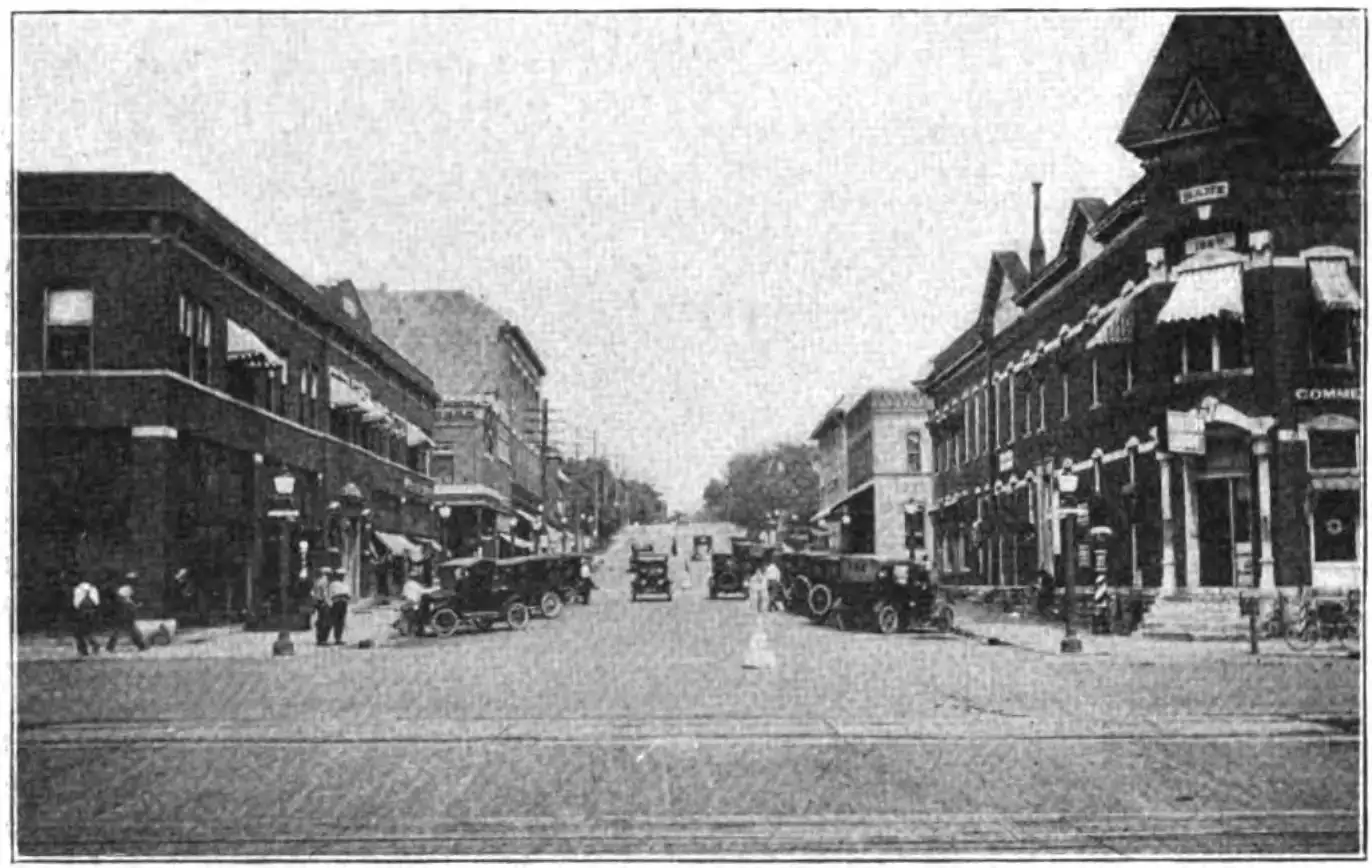
The Dodge City of 1923 is a revelation, even to the old- timers. It has a population of nearly 7000; eleven miles of paved streets, a modern sewer system, municipal water works, ten churches, a $225,000 high school, numerous graded schools, a live Chamber of Commerce of over 300 progressive members, a $100,000 theater, two modern hospitals , State Soldiers’ Home, two newspapers and business blocks which would do credit to a city many times its size. It is a division point on the Santa Fe railroad trunk line, with an average monthly pay- roll of $ 100,000. It is a ” far cry” from the gun – toting, lawless Dodge of the early seventies to the progressive, conservative Dodge of the present day. (1923)