Hide Shipments 1811-1820
Aberdeen Journal North of Scotland
Aberdeen Scotland Jan 16 1811
Lots of Hides
Dried buffalo hides in the hair, sound in the grain, about 20lb per hide.
Dried Spanish Horse Hides in the hair, fit for tanning or covering trunks.
A few dozen of Dutch Calf Skins salted, about 136lb per doz.
The Caledonian Mercury
Edinburgh, Scotland Mar 25th 1811
50 buffalo hides
Missouri Gazette and Public Advertiser
St Louis, MO June 27, 1811
FOR SALE
The following articles, the property of the United States, now on hand. VIZ.
About 200 packs of shaved deer skins,
32 packs bear skins,
60 bear skins, (loose)
6500 lbs, Buffalo, Elk & Deer Tallow,
2000 lbs mould Candles in boxes,
3 barrels bears oil,
30 Indian Mats.
Any person wishing to purchase will please to apply to
Wm. Clark, U.S. Agent. In. Dt.
St, Louis, 21st, March, 1811
Ina few days , a quantity of Lead, Peltries &c is expected, which will also be for sale. W.C.
The Caledonian Mercury
Edinburgh, Scotland Aug 12 1811
Cargo of CROWN SCHOONER
Also, 50 buffalo hides imported in the PATRIOTEN; likewise the Guns and Small Arms belonging to Prince of Christian and Klempaa Privateers. ( these ads continued all year it seems)
Vermont Burlington Sentinel and Democrat
Northern Centinel
Oct 24 1811
Reports a ship seized by the United States and among the cargo was 4 buffalo skins.
Hampshire Telegraph and Naval Chronicle
Portsmouth, Hampshire, England
Dec 16 1811
Public Sale
Whiskey, Salt, Coffee, Bones, Buffalo Horns, etc….
The Freemans Journal
Dublin Ireland Dec 24 1811
There are plenty of horses, but of a diminutive size, and buffaloes are invariably used for every purpose of agriculture.
Buffalo Gazette
Village of Buffalo New York
Jan 28 1812
Peter H. Colt
2 bales buffalo ROBES, etc.
(Repeated Feb 5th 1812, Oct. 12th)
Aurora General Advertiser
Philadelphia, Pa. Mar 18, 1812
Furs & Peltries
Indian dressed Deer and Elk Skins, Buffalo Robes, Deer’s Tallow, Buffalo Horns and Indian Mats.
(Repeated March 20th April 1st, April 4th,April 9th, April 16th)
The Freemans Journal April 13 1813
Household Furniture TO BE SOLD AT AUCTION, etc…
Mack, Williams, & Gieton, Auctioneers. The buffalo hides will be sold at two o’clock on Thursday, the 15th inst.
The Freemans Journal
Dublin, Ireland Apr 13 1813
SOLD BY AUCTION
100 BUFFALO HIDES THE PROPERTY OF Mr. McKean, at his house, Hardwicke-place.
The United States Gazette
Philadelphia, Pennsylvania
08 May 1813
SPRING CATTLE SHOW
The ninth Show and Fair held by the Pennsylvania Society for promoting the breed of Cattle, took place at their establishment, at Bush Hill, on Wednesday and Thursday last. The following stock were exhibited…..
(extract)
By Dr. Logan – His fine stud horse, Eclipse, and a colt by him.
Thirty Four poor steers, were sold on the second day of the show.
Mr. McIntyre, from St. Louis, showed a Bison calf, eleven months old – he measured four feet six inches round the body. It is to be regretted, that the farmers on the frontier have not yet crossed this strong animal with the native cow, as a breed would be produced, which would prove of the greatest utility, bearing the heat and cold of our climate much better and possessing greater strength that the Ox.
Etc.,,,
War Journal
Portsmouth, New Hampshire
23 Jul 1813
(extracted)
The distance from the Arricorsa to this mountain is about 450 miles over an extremely rugged tract, by no means furnishing sufficient supply of water; but during the twenty-eight days they were only in a few instances without abundance of buffalo meat.
Three days took them over to the plains of Madriver ( the name given the Big Horn above this mountain) which following for a number of days they left it where is was reduced to thirty yards in width, and the same evening reached the banks of the Colorado or Spanish river. Finding flocks of buffalo at the end of the thirty days’ travel on this stream, the party passed a week in drying buffalo meat for the residue of the last animals of the kind they would meet with. From this camp on one day they crossed the dividing mountain and pitched…etc
Vermont Republican
Saint Albans, Vermont Nov 20 1813
Just received and opened a grand lot of Buffalo Robes, Fur Caps, Boas and Collars. W, & G.H.Farrar
Nov. 1 1813
The Maryland Gazette
May 4, 1815
Extract from Lewis and Clarke travels.
This extraordinary range of rocks we call the gates of the Rocky Mountains. We had made twenty two miles, and four and a quarter miles from the entrance of the gates. The mountains are higher today than they were yesterday. We saw some big-horns, a few antelopes and beaver, but since entering the mountains have found no buffalo; the auditor however are in great plenty; the mosquitoes have become less troublesome then they were.
Vol. I.p.310,311.
The Evening Post Jan 31 1816
LEATHER, &n.
Henry I. Megarey. 48 Maidan-lane, has received by the late arrivals from England, a considerable quantity of Skivers and Basils or Buff Leather – also red blue and green roans- of a very superior quality, with a few Russian Buffalo Hides prepared for extra work. The above with an elegant assortment of Pockets, Books, Pen Knives, Scissors and Razors, will be sold reasonably by the boxes or otherwise.
The Evening Post April 2 1816 (bales of skins)

The Pittsburgh Gazette Oct 1 1816

The Pittsburgh Gazette Jan 28 1817

The Maryland Gazette May 7 1818
ANOTHER NEW MONSTER
To Dr. Mitchell, the editors of the New York Gazette are indebted for a copy of the following letter, addressed to him by James Crawford, Esq.
Prairie des Chein, 25th Nov. 1817
Sir,
Understanding that you entertain a strong predilection for natural curiosities, I, at the particular request of a friend personally known to you, transmit you the subjoined relation, which you are at liberty to make use of as you may deem consistent.
Returning late last fall from the Indian hunting ground, situated near the mouth of the River Street Peters, I had an occasion to go ashore at a particular rock, which forms the cave noticed in the Journal of the late Mr. Carver, with two of my hunters, when our attention was attracted by a noise, somewhat resembling the bellowing of a Buffalo at a distance. We immediately proceeded in search of the object, and on arriving at the mouth of the cave, encountered a serpent of most prodigious appearance, probably 15 feet high in length, and proportionable in thickness, with four short legs, somewhat resembling the alligator. His head was disproportionally larger, with glossy eyes situated towards the back of his head. The back was of a shining black, covered with strong and apparently impenetrable scales. The belly was variegated with different colors. It’s tail on perceiving us was coiled over the back, except when it beats the ground, which was always accompanied by the bellowing which first attracted us. It may be enquired, why we did not fire on it, which can be mostly easily defined by imagining the indescribable agitation which the menacing attitude of such an it extraordinary creature would excite. The whole party stood with their muskets cocked transfixed with terror, and tell it quickly glided into the recess of the cave. But be assured Sir,(he adds) that we have not abandoned the idea of obtaining it in the ensuing spring. A party is already formed for the purpose who are determined to brave every risk to gratify their curiosity respecting this wonderful creature and should we succeed, on may depend on receiving a minute delineation as well as a faithful recital of the circumstances attendant on the expedition.
I am, Sir, with respect your obedient servant, James Crawford
Dr. Samuel L Mitchell, New York
THE MAMMOTH
From the Emigrant, published at Louis.
Prairies des Chein, March 18
Sir,
The present appears to be an age fruitful and curiosities, on the land as well as on the deep. I take the liberty to send you for publication a copy of a letter to Dr. Mitchell, written by a gentleman of New York, who has been for some time past, of sojourner in the wilds of the upper Mississippi. This strange account which he very gives of the reappearance of the Mammoth, the causes of so great commotion among the wild animals will afford to the naturalist matter of deep speculation, and excite in the public generally, equal curiosity with the recent appearance of the great serpent on the shores of the Atlantic.
I am, Sir, your obedient servant, & c.
Praire des Chein, March 1 1818,
Dr. Samuel L Mitchell,
Sir, Believing that the occurrence which happened in this country, will not be uninteresting to you, suffer me to describe to you the emigration of the Buffalo and the recent appearance of a large animal, supposed to be the Mammoth.
Do not be too surprised at the mention of a quadruped so famed for its size, and which has long since been considered extinct. Though the present age is only acquainted with the skeleton of the Mammoth there is strong grounds for believing the present existence of this once formidable and gigantic animal. Various Indian accounts have lately reached us of its having been seen on the Big Prairie, and not far from the head of the Redwood River, which empties into River St. Peter’s. The latest account of it, is given us by the Sioux of the land, (as they are termed) a wandering band of the Sioux nation. They describe it as being far superior in size to the Buffalo, or any known animal that abounds on the Mississippi or its waters. On seen this animal the Indians were alarmed and terrified. They conceived it to be the Matchi Matchi Manitou or evil spirit.
Besides the attention which the appearance of this animal has excited, the minds of the people here have been awakened at the site of numerous animals, that are collected to, and surrounded this place. What has given rise to this great commotion of the animal kingdom in this quarter of our country, will appear difficult to explain. From some cause or other the animals have been much disturbed; and being either impelled by fright, or the want of subsistence, have wandered from their unaccustomed abodes, and sought a shelter in this neighborhood. The deer, the panthers, and the bears, are now seen around us, and greater plenty than has ever yet been known. The Buffalo which has long since been driven off the Indian hunting grounds, and sought security from the Savage Hunter, by retreating West, have lately crossed the Mississippi nigh this place, inconsiderable herds; and are traveling towards the lake frontier.
To account satisfactorily for the extraordinary emigration of animals and the recent appearance of this supposed mammoth (which the Indian traders say, came from the unexplored regions of the Northwest) will be deemed it difficult. But I think one probable conjecture is, that earthquakes have been the principal cause. We have felt several light shocks here; and have received accounts of dreadful earthquakes in the West.
Milledgeville, April 18 (see June 1820 for more)
Latest from the Army.
A letter from Gen Mascock to the editors of the Journal, dated
Indiana Republican
Madison, Jefferson County, 27 June 1818
Commotion among the Wild Beast.
Letters from the Missouri and Illinois territories, addressed to the learned Doctor Mitchell, have given accounts of a recent wonderful disturbance among the beast of the great Western forests. The deer, the wolf, the elk, the panther, the buffalo, and even the mammoth and serpent race, have been flying towards the settlements, apparently in the greatest consternation. Intent upon their common safety, they appear to have lost their native ferocity, and they now heard together as quietly as whilom they did when crowded together in the hold of the ship commanded by the celebrated circum-navigator, Admiral Noah. The scientific Doctor, it is said, has been more puzzled to account for this phenomenon, than he was to decipher the hieroglyphics upon the Babel brick-bats. To us, the cause of this confusion and consternation among the Lords of the forest, is perfectly plain, and we hastened to communicate it for the information of the whole community, and more particularly of the Doctor period it is nothing more nor less, then that Mr. Evans, the hero of the preceding article, in the prosecution of his tour , has recently passed through those vast wilds of the West; and truly, if his shaggy garments have not been changed since he passed the city, we cannot wonder that even the wild beasts should fly in terror at his approach. Albany Gaz.
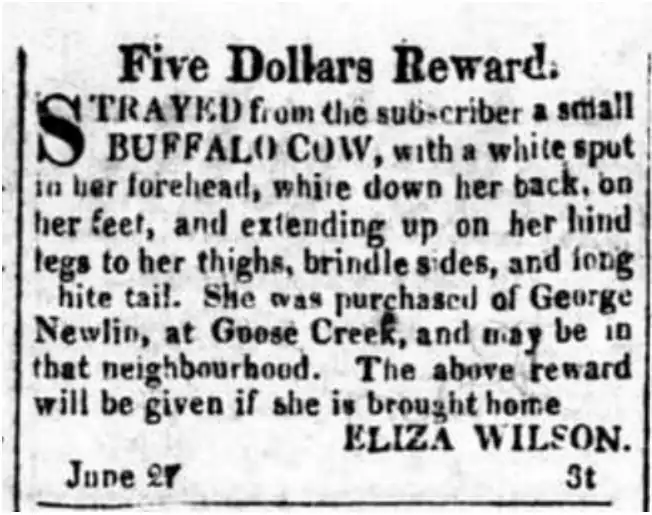
The Pittsburgh Gazette Oct 16 1818 70 bales

The Pittsburgh Gazette Nov 17 1818

1819 Dr. Cuvier of the ménagerie du Jardin des plantes received a young male bison from the United States. The calf was from the Kansas plains and handled by an African American. In 2017 author Charlotte Sleigh wrote in one of her books:
This young specimen was brought to a French menagerie in 1819, accompanied by his African-American keeper. The keeper led the bison by a ring in his nose, and was the only person permitted by the beast – so Saint-Hilaire tells us – to wash, comb and rub him down.
Western Sun & General Advertiser
Vincennes, Knox County, 10 April 1819
YELLOWSTONE EXPEDITION (Yellowstone)
Copy of a letter from an officer of the Yellow Stone expedition to his friend at Belle Fontaine, dated Martin Cantonment, Jan 14th , 1819
Sir -The conduct of the Kansas, since our arrival at this place, has been so audacious and even outrageous as to induce Capt Martin, the commanding officer to seize their chiefs, with several of the principal offenders and confine them to the guard house in irons.
Those reputed unsophisticated beings are deeply versed in intrigue and deceit, although the style of the bar is a language as little known to them as that of China.
After a punishment of a few days confinement, the commanding officer arraigned them before him specified the charge exhibited against them and admitted the, to plead in their own behalf.
They were charged 1st with theft, stealing both public and private property from the garrison, while permitted to encamp near it. Thus repaying our civility and hospitality with insult and ingratitude.
2d. With having repeatedly robbed our hunters of their game, ammunition and wearing apparel, thereby breaking the bonds of peace and friendship, which they had pledged themselves to observe. Thus proving themselves false and treacherous, unworthy either our protection or confidence.
In reply to these charges, their chief rose, and after casting his eyes over the guard of soldiers which invested him, thus addressed the commanding officer : ” Father Your young men are prescribed within certain bounds, not one of them can pass that chain of sentinels without your permission, thus ever within your power you govern them with ease. My warriors impatient of restraint as the wild horse in the toils of the hunter brook no control, free as the air which they breathe, light and impetuous as the Antelope, they bound over the mountain and moor, in the pursuit of pleasures which nature has ordained they should enjoy. To confine them to one valley would deprive them of their subsistence; they would pine and die in penury and want.
Father- These woods and streams are ours. The beaver which inhabit this river, and the buffalo which range in these Forests are ours, their skins afford us clothing and a shelter from the rude blast of winter; their meat a luxurious subsistence. Shall we then, who are lords of the forest, quit the pleasures and the advantages of the hunt, and like you, confine ourselves to one solitary valley, to practice discipline and subordination, to live in idleness and indolence. No, Father in pursuit of the Elk and Antelope, we will snuff the morning breeze on the mountains in the evening repose among the lilies of the vale, reveling on the spoils of our hunters, and the embraces of our wives.
Father -These pleasures we invite you to participate; we also invest you with an equal right with ourselves to take meat from our forests and fish from our fountains; as freely, as the Great Spirit gave them to us.
Father -We love and respect you, and mourn that there are bad men among us, who have done you wrong. Their actions, Father, were not within my control. Punish not the innocent for the guilty. Free our hands from these chains, we will seek out the culprits who have injured you; although they crouch in the thickest glen, or lie concealed in the recesses of the most inaccessible mountain.
Father -We will deliver them to you, to punish to your satisfaction, for the outrages they have committed against you; and pledge ourselves that should one of our nation at any future period evince an evil disposition towards you we will give him to your power, that with the rod of correction, you may open his eyes to reproof.”
The sophistry of this address, however, did not deter the commanding officer from severely flagellating five of the culprits, who were recognized as the offenders; after which they were permitted to retire; strongly enjoined to mend their manners and morals.
I am happy to inform you that the promptness with which Capt. Martin, seized and punished these offenders has made a desirable and deep impression on the minds of the whole nation, since which they have evinced the most peaceable and friendly disposition, uniformly whenever they have met with our hunters, courteously taken the burthen of game and borne it to our camp.
Notwithstanding the reluctance evinced by our troops on their embarkation, and their present exiled situation, the utmost cheerfulness, harmony and good humor prevails, every one appears enraptured with the expedition and “for bold adventures eager.”
This happy change may I think be attributed to the uniform and correct system of discipline which has been observed by the officers, and the prompt and regular manner in which .they have been paid. One of our best soldiers lately received an accidental shot in the knee which has eventuated in the loss of a leg; on which the commander immediately very generously presented him with a donation of seven hundred dollars for his future support.
The troops are remarkably healthy, and the season beyond description fine.
The Evening Post May 28 1819 buffalo tools

The Maryland Gazette
Annapolis, Maryland
August 19, 1819
Ottawas of Lake Huron Story of Machiwita
{extracted}
To be happy, perhaps, is to be usefully active, with the power of vocational relaxation; and if the Indian, in the pursuit of the deer and the buffalo, is happy, I much question the principal that will go to trespass on ground given to him by inheritance and original occupation, because the wants of civilization require more land to cultivate, or the gratification of his avaricious neighbor.
Indiana Centinel,
Vincennes, Knox County, 28 August 1819
(extract) – about horses -Western Expedition
A region so vast, so different from all others in air and water, must have a vegetable kingdom of its own, and the botanist will doubtless find abundant subjects for the employment of his talent. In the history of the white, or grizzly bear, the zoologist will discover fresh cause for covering with contempt that very of the Count Buffon and the Abbe Raynal which attributed to nature a disposition to belittle her animal productions in the new world. This bear finds no parallel in the old world among the rest of his species, either in his size, his strength or his dauntless ferocity. Beyond the Rocky Mountains, if these should be passed, a still nobler instance of animal production will be found. The horse of the Columbia River, taken all in all is perhaps the finest animal of his kind in the known world, he is derived from the old world, but instead of degenerating, has improved on the banks of the Columbia. Fineness of form, fullness of all the muscular parts, docility of spirit, capacity to sustain great fatigue, to provide food for himself, and to hunt down the deer and the buffalo for his master, are a part of his characteristics. The Geology and mineralogy of the country will present enquiries of great interest. Different parts of the region through which the river flows, exhibit clays and earths of great fineness and most uncommon composition, from the properties of which the river is supposed to derive its peculiar qualities The Rocky mountains have not yet been examined. They are supposed to contain minerals, precious stones, and gold and silver ore. It is but of late they have taken the name of Rocky mountains, a name which imports nothing appropriate or peculiar, as all mountains are rocky. By all the old travelers they are called shining mountains from an infinite number of crystal stones, of an amazing size, with which they are covered, in which when the sun shines full upon them sparkle so as to be seen at a great distance.” (Carver) The same early travelers gave it as their opinion “that in future ages these mountains might be found to contain more riches in their bowels than those of Indostan and Malabar, or which are found on the golden coast of Guinea, or in the mines of Peru.”
Indiana Centinel,
Vincennes, Knox County, 28 August 1819
The living Bison, or Buffalo, of the North America forests, that was purchased for transportation to France, has been safely conducted to Paris, and lodged in the menagerie of Louis XVIII. A grand Wapiti Deer is now feeding at New-York, waiting for a passage to Hav re de Grace. He will be conducted to the same quarters. The monarchy incurs all this expense, and abundance more, for the sake of honoring itself, of promoting science, of enabling the professors attached to the king’s cabinet to examine for themselves, and to assist those who are preparing the great national work, on quadrupeds, to insert in the likeness from the life, of every creature that can be procured, at any trouble or cost. Mr. Milbert is the diligent and faithful agent. Boston Intelligencer
The Evening Post Nov 13 1819 1000 Robes

The Evening Post Nov 25 1819 1000 Robes

The Evening Post Dec 6 1819 1000 Robes

The Evening Post Dec 13 1819 1000 Robes

 Buffle., lithograph with applied watercolor, ca. 1820-1850
The Evening Post April 3 1820 1000 Robes

Indiana Centinel,
Vincennes, Knox County, 12 August 1820
Parts of animals brought to view by the late Earthquakes, near New-Madrid.
TO JASPER LYNCH, Esq. New York, June 26, 1820.
Dear Sir- You decided justly, in putting the fossil bone from the Mississippi, near New Madrid, in the paleo appropriated for geological articles, at the college for physicians. There, every necessary book and authority is at hand, to explain and educate subjects of this kind.
I agree with you, that the huge production, large as a hickory forestick, belongs to the mastodon, or mammoth, as he is erroneously called, that formerly walked upon the soil of North America; and from his head quarters at the region watered by the Wahill within Ulster and Orange counties of New York, made excursions through New Jersey, Pennsylvania, Virginia, Kentucky, Ohio, Louisiana, and other tracks of the south. The part of his skeleton, drawn out by the earthquake of 1812, appears to be the ulna, or larger of the two bones forming the lower joint of the right fore leg. Notwithstanding its decayed condition, there are characters remaining, of sufficient distinctness, to warn the conclusion. His relic appears to have been disinterred at the same time, and by the same agent, which hove up the petrified bison scull, (or buffalo head) that was brought hither some time ago by Mr. Hill, and build us with admiration. (skip forward)
Many of the savans have already examined your offering, whereupon, I trust you will allow me to tender you by thanks and good wishes. Samuel L. Mitchell.