Wood Bison- (Buffalo)
Haningtoni (Mountain) Bison bison (extinct)
Oregonus (Bison bison)
Pennsylvanicus (Bison americanus)
When a supposedly authoritative publication like “Report of the Pennsylvania Department of Agriculture” for 1896 states that “perhaps two hundred years ago the lordly bison inhibited what is now the Keystone State,” it would seem well nigh impossible to trace down the animal’s existence within our borders to a more comparatively recent date. The published references to the buffaloes in Pennsylvania are few and far between. The earliest travelers and chroniclers like Peter Kalm, Dr. Schoepf, and even William Penn make little mention of them, but that is entirely due to the fact that in their travels they passed just outside of the bison’s limited range, although Albert Gallatin has much to say concerning them. Dr. W. T. Hornaday in his monograph on the extermination of the American Bison has devoted more space to the existence of these animals in the State than any other writer. In the map which he prepared showing the former range of the buffaloes in North America he has drawn a line approximately just west of the Susquehanna showing where the herds and then the stragglers lingered until the last years of the eighteenth century. This would bring the range a trifle west of Harrisburg, of Liverpool. of Sunbury, Lewisburg, Lock Haven, Emporium and Bradford. West of that the buffalo’s range extended unbrokenly to the Rocky Mountains. S.N. Rhoads in his “Mammals of Pennsylvania and New Jersey” has furnished some interesting information on the Bison in Pennsylvania, as has Prof. J. A. Allen in his very complete treatise. But they have failed to give anything like a description of the Pennsylvania Bison, how he looked, his size, habits, or the details of his extermination. With meagre records the hunt for traces of the Bison of the Keystone State might seem discouraging, were if not for the wealth of oral traditions, embracing; every topic connected with life in colonial days, which still runs like an underground stream through the hearts and minds of the old pioneers. These people, with their clear intellects, well-developed consciences, and kindly natures, are fast falling beneath the hand of the Reaper, but from them some record of the Pennsylvania Bison has been obtained, and on the following pages is preserved. However, much of what has been thus obtained will only interest the scientist and the student, for it matters little to most persons to learn that the Pennsylvania Bison was different in appearance from most of his western congeners, that he belonged to the type known as the wood bison. At the same time it does seem worth while to present a description of our bison, from the lips of the grandson of a noted hunter of the species. It brings us closer to this vanished forest monarch, makes Bison americanus seem more real. But from points of difference he deserves to be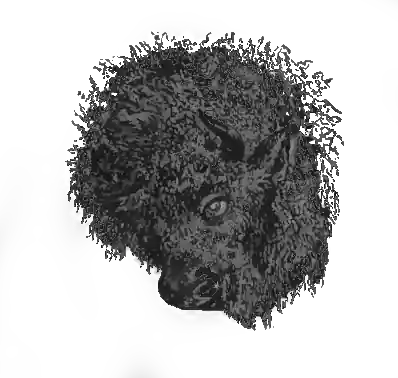 called Bison americanus Pennsylvanicus. Doubtless west of the Alleghanies the individuals shaded into the true bison of the plains, but those which ranged between the east and west slopes of the Alleghanies, migrating between the (Great Lakes and the valleys of Southern Pennsylvania, Maryland and Virginia, to Georgia represented the type of bison of the Keystone State. Doubtless in Georgia they encountered the Northern migrations of a Southern or Southwestern type of bison, the bison of Louisiana, but probably it too was closely related to the Pennsylvania type. The lengthy migrations were hardly in keeping with known characteristics of the wood bison of Colorado, Wyoming, and Montana, and of the Canadian Northwest. But this can be clearly judged and determined after the stated facts are weighed and digested. But most interesting of all seems the vast numbers of bison which roamed through the Central and Western parts of our state, now gone and forgotten through man’s rapacious greed.
Gabriel Thomas in 1698 says that the buffalo was found in the province. (Eastern Pa.)
Archer Butler Hulbert often mentions buffalo paths in Central and Western Pennsylvania.
The London Gazette England, United Kingdom Sep 14 1704
Sold by the Black Eagle of Teneriff (Teneriss)
lot 33 Cont. Tann’d Buffalo Hides
Lots 130, 131,132,133 Cont. 4000 Pricks of Tobacco; Sold November 9 1703
My Notes : FIND
Nov 2 1704 The London Gazette England, United Kingdom Buffalo Hydes
May 27 1717 The Boston News Letter And The New-England Chronicle Boston, Suffolk County, Massachusetts, United States- Buffalo Hides 200 tons Beacon ferry
Vaudreuil, describing Lake Erie, in 1718, says:” There is no need of fasting on either side of this lake, deer are to be found there in such abundance; buffaloes are found on the south , but not on the north shore.”
The Pennsylvania Gazette Dec 8, 1730
John Pembeiton kill’d a Buffalo upon Shunadore River, which weigh’d after it was drefs’d 1400 weight, and the Hide 300. There was one kill’d there some time before, which weigh’d 1800; and in those Parts ’tis said the frequently see ten or more of those Creatures together.
The Pennsylvania Gazette
We hear that Capt. Tomson, who lately arrived on board the Ship; two; Brothers from Georgia,has brought over a Treaty of Friendship and Alliance made by King Thomd Chachi, and the rest of the Indian Chiefs, with the Honorable Trustees for setting of the Colony of Georgia, which is most beautifully wrote on a large Buffalo’s Skin, with the Hair on it. (cont)
Fort Le Beouf, (Waterford,) in Erie county, Pennsylvania, established by the French about 1754, meant Buffalo Fort.
Colonel James Smith was captured by the Indians in Pennsylvania in 1755, when a boy, and taken to Ohio, where he remained a captive until 1759. Forty years after his release he published a circumstantial account of his captivity, which is an American classic. In this account Colonel Smith frequently mentions buffaloes as forming part of the staple diet of the Indians with whom he lived in the eastern part of Ohio. He killed one himself.
Hew Hampshire Gazette January 18 1760
Charlestown, South Carolina, Nov. 20.
In a letter from Fort Loudon, dated the 3d instant, we have the following account of the Little Carpenter’s late expedition, viz. That he arrived at that fort the 24th ult. with two French prisoners, and 4 scalps. That after the usual ceremonies on such occasions, and receiving presents for his good behaviour, he informed Capt. Paul Demere, the commanding officer there; That on the road he got intelligence, that there were many Shawanese at Fort L’Asomption, who were continually on the watch ; and if he intended to do any execution, he should go between new Fort Chartres, on the Mississippi river, and L’Asomption, where he would meet with parties continually going from one fort to the other ; that he accordingly took that route, waited a’long time in vain, and dreaded that he should be obliged to return without either prisoners or scalps ; but at length & scouting party, which he had sent out in the morning, presently returned. and informed him, that they had discovered fresh tracts of upwards of 30 people, leading towards L’Asomption ; that he there upon set off, fully determined to do execution ; that on the 18th of September, two scouts, who had been sent out the day before, came in, and informed him, they had discovered Frenchmen and Indians dressing
Victuals at the water side ; whereupon he advanced undiscovered, fired upon them, killed three Frenchmen, and one Indian, and took two Frenchmen prisoners; that the Enemy fired at his party, and wounded one of them, who died soon after, but this did not prevent the rest from making a good meal of four buffaloes the enemy had killed, part of which they were dressing when surprized; that the party he surprized consisted of only 15 men, the rest (17 in Number) being that morning gone to hunt for more buffaloes, and that he had not been there long before he discovered a large boat under sail, full of people, upon which his party hid themselves between the rocks, and when it approached to a proper distance, fired upon it and killed a good many of the people.” One of the prisoners confirmed the Little Carpenter’s relation ; knew the boat ; said there was an engineer on board ; and that the was loaded with ammunition, provision, and liquor. for Fort L’ Asomption, and that when the Indians fired upon her, he saw some of the people drop into the water, and others fall in the boat.
The last accounts we have from the Creek Country are, that the Chactaw traders were returned, after having sold their goods to great advantage, and settled a very beneficial standard for their future trade and that having two of the enemy’s forts to pass in their way, the French had formed a design to cut them off, but the Chactaws having notice of it, escorted them in safety, with 700 men, quite to the Creek towns. That the Cowetas and Cussitahs were mightily pleased with what had lately been transacted at the Savannah, regarding them; had resolved not to engage in any hostile measures with the Cherokees, but to resent any outrages they should commit, that might have a tendency to hurt their trade, reputation or hunting; and that they had given notice of such their resolutions to the Cherokee nation. And that the hon. Mr. Atkion had recovered of his wounds, and remained in one of the most remote Creek towns. (continues)
The New Hampshire gazette. (Portsmouth, N.H.) , May 22, 1761
Some few remarks made on the Settlements the French have on the River Mississippi, Oubach, or St. Jerom, also on the Navigation of the said Rivers, made in the Year 1754
[St Jerome Creek=Chesapeake Bay MD ? needs more research]
THE first of these Rivers is so rapid as to allow or admit of no large Vessels to go upany considerable Length ; they are obliged therefore, to use a kind of large Batiesus, rowed by 30 or 40 Men, to carry their Stores and Necessaries up and -down said River, also to the llinois and Oubach Settlements, from whence they carry great Quantities of Grain, and other Provisions to Mississippi ; these Boats are generally escorted by a Number of Men, to protect them from the Cherokees and Chiekefaws, who have often attacked and destroyed several of the French in their passing that Way ; the Place they generally fell upon them, is where the Rivers Oubach and Ohio falls into the River Mississippi.
They commonly take to go from Kufkufkes, Chartres, Cahoki and Fort Vancent, from 15 to 20 Days to Mississippi, and three Months to come back. At the first of these Places there is a Fort garrisoned with 100 Men, several Priests and Jeluits, who have besides indians, large Copgregations, there being above 100 Houses there five Years ago ; Land exceeding fertile : At the second Place, they have also have a Fort with 40 Men and 50 Families : At the third, above 20 Houses, no Fort five Years ago; these three Places are on the Mississippi ; the fourth, which is Fort Vincent on the Oubach, is strongly garrison’d ; the Officer of the said Fort is Commandant, and receives his Orders from the Governor of Mississippi ,whose Authority reaches no further that Way, viz. to the North East In that Country they have great Plenty of Buffaloes, or Wild Cowes, which they make great Use of ; there is another Settlement of above 20 Houses; at Wawisghtanhook; on said River Oubach, 60 Leagues above Fort Vincent ; there is another Fort about 60 Leagues farther, on the Miamis River, where there is a carrying Place from said River into the Oubach, of some Miles. The next is Detroit, a very considerable Settlement of French ; then follows in Course their two Forts at Lake Erie, River Beanff, and next Niagara, “The French have been trying all means to obtain Liberty of settling on the Missouri River ; they at Length, after losing much Blood and Treasure thereby, built a Fort there, and now have engaged several Nations of the Indians about them in their Interest, whom they not only invite to war against the Panys, &c. but join them in all their hostile Expeditions : The Indians thereabouts generally fight on Horseback, with Targets made of the neck Part of the Buffulo’s Hide.
N.B. The White River, which is pretty large, should , be between the Oubach and Belle Rivere ; but is omitted in De Auville’s Map, corrected by Bolton.
The South Carolina Gazette June 20 1761 (extract)
That the Indians of the Lower Towns were almost starved, and had been obliged for some time past to subsist upon acorns and strawberries, their corn being mostly expended , but they have beef and buffalo enough, with which the Young Warrior of Estatohwih (sp) had of late frequently supplied the garrison.
The New-Hampshire gazette and historical chronicle.
September 30, 1763
Extract of a letter from Fort Cumberland, September 8.- One Henry Adams informs me that he was Yesterday at John Forman’s Fort, about 3o Miles from this Place, “on the South- Branch, when an Express arrived there from Fort Pleasant, who informed, that Capt. Luke Collins, with some Men, had followed a Party of Indians to Cheat River, one of the main Branches of Monongahela, where he overtook them, and killed fix of their Number ; took 11 Guns, 14 shot Pouches, several Horses, and a large Quantity of other Plunder, to the amount of One Hundred Pounds, or more exclusive of the Horses: He also released a Son of Captain John Walton’s from the Enemy. It is remarkable that not one of the Guns taken from the Indians was loaded, and, when attacked, they -were barbacuing a Buffaloe, not thinking of Danger. It appears that their Party did not consist of above eleven some of the Shot Pouches being taken from the lnhabitants;”
Notes:
Cheat River
River in West Virginia and southwestern Pennsylvania, United States The Cheat River is a 78.3-mile-long tributary of the Monongahela River in eastern West Virginia and southwestern Pennsylvania in the United States. Via the Ohio River, the Cheat and Monongahela are part of the Mississippi River watershed.
Fort Cumberland was an 18th-century frontier fort at the current site of Cumberland, Maryland, USA.
John Forman, He lived on the south branch of the Potomac river in Hampshire county, where there was a string of Forts, one called Forman’s Fort.
June 20 1768- South Carolina Gazette & Country Journal (extract)
Saluda, Tiger, and other less but reputable rivers, may in be made navigable for small craft, whole banks, waters, and even high land, is enriched with a variety of good soil, plants, wood, and fish; all necessaries of life flows in abundance, salt excepted; plenty of iron ore near navigation, whose real use surpasses that of gold. Here is many buffalo licks, a kind of earth the cattle is fond of, and resorts thither in the spring time in large herds, wild and tame, (buffalos being wholly hunted out of this province, and fled to the mountains)
In 1770 Washington visited what is now known as West Virginia, and in the journal of his trip he speaks of receiving from “an old acquaintance,” Kyashuta, “a quarter of very fine buffalo.’”’ He also mentions a buffalo path, ‘the tracks of which we saw.’’? On November 2, recording his exploration of the Great Kanawha river, he writes: ‘Killed five buffaloes and wounded some others, three deer, etc. This country abounds in buffaloes.” He says of a creek near which he encamped that ‘on this creek are many buffaloes, according to the Indians’ account.’ In 1784 Washington paid a visit to Western Maryland, Western Pennsylvania, and what is now West Virginia, and in his diary of that journey he refers to buffalo paths and salt licks frequented by buffaloes in the vicinity of Morgantown, which is only a few miles south of the Pennsylvania line.
Dr. Bausman, ‘‘sending hunters to the Little Kenawha to kill buffaloes,’
Colonel Brodhead, in a letter to Rev. D. Zeisberger, under date of December 2, 1780, “ proposes that he should send fifteen or twenty best hunters to Little Kenhawa, to kill buffalo, elks, and bears, to be salted down in canoes made for that purpose.’
The New Hampshire gazette and Advertiser Dec 2nd 1789 (extract)
The Sachems and chief warriors of those nations, particularly those who reside at Buffaloe Creek and who had not attended at the two last treaties, very generally attended at this, and with the greatest unanimity and apparent satisfaction, ratified and confirmed the deeds of session and former agreements which their respective nations had entered into with the state.
Capt. Brant and Capt. Daird, of the Mohawks, and many of the most distinguished characters of other nations also attended the treaty, and their conduct and behaviour on this occasion evinced the most friendly disposition, and afforded the commissioners the strongest assurance of their good will and attachments. We hear that his Honor the Lieutenant Governor and Generals, Ten Broeck and Gansevoort, the other commissioners who attended the treaty, parted with the Governor
at their respective places of residence.
It is with sincere pleasure we inform the publick, that Major Doughty of the Federal troops who was reported to have been killed by the Indians on the river Tenessee, safely arrived at Fort Harmar, on the Ohio, the 15th of last month. This valuable officer was charged with important publick business to the Chickasaw and Choctaw nations of Indians. While ascending the Tenessee, on the 21st of March last, he met a party of 40 Indians, in three canoes, having a white flag hoisted. This party were a banditti of Cherokees and Shawanese, with three Creeks.
The Major was in a barge with Ensign Sedam, and fifteen non-commissioned officers and privates. The lndians appeared very friendly, and their Chief and several others even came on board of the barge. ‘They received, with the greatest apparent thankfulness, presents of corn and tobacco. They endeavoured, by every means in their power, to persuade the Major to land, and pass the night with them promising to hunt turkies and buffaloes for him ; but he, being suspicious of their design, evaded their entreaties. After having thus passed upwards of an hour they shook the Major by the hand, and left him : but the men had scarcely got to their oars, before they received from the Indians a severe fire, which was instantly returned, and the boat put about. The barge then floating down the stream, an incessant fire ensued for our hours. During this time the Indians manifested an intention of boarding the barge ; but the cool and well directed fire of the Major’s party prevented the design. ‘The Major lost five of his party killed, and fix wounded, one of whom died afterwards. (continues, returns to Tennesse)
The Buffalo Creek Reservation was a tract of land surrounding Buffalo Creek in the central portion of Erie County, New York. It contained approximately 49,920 acres of land and was set aside for the Seneca Nation following negotiations with the United States after the American Revolutionary War.
American Intelligence.
PITTSBURG, July. 2. 1791
Thursday evening last arrived here from Detroit, which place he left the 10th ult. from captivity among the Savages, Mr. Thomas Ray, who was taken from Cussawago by four Indians some time ago. Mr. Ray has related to us the following, viz. At the time he was taken the Indians killed and scalped one William Gregg ; they then proceeded to Sandusky, where a party of Indians had just returned
from committing depredations on the frontiers of Ohio country, who were a bout half drunk, and they beat him in a cruel manner. Seven days after his arrival there news came in that our army was on their march, against that place, upon which they burnt the houses and destroyed the corn they had planted, and removed their families off to the rapid of the Miami river ; at that place he saw a great many Indians, to the amount of two or three thousand, receive arms and ammunition and proceed on to the Maumee towns, where it was said 7000 were assembled ; that at Detroit, on the first Thursday of June, at a review of the militia, he saw 150 turn out voluntarily to join the Indians ; that he saw a number of Indians to the amount of 12 or 18 canoe loads, who said they had been three moons on their journey, come to join the others ; they had bows and arrows, and had otter skins for breech clouts, and buffaloe skins instead of blankets ; that about the 1st or 2d of June the Indians brought in 12 scalps together with the guns bayonets, &c. belonging to the party ; that he saw Thomas Dick and his wife, who were taken from near this place, in good health at the Miami River, and the boy, by the name of Brickel, with his head shaved and painted on his way with a party to the Maumee towns. Mr. Ray was brought from the Indians by a British Officer by whom he was released. Mr. Ray further informs, that the Indians entirely blame Mr. Wilson and Mr. Hamilton, as being the cause of the Indians killed on Beaver creek, and say if they ever should fall into their
hands they would put them to death in the most cruel manner.
National Gazette Philly pa November 07, 1791 (extract)
The Buffaloes have been entirely quitted the cultivated parts of Kentucky.
National Gazette Aug 18 1792
It maybe necessary to remark, that the distance from the mouth of the Mississippi to the entrance of the Missouri into it, is about 1200 miles, that the navigation of the Mississippi, upwards, is tedious and difficult, owing to the current continually running the same way, by which means the vessels employed on the occasion seldom make that distance in less than three months A light boat, well manned, however, might go from New-Orleans to the Missouris in six weeks : and from Kentuckey, on the Ohio, in less than three weeks ; whereas on their return, the same distance is made in a few days ; that the country bordering on those rivers is extremely fertile ; that in very severe winters they are subject to frost, which is generally of short duration that every article for the use of man grow: almost spontaneously ; that large number: of buffaloes are taken, the hides and tallow of those animals, as well as deer skins, beaver, &c. are carried down the Mississippi to New-Orleans, from whence they are exported to different parts of Europe (continues)
National Gazette Philly Pa Oct 27 1792
The buffalo are mostly driven out of Kentucky. Some are still found upon the head waters of Licking Creek, Great Sandy and the waters of Green River.
National Gazette Philedlphia Pa Nov 24th 1792 (extract)
Salt Springs have been found in every part of the western country which has been well explored, and I have no doubt that time will prove that every part of it is well supplied with them. The manner by which they are mostly found in uninhabited places is by large buffalo roads which lead to them. Whenever the ramification of those roads begins to concenter, it is almost an infallible sign that a salt lick is near. Those animals resorting to them throughout the temperate part of the year for the benefit of the salt, make large roads, which leading from the lick, branch different ways into the country.
By HENRY W. SHOEMAFER,
TELLING OF SLAUGHTER OF LAST PENNSYLVANIA BISON HERD IN “BOONEY’S HOLE,” RECALLS SIMILAR MASSACRES. (extract)
The last buffalo in Pennsylvania was killed at a much later date than is mentioned in the instructive article in “We, the People.” The date is October, 1810, the place one of the Glades of Somerset county near Buckstown and the slayer John Yutsey, whose named “Englished” from the Macedonian, means “Gipsy,” otherwise the famous “Gipsy John.” Earlier in the same year Frederick Stamm killed a bison in Northumberland county, while Jacob Weikert drove the last buffalo out of the Buffalo Valley of Union county in 1803. In 1792, in Harrisburg, a large bison driven from the Blue Mountain by dogs, was shot in Derry street and the meat was divided among the hunters.
The National Gazette Feb 2nd 1793
The buffalo beef lately killed in this city, sold in the market at 2s. 6d per lb. The exact resemblance of this creature in a preserved state, is now to be seen at Mr. Peales museum.
National Gazette Sept 4 1793
Extract of a letter from a person in Philadelphia, to his friend in Maryland.
” Having sufficiently rested myself after my arrival in this city, I divided the remaining days assigned for my stay here, into equal dividends, that I might be clear of embarrassment at the time of my intended departure. In the first place to gratify my curiosity I went to see Mr. Peales Museum, a repository of once-living things, preferred to as to resemble life.
The room so called is about 50 feet long, and 20 high. On the floor, and near the door the American Buffaloe stands in its huge natural shape ; this aborigine of the western hemisphere may properly be called a substitute for the Cow : the taming and domiciliation of which, is one the greatest desideratum’s of the inhabitance in the Trans Allegheny regions of North America, as it can support itself in the winter season, without the help of man. Yarn spun from the wool of this animal was produced by Mr. Peale and cannot be distinguished from that made of sheep’s wool.
Schoolcraft : “ There was added for all the region west of the Alleghenies the bison of the West (Bos Americanus), the prominent object and glory of the chase for the tribes of these latitudes.”
DISTRIBUTION OF THE AMERICAN BISON IN PENNSYLVANIA, WITH
BY SAMUEL N. ROADS . 1895
Pennsylvania enjoys the distinction of being the scene of the most easterly range of the buffalo , Bison bison , in North America . Dr. J. A. Allen , whose excellent memoir on the American Bisons furnishes the best data on this subject, has conclusively proved its existence up to the beginning of this century as far east as Buffalo Valley , near Lewisburg , in Union County. The last buffalo killed in that region was shot by Col. John Kelly, ” about 1790 or 1800,” on the McClister farm adjoining his own , and situate in Kelly township , about five miles from Lewisburg . Col. Kelly stated that an old Indian named Logan informed him of the former abundance of buffaloes in this valley. In the map of its distribution, Dr. Allen practically limits the range of the buffalo in the Keystone State to the country drained by the Alleghany and Monongahela rivers, which includes the region west of the Alleghany ridge on the south, and on the north, from a point in Clearfield county to the eastern shore of Lake Erie, westward. The movement east of this area is supposed to have been limited to the mountain passes extending along the west branch of the Susquehanna, to the forks below Lewisburg.
Prof. Baird mentions, in the Patent Office Report of 1851, the existence of bones of this species in Pennsylvania caves and alluvial
deposits. Dr. Allen took the pains to search for the reported remains taken by Prof. Baird in caves near Carlisle, but was unable to find them, and on inquiry the Professor wrote Dr. Allen that a reexamination would be necessary in order to determine whether they are of the bison, and if so of which species. The uncertainty of the matter justly led Dr. Allen to ignore it and make the Lewisburg record stand as the most easterly authenticated one for North America. In 1873 Dr. Joseph Leidy described and figured the second upper molar of a bison found at Pittston, Luzerne Co., Pennsylvania, in association with the remains of the mastodon and fossil horse. This he identified as belonging to the extinct Bison latifrons. Dr. Allen contends that this tooth not only lacks the accessory column characteristic of the genus Bison but “it is in any case too small for a tooth of Bison latifrons,” and thinks it “undoubtedly referable to the extinct musk-ox.” Having examined the specimen in question and compared it with corresponding teeth of Bison-bison and the types of extinct muskox in the museum of the Academy of Natural Sciences of Philadelphia I find that this Pittstonl specimen is very much worn, the triturating surface having reached to the alveolar base of the enamel on the anterior and posterior sides. The roots of the tooth are intact, and comparison with a corresponding molar removed from the jaw of an adult Bison bison from Utah shows that the Pittston specimen is not materially larger than the one from Utah. Owing to the wearing of these molar teeth their triturating surface changes from an oblong, twice as long as wide, to a nearly square figure of nearly twice the triturating area seen in the teeth of a younger adult animal of same size. Dr. Leidy’s oversight of this fact was probably the reason for his identification of the tooth as that of Bison latifrons, to which species, it may be remarked, he had referred larger specimens of the smaller B. antiquus.
In this respect Dr. Allen’s position is sound; the tooth is too small to belong to latifrons. (continues – source jstor.org)
Professor Spencer F. Baird has mentioned the existence of fossil remains found near Carlisle which he says may have been buffalo bones.
In Rhoads’s Mammals of Pennsylvania and New Jersey (1903) he mentions buffalo bones which have been found in Pennsylvania and are preserved at the Academy of Natural Sciences in Philadelphia.
Early French explorers in the region south of the Great Lakes mention the presence of ‘wild bulls,” “ wild beeves,”’ and “vast herds of wild cattle’”’ in the territory they visited, and some of these buffaloes were seen on the southern shore of Lake Erie, which would include Pennsylvania.
Mr. Gallatin in 1848 referring to buffaloes, says: ‘‘The name of Buffalo creek, between Pittsburgh and Wheeling, proves that they had spread thus far eastwardly when that country was first visited by the Anglo American. In my time (1784-1785) they were abundant on the southern side of the Ohio, between the Great and the Little Kanawha. I have during eight months lived principally on their flesh.’ He also says of the buffaloes that “they had at a former period penetrated east of the Allegheny mountains.”
Northwestern Pennsylvania ,Thomas Ashe, at Erie, in April, 1806. ‘‘An old man, one of the first settlers in this country, built his log house on the borders of a salt spring. He informed me that for the first several seasons the buffaloes paid him their visits regularly.” ” He supposed that there were no less than 10,000 in the neighborhood of the spring. Ashe further says that in the first and second years this old man, with some companions, killed 600 or 700 of these noble creatures for the sake of their skins. He also says that buffalo bones had been found in large quantities on Buffalo creek, but he does not locate the creek.
William T. Hornaday says that in the region between the Allegheny river and the west branch of the Susquehanna “there were at one time thousands of buffaloes.”
Professor Allen refers to Buffalo creek, ‘‘which empties into the eastern end of Lake Erie,” and to other evidences that buffaloes ‘‘once existed in Western New York.” Hornaday adds that “from the eastern end of Lake Erie the boundary of the bison’s habitat extends south into Western Pennsylvania to a marsh called Buffalo swamp map published by Peter Kalm in 1771.”
Allen as saying of this swamp that it ‘‘is indicated as situated . . . near the heads of the Licking and Toby’s creeks, apparently the streams now called Oil creek and Clarion creek.” It was in this locality that there were at one time “thousands of buffaloes.’
March 14, 1876, by Professor Loomis, of the University of Lewisburg, to Professor Hamlin, in which letter Loomis copies as follows from a letter received by him from J. Wolfe: ‘Since seeing you this morning I have had a conversation with Dr. Beck, and he informs me that buffaloes, at an early day, were very abundant in this valley, and that the valley received its name from that circumstance. The doctor received his information from Colonel John Kelly, who was a prominent and early settler in
this valley. Kelly told the doctor that he shot the last one that was seen in the valley. Kelly received his information of the abundance of buffaloes from an old Indian named Logan, friendly to the whites, and who remained among the whites after the Indians were driven away.”
On March 30, 1876, Professor Loomis wrote again to Professor Hamlin, from which letter Allen quotes as follows: “I sought an interview with Dr. Beck. The Colonel Kelly referred to was a soldier and an officer in the Revolutionary war. . . . (He died in 1832, aged 88 years.) He owned a farm about five miles from Lewisburg, in Kelly township, which was named after him. About 1790-1800 Colonel Kelly was out with his gun on the McClister farm, (which joined that of Colonel Kelly,) and just at evening saw and shot a buffalo. His dog was young and at so late an hour he did not allow it to pursue.
The next morning he went to hunt his game but did not find it. Nearly a week later word was brought him that it had been found dead, some mile or two away. He found the information correct but the animal had been considerably torn and eaten by wolves. He regarded the animal as a stray one and had never heard of any in the valley at a later day. Dr. Beck had the account from Colonel Kelly about three months before his death. The colonel repeated the statement of the friendly Indian, Logan, who said that buffaloes had been very abundant. He, Dr. Beck, had the same statement from Michael.
Grove, also one of the first settlers in the valley. . . “I was more particular than I should ordinarily have been because this is about the last stage when reliable tradition can be had.” Allen says: “This, of course, affords satisfactory proof of the former existence of the buffalo in the region of Lewisburg, which forms the most easterly point to which the buffalo has been positively traced.”
(Buffalo valley, in Union county.)
Watson’s Annals, 1857, ‘‘the latest notice of buffaloes nearest to our region of country is mentioned in 1730, when a gentleman from the Shenandoah, Virginia, saw there a buffalo killed of 1,000 pounds, and several others came in a drove at the same time.’’ As the Shenandoah valley is an extension of the Cumberland valley in Pennsylvania it is easily to be inferred that if buffaloes would come into one valley they would naturally invade the other. Hence it is altogether probable that the bones found by Professor Baird near Carlisle were what he supposed them to be, Carlisle being in the Cumberland valley.