Natural Weather Disasters for Bison Wildlife.
The American bison is not without disastrous weather conditions, (killer storms) an iconic symbol of the vast and untamed wilderness of North America, has a history that is as complex as it is fascinating. Once estimated to number between 30 to 60 million in the 1500s, these majestic creatures roamed freely across the continent’s grasslands and plains. The sheer abundance of bison was so significant that they became a symbol of the seemingly endless resources of the newly found continent.
The bison’s story is not without its tragedies. With the mass destruction that began in the 1830s and the construction of the railroad in the 1860s, the bison population witnessed an unprecedented decline. By 1889, the population had plummeted to just over 1,000 animals, a stark contrast from the millions that once graced the plains. This rapid decline served as a grim reminder of human impact on the environment and the fragility of even the most abundant species.
That being said, I wanted to look into just how many may have died of natural disasters. It couldn’t have been that great to end in their demise, or could it?
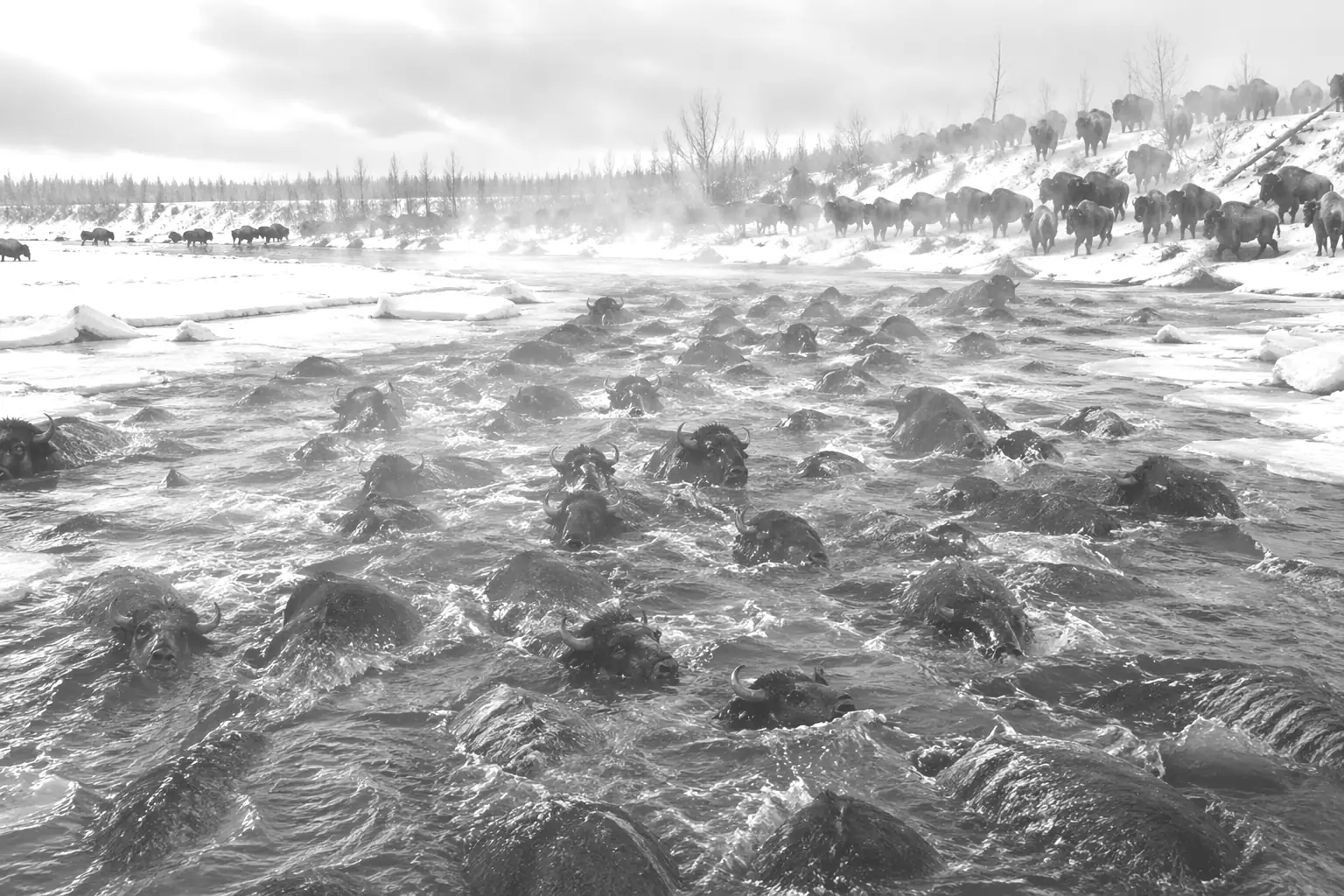
While I have read hundreds of accounts of terribly severe storms, were they bad enough to kill buffalo?
I think I can safely say these variations of natural disasters killed millions, maybe even yearly.
In the thirties (1830s), when the American Fur Company was in the heyday of its power, there were sent from St. Louis alone in a single year one hundred thousand robes. The company bought only the perfect robes. The hunter usually kept an ample supply for his own needs; so that for every robe bought by the company, three times as many were taken from the plains.
St. Louis was only one port of shipment. Equal quantities of robes were being sent from Mackinaw, Detroit, Montreal, and Hudson Bay. A million would not cover the number of robes sent east each year in the thirties and forties.
Army officers related that in 1862 a herd moved north from the Arkansas to the Yellowstone that covered an area of seventy by thirty miles.
In 1867, 2000 buffaloes, or half a herd, became entangled in the quicksands of the Platte River. At another time a herd was lost by breaking through the ice of Lac Qui Parle in Minnesota. The cold winters sometimes killed many that remained in the far north, but these dangers were nothing compared to man.
In 1868 Inman, Sheridan, and Custer rode continuously for three days through one herd in • the Arkansas region.
In 1869 trains on the Kansas Pacific were held from nine in the morning till six at night to permit the passage of one herd across the tracks.
TEXAS FEVER – Oklahoma History
From the pre–Civil War years and through the World War I era Texas fever threatened the welfare of the nation’s cattle industry. Caused by a parasitic protozoa called Babesia bigemina, the malady was characterized by a high fever, emaciation, anemia, bloody urine, numerous other symptoms, and eventually, death. The protozoa were hosted by cattle ticks. From the mid-nineteenth century several major cattle trails led from Texas through Indian Territory (Oklahoma) to Missouri, Kansas, and northward. American Indian ranching was also important in the territory, and in addition, a large amount of Indian land was regularly leased to whites for grazing. The disease was spread to local cattle by tick-infested longhorns in the herds being driven north. Texas fever outbreaks caused many midwestern states to quarantine Texas cattle herds, and Kansas completely banned them in 1885. Even after the demise of the trail drives, the illness plagued the region’s livestock industry. Scientific research from 1889 to 1893 proved that cattle ticks carried the microbes, and a widespread tick control program slowly developed.
Drought
The annual assault of ice and snow was surely the greatest trial for the buffalo, but other elemental forces took their toll as well. The drought of 1276-1299, dated by evidence of hardship it inflicted on Indian populations in parts of the southwest, is suspected of having devastated herds in the same region; at about this time, especially in New Mexico, buffalo disappeared from some districts never to return. In 1875 drought was said to have resulted in the starvation of hundreds of buffalo in central Texas. (Although many victims of drought succumb to starvation immediately, the local population may be weakened for many more months by a shortage of Vitamin A. The only natural source of this vitamin, green forage, customarily dries up during a drought. The resulting vitamin deficiency carefully documented in sheep – causes a lowering birth rate, and in time reduces numbers as surely as starvation.)
Boyd: Expedition of Marcos Delgado, 1686
From his account the passage of the lesser Choctawhatchie, the Choctawhatchie, Pea and Conecuh rivers, (SE Alabama) as well as many lesser streams can be identified. In the vicinity of the first named stream they observed many buffaloes and bears.
During the last few days of their journey they suffered greatly from thirst, drouth conditions prevailed and they went for three days without water.
After fifteen days of travel they reached the margins of the Tallapoosa river in the Creek country which he calls Tiquipache and were well received by the Indians. Conferences were held and presents of beads and bells distributed. Delgado explained that he was travelling in haste on royal business and asked to be sold provisions. The Indians professed to be without any corn owing to lack of rain throughout the entire year.
Thousands Starve to Death – Charles Goodnight-(continued in the next article)
“In 1867 I was coming in on the Goodnight trail from New Mexico at a time when there had been a drought. I struck the Colorado river about the first of June and there was no fresh grass to speak of, but the buffalo were slowly drifting north. They had died in such large numbers from starvation and the of flies that what was known as the ‘screw fly’ had hatched in the carcasses in such swarms that he it was impossible to eat a meal in the day time. That buffalo carcasses were innumerable along this route.
Charles Goodnight – Adventures of the Trail
When they crossed the divide between the Concho and the Colorado, they came into country where the buffaloes had wintered in great numbers. The annual spring migration started with the growth of grass, but in 1867 rains did not come until June, and the herds gathered here in such numbers that they had eaten the country clean. For some strange reason they had not mounted the mesa and crossed the divide to the west, to the Concho side, where there was still good grass.
“But here,” to let Goodnight continue the story, “they had remained until the grass was gone, and had died from starvation by the thousands and thousands. The dead buffaloes, which extended for a hundred miles or more, were so thick they resembled a pumpkin field, and their carcasses had hatched millions and billions is what is known as screw flies. The air was so full of them we positively could not eat during the day time. In spite of all we could do, our cups, our plates, and cooking utensils would become full of them. Thus we did not attempt to stop during the day. Fortunately, we had a little corn for the horses, and getting our breakfast and breaking camp before daylight, we made all speed possible and never stopped again until dusk.
“Our northeast course was much the same as the drift of the buffaloes, and we did not get rid of these conditions until we reached the Elm tributary of the Clear Fork of the Brazos, where grass was fairly good. I presume the buffaloes had died the full width of the herd in the same proportion as they had along the trail. From our observation the herd would average twenty-five miles wide, which meant that several million head had perished that spring for lack of food alone. This may sound unreasonable – no one would believe it who had not seen the immense number of flies.” (post Civil War) http://www.oupress.com The Cowboy and the Plainsman (Texas Tick Fever?)
Drownings
Relation to Alvar Nunez
Headed for Apalache. June- That night we came to a river which was very wide and deep, and the current very rapid. One of the horsemen, Juan Vasquez by name, a native of Cuellar, impatient of detention, entered the river, when the violence of the current cast him from his horse, he grasped the reins of the bridle, and both were drowned. – They conducted us through a country very difficult to travel, and wonderful to behold. In it there are vast forests, the trees astonishingly high, and so many of them were fallen on the ground that they obstructed our march, in a manner that we could not get on without much going round, and greatly increased toil.
Of those erect, many were riven from top to bottom by the bolts of lightning which fall in that country, where there are often violent storms and tempests. We labored through these impediments until the day after Saint John s, when we came in view of Apalache, without the inhabitants being aware of our approach
Alexander Henry (1771) 1760-1776
On one of the lakes we saw geese; and there were a few pigeons. The only four-footed animal was the caribou and this, it is probable, was first conveyed to the island on some mass of drifting ice. It was, however, no new inhabitant; for in numerous instances I found the bones of cariboux, apparently in entire skeletons, with only the tops of their horns projecting from the surface, while moss or vegetable earth concealed the rest. Skeletons were so frequent as to suggest a belief that want of food in this confined situation had been the destruction of many; nor is anything more probable; and yet the absence of beasts of prey might be the real cause. In forests more ordinarily circumstanced the graminivorous animals must usually fall a prey to the carnivorous long before the arrival of old age; but in an asylum such as this, they may await the decay of nature.
March 30th. Rain broke up the ice; it drifted in large masses, making a great noise by crushing, tumbling, and tossing in every direction, driven by a strong current. Many trunks of trees and much mud are carried down on the ice. It continued to drift on the 31st, bearing great numbers of dead buffalo from above, which must have been drowned in attempting to cross while the ice was weak.
Wednesday, Apr. 1st. The river clear of ice, but drowned buffalo continue to drift by entire herds. Several are lodged on the banks near the fort. The women cut up some of the fattest for their own use; the flesh appeared to be fresh and good. It is really astonishing what vast numbers have perished ; they formed one continuous line in the current for two days and nights.” One of my men found a herd that had fallen through the ice in Park river and all been drowned ; they were sticking in the ice, which had not yet moved in that part. The women had excellent sport in raising the back fat and tongues.
This account is not exaggerated. John McDonnell’s Journal of May 18th, 1795, when he was descending Qu’Appelle r., states: ‘* Observing a good many carcasses of buffaloes in the river and along its banks, I was taken up the whole day with counting them, and, to my surprise, found I had numbered when we put up at night, 7,360, drowned and mired along the river and in it. It is true, in one or two places, I went on shore and walked from one carcass to the other, where they lay from three to five files deep” (Masson, I. 1889, p. 294). Itis probable that the total number of buffalo killed by man in those days was insignificant in comparison with the destruction wrought by the warring of nature’s elements against the poor brutes,
18th. Rain; drowned buffalo still drifting down the river, but not in such vast numbers as before, many having lodged on the banks and along the beach.
25th Drowned buffalo drift down river day and night.
30th Chased a herd and killed two. They are now getting in very good flesh. Killed also two calves, whose thighs make excellent steaks. Drowned buffalo drift as usual.
May 1st. The stench from the vast numbers of drowned buffalo along the river was intolerable. Gummed my canoes. 2d. Two hunters arrived in a skin canoe from Grandes Fourches with 30 beaver and 7 bear skins. They tell me the number of buffalo lying along the beach and on the banks above passes all imagination ; they form one continuous line, and emit a horrid stench. I am informed that every spring it is about the same.
Encamped at the Bois Percé with my people, I was actually prevented from taking supper by the stench of drowned buffalo that | lay on the banks in a state of putrefaction. Early on the 5th the canoes were off, and I soon followed on horseback.
Nearly all the early explorers, from Radisson and Hennepin in the 16oo’s, mentioned the abundance of this animal. On the last day of March, 1801, Alexander Henry, who was trading south of Pembina on the Red River, saw in the stream “great numbers of dead buffalo from above,’ which must have been drowned in attempting to cross while the ice was weak.” On the day following, Henry again observed dead bison: “It is really astonishing what vast numbers have perished; they formed one continuous line in the current for two days and nights,” he remarked in his journal. A month later, on May 1 and 2, he recorded that “The stench from the vast numbers of drowned buffalo along the river was intolerable. . . . I am informed that every spring it is about the same.”
Catlin and Inman and army men and employees of the fur companies considered a drove of one hundred thousand buffalo a common sight along the line of the Santa Fe trail. Inman computes that from St. Louis alone the bones of thirty-one million buffalo were shipped between 1868 and 1881. Northward the testimony is the same. John MacDonell, a partner of the North-West Company, tells how at the beginning of the last century a herd stampeded across the ice of the Qu’Appelle valley. In some places, the ice broke. When the thaw came, a continuous line of drowned buffalo drifted past the fur post for three days. Mr. MacDonell counted up to seven thousand three hundred and sixty: there his patience gave out. And the number of the drowned was only a fringe of the travelling herd.
Lewis & Clark
30″: {20) of March Sunday {Friday) 1805 The obstickle broke away above & the ice came down in great quantities the river rose 13 inches the last 24 hours I observed extrodanary dexterity of the Indians in jumping from one cake of ice to another, for the purpose of Catching the buffalow as they float down ‘ many of the cakes of ice which they pass over are not two feet square. The Plains are on fire in View of the fort on both Sides of the River, it is Said to be common for the Indians to burn the Plains near their Villages every Spring for the benefit of their hors[e]s, (Qu) and to induce the Buffalow to come near to them.
Biddle describes the manner in which the Indians capture buffaloes which, trying to cross the river, have become isolated on ice-floes. Mackenzie (ut supra, p. 337) states that the Indians on the Missouri also search eagerly for the carcasses of buffaloes and other drowned animals that float down the river in the spring season ; these, although rotten and of intolerable stench, “are preferred by the Natives to any other kind of food. … So fond are the Mandanes of putrid meat that they bury animals whole in the winter for the consumption of the spring ” — Ed.
I had supposed from previous information that they most commonly deposited their eggs, saw some Buffaloe and Elk at a distance to-day but killed none of them, we found a number of carcases of the Buffaloe lying along shore, which had been drowned by falling through the ice in winter and lodged on shore by the high water when the river broke up about the first of this month.
I believe that two good hunters could conveniently supply a regiment with provisions. for several days past we have observed a great number of buffaloe lying dead on the shore, some of them entire and others partly devoured by the wolves and bear. those anamals either drownded during the winter in attempting to pass the river on the ice during the winter or by swiming acr[o]ss at present to bluff banks which they are unable to ascend, and feeling themselves too weak to return remain and perish for the want of food ; in this situation we met with several little parties of them.
The country is as yesterday beatifull in the extreme, saw the carcases of many Buffaloe lying dead along the shore partially devoured by the wolves and bear.
Some little rain & snow last night the mountains to our S E. covered with snow this morning air verry cold & raining a little, we saw 8 buffalow opposit, the[y] made 2 attempts to cross, the water being so swift they could not. June 5th 1805
June 25th 1805 The Fragments of Many Carcasses
Saw a vast number of buffalo feeding in every direction around us in the plains, others coming down in large herds to water at the river. The fragments of many carcasses of these poor animals daily pass down the river, thus mangled I presume, in descending those immense cataracts above us. As the buffalo generally go in large herds to water, and the passages to the river about the falls are narrow and steep, the hinder part of the herd press those in front out of their depth, and the water instantly takes them over the cataracts, where they are instantly crushed to death without the possibility of escaping. In this manner, I have seen ten or a dozen disappear in a few minutes. Their mangled carcasses lie along the shores below the falls in considerable quantities and afford fine amusement for the bear, wolves, and birds of prey. This may be one reason- and I think not a bad one, either that the bear are so tenacious of their right of spoil in this neighborhood.
The mountains in every direction have snow on them. The plain to our left is level. We saw one bear and innumerable numbers of buffalo. I saw 2 herds of those animals watering immediately above a considerable rapid. They descended by a narrow pass, &c., the bottom small. The river forced those forward into the water, some of which were taken down in an instant, and seen no more. Others made shore with difficulty. I beheld 40 or 50 of those swimming at the same time. Those animals in this way are lost, and accounts for the number of buffalo carcasses below the rapids. Captain Clark, 17 June 1805
Scenery a fall in an open leavel plain, after takeing the hight & measureing the river proceeded on, saw a gange of Buffalow swiming the river above the falls, several of which was drawn in to the rapids and with dificuelty made shore half drowned, we killed one of those Cows & took a[s] much meat as we wished. emence herds of those animals in every direction,
June 27 Clark
Several Buffalow pass drowned in passing over the falls cloudy all night, cold
1810 Travels in Interior of America
2nd.- We this day passed the scite of a village on the north-east side of the river, once belonging to the Missouri tribe. Four miles above it are the remains of Fort Orleans, formerly belonging to the French; it is 240 miles from the mouth of the Missouri.” We passed the mouth of La Grande Riviere, near which I first observed the appearance of prairie on the alluvion of the river. Our hunters went out, but soon returned without attempting to kill any thing, having heard some shots fired, which they discovered proceeded from Indians in pursuit of elk. The navigation had been very difficult for some days, on account of the frequent occurrence of, what is termed by the boatmen, embarras. They are formed by large trees falling into the river, where it has undermined the banks. Some of these trees remain still attached by their roots to the firm ground, and the drift-wood being collected by the branches, a dam of the length of the tree is formed, round the point of which the water runs with such velocity, that in many instances it is impossible to stem it. On account of these obstacles, we were frequently under the necessity of crossing the river. This day the carcases of several drowned buffaloes passed us.
16th.- We began to notice more particularly the great number of drowned buffaloes that were floating on the river; vast numbers of them were also thrown ashore, and upon the rafts, on the points of the islands. The carcases had attracted an immense number of turkey buzzards, (vultur aura) and as the preceding night had been rainy, multitudes of them were sitting on the trees, with their backs towards the sun, and their wings spread out to dry, a common practice with these birds after rain.
27th.- The weather continues fine, as it has been for the last fortnight, and is delightful. For some days past it has been very warm, and the carcases of drowned buffaloes on the islands and shores of the river become extremely offensive. We had a fine breeze from the S. E. and made all the sail the extreme cowardice of our Canadians would permit, in order to reach Little Cedar Island, as it was intended that we should stop there to procure new masts, some of our old ones being defective. Late in the evening we accomplished our purpose to the joy of our voyageurs, who frequently in the course of the day, when the boats heeled, cried out in agony, ” 0 mon Dieu! abattez le goile. ” As we had now in our party five men who had traversed the Rocky Mountains in various directions, the best possible route in which to cross them became a subject of anxious enquiry. They all agreed that the route followed by Lewis and Clarke was very far from being the best, and that to the southward, where the head waters of the Platte and Roche Jaune rivers rise, they had discovered a route much less difficult. This information induced Mr. Hunt to change his plan, which had originally been to ascend the Missouri to the Roche Jaune river, one thousand eight hundred and eighty miles from the mouth, and at that place to commence his journey by land. It was now concluded that it would be more adviseable to abandon the Missouri at the Aricara Town, four hundred and fifty miles lower down the river.
George Catlin 1844
During the remainder of that day we paddled onward , and passed many of their carcasess floating on the current, or lodged on the heads of islands and sand-bars. And, in the vicinity of, and not far below the grand turmoil, we passed several that were mired in the quicksand near the shores ; some were standing fast and half immersed ; whilst others were nearly out of sight, and gasping for the last breath ; others were standing with all legs fast, and one half of their bodies above the water, and their heads sunk under it, where they had evidently remained several days ; and flocks of ravens and crows were covering their backs, and picking the flesh from their dead bodies .
Dr. Hayden on Buffalo Drownings. 1858
“The wolves watch the deer, antelope and other feebler animals as they go down to the streams to drink, and all over the wide bottoms are the skeletons of these animals in a more or less perfect condition.
It is not an uncommon occurrence for a band of wolves to attack an aged buffalo too old to offer a successful resistance.
He must always betake himself to the river, where he is not unfrequently drowned, or is destroyed by the wolves on a sand bar or island. Annually thousands of buffaloes are drowned in attempting to cross the Missouri on the ice, as it is breaking up in the spring. Their bodies have been seen floating down the Missouri at Fort Union and Fort Clark by hundreds, and lodging on some of the islands or sand bars in the river. In the spring of 1858 several thousand bodies of buffaloes passed down the Kansas River below the mouth of Solomon’s Fork and were carried into the Missouri.” (see For Union under”Snow”)
George Catlin
As we were drifting by these, and supposing ourselves out of danger, I drew up my rifle and shot one of them in the head , which tumbled into the water, and brought with him a hundred others ,
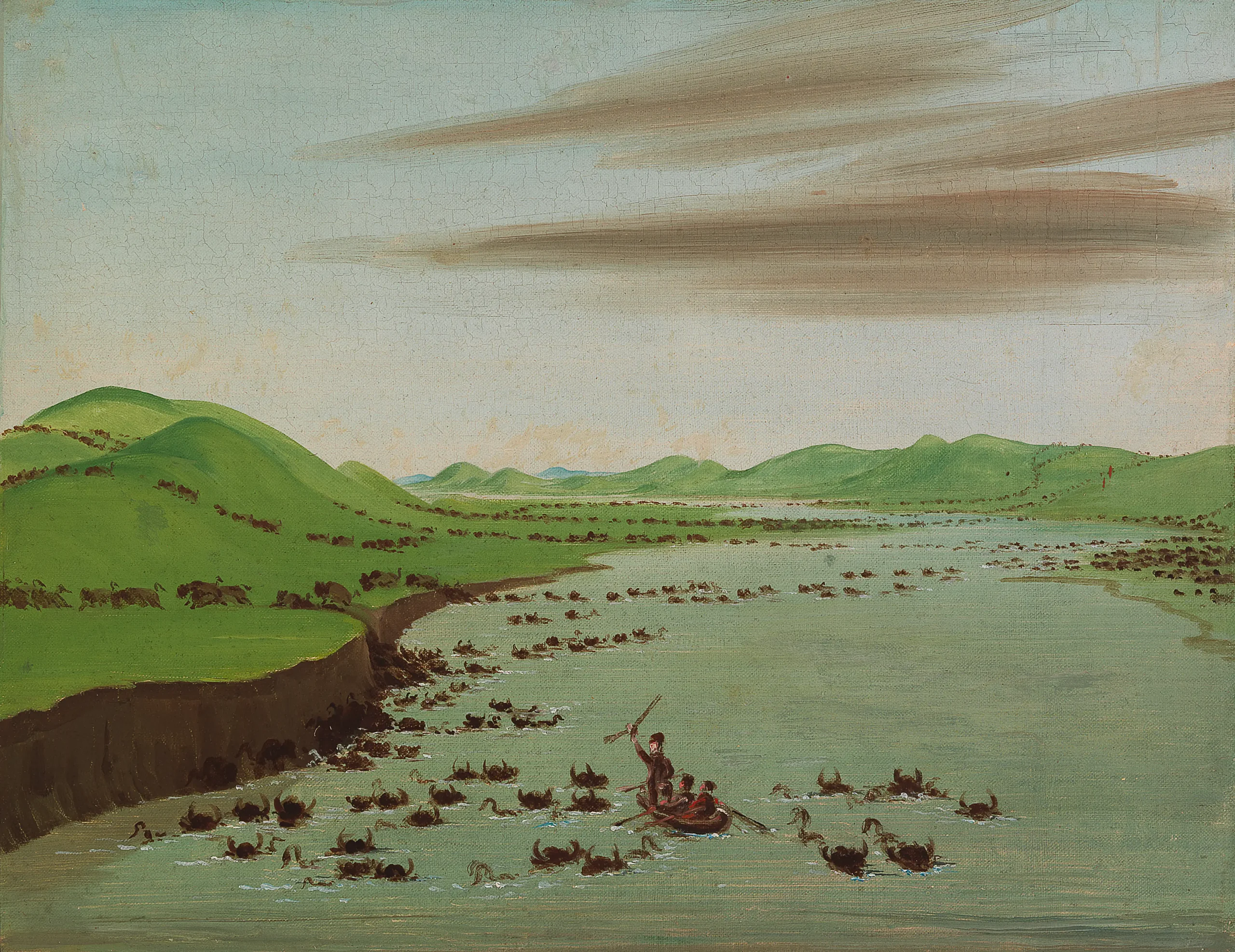
which plunged in, and in a moment were swimming about our canoe, and placing it in great danger. No attack was made upon us , and in the confusion the poor beasts knew not, perhaps, the enemy that was amongst them; but we were liable to be sunk by them, as they were furiously hooking and climbing on to each other. I rose in my canoe, and by my gestures and hallooing, kept them from coming in contact with us, until we were out of their reach .
This was one of the instances that I formerly spoke of, where thousands and tens of thousands of these animals congregate in the running season, and move about from East and West, or wherever accident or circumstances may lead them . In this grand crusade, no one can know the numbers that may have made the ford within a few days ; nor in their blinded fury in such scenes, would feeble man be much respected.
During the remainder of that day we paddled onward , and passed many of their carcasess floating on the current, or lodged on the heads of islands and sand-bars. And , in the vicinity of, and not far below the grand turmoil , we passed several that were mired in the quicksand near the shores; some were standing fast and half immersed; whilst others were nearly out of sight, and gasping for the last breath; others were standing with all legs fast, and one half of their bodies above the water, and their heads sunk under it, where they had evidently remained several days ; and flocks of ravens and crows were covering their backs, and picking the flesh from their dead bodies .
History of Early Steamboat Navigation on the Missouri River
The ordeal of inspection being over, the boat proceeded on her way with no further drawbacks than those arising from the various hindrances to navigation. One of the disagreeable features of the trip above the mouth of the Big Sioux River was the vast number of dead buffalo that were encountered. They had been drowned on the upper river at the time of the spring break-up in attempting to cross the ice after it became too weak. Their bodies had then floated downstream and had lodged all along the river on sandbars, islands, or the low shores. Some time having elapsed since they were drowned, their flesh was now in a condition that rendered the air almost insupportable.
THE BOOMING RIVER –1874 AAB
The Annual “ June Rise” of the Missouri.
And so the great river goes roaring down its winding track, full to the banks, bearing the evidence of the country and people along its course. The pure limpid snow water soon falls into bad associations and after running for weeks with the clay hills of Montana it comes out contaminated and corrupted to a turbid brawling massive mud. The hills, to be sure, were also the sufferers from the companionship, for the rivers ceaseless energy undermined them and tumbled them into the depths; but the purity of the stress is gone never to return, even soiling the character of its future consort, the clear Mississippi. So much for the corrupting effects of bad company.
Saline on its boiling surges go floating lost dugouts of Indians, dead carcasses of buffalo that dropped through the ice last winter, small logs of Cottonwood, pointed at both hands as gnawed off by the myriad beaver that line all its shores, and fragments of red and blue, and purple lava from the volcanic rocks and Scoria of the Bad Lands. And tall steamers float like swans on the surface, their flat bottoms secure from the hateful sand-bars below, now buried and forgotten.
Charles Goodnight
“Wild buffalo seem to be intelligent enough in some ways, and others they do not show the least ‘sense.’ They had a habit of going into rivers wherever they could get in, going down steep bluffs where they could easily go around in swimming against high banks, trying to get out where it was impossible when a landing was convenient and near; trampoline and drowning each other in these ways by hundreds. This did not happen in Texas where rivers are usually broad and shallow, but it often happened in the Arkansas and other rivers.” There is some question as to whether two different herds should not be called the “northern bison” in southern Buffalo.” While there is no doubt that they are the same species, there is enough difference in the two for any judge who is familiar with their peculiarities to tell them apart at once. I positively know that the southern herd, the ‘buffalo’ never went as far north as the Arkansas river, though they went as far as the Wichita mountains. I know also that the northern herd, or ‘bison’ came as far south as the Wichita mountains and then turned and drifted back. When this herd came to the Arkansas river with the order of the River frozen and a strong current in the middle, many thousands drowned, being unable to raise themselves on the ice. The Army officers who lived in this section in those days could verify the statement.
1914 South Dakota – Criminal Massacre of American Buffalo
Regularly as winter came on, these animals moved to the southern part of their range, much the same as do certain species of birds. Upon reaching their winter pasturage they scattered, and at the end of the season returned north in less conspicuous herds. They traveled much faster than one would suppose from their ungainly appearance, and rarely followed any but their own well beaten path. When free from, ice, rivers as wide as a mile were crossed without hesitation. In winter the combined weight of the herds often broke the ice, drowning many. Soft, muddy places and shallow pools were sought by these animals, .where they rolled and wallowed until they had completely covered themselves with mud which, when baked in the sun formed an effective armor against attacks of annoying insects.
Just today there was a news article from Delta Junction, saying how they were going to cut back hunting tags due to low numbers in the bison. Here is part of that story:
“Upon hiking in, we found the collar and we counted — minimally — almost 40 carcasses all the way around this pond,” Schmidt said. “So what appears to have happened, even with the collars, you know — the collar was underwater, that would make it not work, and then it washed up to shore along with all the bison that went through the ice.”
Schmidt said that there could be more bison in the water. His team estimated that up to 80 bison could have died due to drowning.
A mass drowning is rare for Delta Junction, but has happened in other parts of Alaska. Schmidt said that the drownings in those cases were primarily due to river crossings, spring flooding, and ice breaks. Schmidt suspects that in this case, the bison fell through the ice and got trapped underneath.” Delta Junction
Fires
The journal of Alexander Henry the Younger (1739-1824)“Burning” in the Red River Valley (North Dakota) made a vivid impression on Alexander Henry in 1804. He noted:
“Plains burned in every direction and blind buffalo seen every moment wandering about. The poor beasts have all the hair singed off; even the skin in many places is shriveled up and terribly burned, and their eyes are swollen and closed fast. It was really pitiful to see them staggering about, sometimes running afoul of a large stone, at other times tumbling down hill and falling into creeks not yet frozen over. In one spot we found a whole herd lying dead. The fires having passed only yesterday these animals were still good and fresh and many of them exceedingly fat …. At sunset we arrived at the Indian camp, having made an extraordinary day’s ride and seen an incredible number of dead and dying, blind, lame, singed, and roasted buffalo.”
A History of Missouri From The Earliest Hauck Pedro
1818 “In the first settlement of the country hundreds of acres of timber in some seasons were all killed at the same time by fire. These trees would fall down, rot or burn, and the prairie would soon be formed. At that time the small undergrowth was burnt out, and in many places nothing but large trees were standing. In process of time those trees would also disappear and a prairie be formed where they grew.””— Reynolds’s Pioneers of Illinois, p. 195. He also says that when the fire is kept out of the prairies they will soon grow up with trees, and predicts that “Illinois in twenty years will have more timber than there is at present.”
After a few killing frosts had completed their work, blasting the long grass of the prairies and rendering it combustible as tinder, came the prairie fires, sometimes filling the air with a filmy cloud for days, and at night fringing the horizon with pale-red tints, at length growing into forked flames, encroaching nearer and nearer until the last tuft of withered grass disappeared in the lambent blaze. If a very sharp wind arose, these fires would spread with marvelous rapidity over the landscape, darkening the sun with smoke and filling the air with ashes and flying sparks— a blizzard of flame!” Before such a storm, no living creature could stand, and, led by wonderful instinct, all animals then fled to the banks of streams for cover. Such a fire Featherstonhaugh witnessed, not in the prairie, but in the forests of southeast Missouri, and describes thus: “Night having fallen, we could see a fiery horizon through the forest in every direction, and hear the crackling of the advancing conflagration. It was a most interesting spectacle, and, notwithstanding my indisposition, I was out until a late hour observing it. We were upon an elevated table-land, covered with dry autumnal leaves, grass, and sticks, upon which stood numerous dead and dry trees, killed by previous fires. Not a quarter of a mile from the house was a narrow edging of bright, crackling fire, sometimes not more than two inches broad, but much wider when it met with large quantities of combustible matter. On it came in a waving line, consuming everything before it, and setting fire to the dead trees that, like so many burning masts, illuminated the scorched and gloomy background behind, and over which the wind — against which the fire was advancing— drove the smoke. Every now and then one of the flaming trees would come to the ground, and the noise thus produced, the constant crackling of the devouring element, the brilliancy of the conflagration, and the great extent of the spectacle formed a picture that neither description nor painting could do justice to. The wild turn our minds had caught from the scenes we were daily passing through was singularly increased by this adventure, and amidst many exclamations of admiration we retired late in the night to the house. I measured the progress of the fire, and found that it advanced at the rate of about a foot a minute, leaving everything incinerated behind it, and casting a beautiful, warm light into the forest in front where we stood.
To “fight the fire’ means to beat this edging of flame out with sticks, which it is not difficult to do when it first begins; but when it has extended itself several hundred yards, it is generally beyond the power of a very few individuals to accomplish. Upon this occasion, the line of fire in front of the buildings was extinguished, but not without great exertions.”
Oregon Trail 1850 (between Council Bluffs Iowa and Ft Laramie, Wyoming) ”There had been a slope of the prairie burned and it had killed hundreds of buffaloes. We saw as many as three hundred lying together with the hair all burned off them while many were roaming around deprived of their eyesight by the fire. Many were shot to put them out of their misery.”
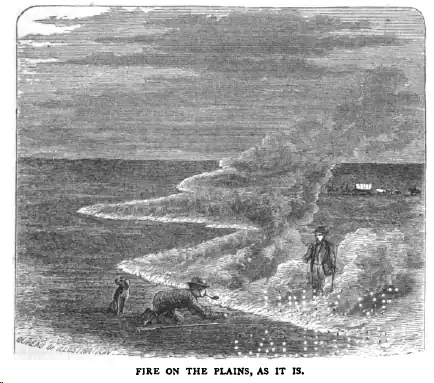
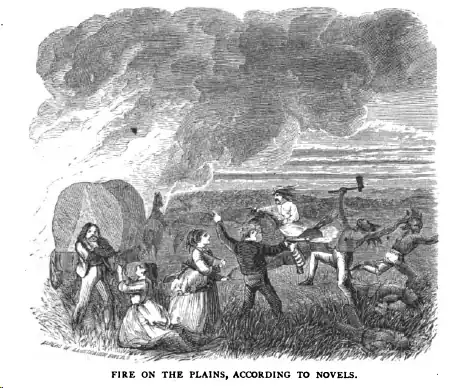
Buffalo Land 1869-1873
At the most critical juncture the “waving sea of grass” usually takes fire, in an unaccountable manner – perhaps from the hot condition of the combatants, or the quantities of burning love and revenge which are recklessly scattered about. Multitudes of frightened buffalo and gay gazelles make the ground shake in getting out of the way, and the flames go to licking the clouds, while emigrants go to licking the Indians. Although the fire can not be put out, one or the other, or possibly both, of the combatants are ” put out ” in short order.
The grass which covers the great plains of the Far West is more like brown moss that what its name implies. perhaps as good an idea of it as is possible to any one who has never seen it, may be obtained by imagining a great buffalo robe covering the ground. The hair would be about the color and nearly the length of the grass, at the season in question. In the spring the plains are fresh and green, but the grass cures rapidly on the stalk , and before the end of July is brown and ripe. It will then burn readily, but the fire is like that eating along a carpet, and by no means terrifying to either man or brute. The only occasion when it could possibly prove dangerous is when it reaches, as it sometimes does, some of the narrow valleys where the tall grass of the bottom grows; but even then , a run of a hundred yards will take one to buffalo grass and safety. This latter fact we learned from actual experience, later on our trip.
George Catlin 1844 – I was lucky enough the other day, with one of the officers of the garrison, to gain the enviable distinction of having brought in together seventy- five of these fine birds, which we killed in one afternoon ; and although I am quite ashamed to confess the manner in which we killed the greater part of them, I am not so professed a sportsman as to induce me to conceal the fact. We had a fine pointer, and had legitimately followed the sportsman’s style for a part of the afternoon ; but seeing the prairies on fire several miles ahead of us, and the wind driving the fire gradually towards us, we found these poor birds driven before its long line, which seemed to extend from horizon to horizon , and they were flying in swarms or flocks that would at times almost fill the air.
The prairies burning form some of the most beautiful scenes that are to be witnessed in this country, and also some of the most sublime. Every acre of these vast prairies (being covered for hundreds and hundreds of miles, with a crop of grass, which dies and dries in the fall) burns over during the fall or early in the spring, leaving the ground of a black and doleful colour. There are many modes by which the fire is communicated to them, both 17 by white men and by Indians-par accident ; and yet many more where it is voluntarily done for the purpose of getting a fresh crop of grass, for the grazing of their horses, and also for easier travelling during the next summer, when there will be no old grass to lie upon the prairies, entangling the feet of man and horse, as they are passing over them.
Over the elevated lands and prairie bluffs, where the grass is thin and short, the fire slowly creeps with a feeble flame, which one can easily step over where the wild animals often rest in their lairs until the flames almost burn their noses, when they will reluctantly rise, and leap over it, and trot off amongst the cinders , where the fire has past and left the ground as black as jet. These scenes at night become indescribably beautiful, when their flames are seen at many miles distance, creeping over the sides and tops of the bluffs, appearing to be sparkling and brilliant chains of liquid fire (the hills being lost to the view) , hanging suspended in graceful festoons from the skies.
But there is yet another character of burning prairies, that requires another Letter, and a different pen to describe-the war, or hell of fires ! where the grass is seven or eight feet high, as is often the case for many miles together, on the Missouri bottoms ; and the flames are driven forward by the hurricanes, which often sweep over the vast prairies of this denuded country. There are many of these meadows on the Missouri, the Platte, and the Arkansas, of many miles in breadth, which are perfectly level, with a waving grass, so high, that we are obliged to stand erect in our stirrups, in order to look over its waving tops, as we are riding through it . The fire in these, before such a wind, travels at an immense and frightful rate, and often destroys, on their fleetest horses, parties of Indians, who are so unlucky as to be overtaken by it ; not that it travels as fast as a horse at full speed, but that the high grass is filled with wild pea-vines and other impediments, which render it necessary for the rider to guide his horse in the zig-zag paths of the deers and buffaloes, retarding his progress, until he is overtaken by the dense column of smoke that is swept before the fire– alarming the horse, which stops and stands terrified and immutable, till the burning grass which is wafted in the wind, falls about him, kindling up in a moment a thousand new fires, which are instantly wrapped in the swelling flood of smoke that is moving on like a black thunder- cloud , rolling on the earth, with its lightning’s glare, and its thunder rumbling as it goes. When Bartiste, and Bogard, and I, and Patrick Raymond (who like Bogard had been a free trapper in the Rocky Mountains), and Pah- me-o-ne-qua (the red thunder) , our guide back from a neighbouring village, were jogging along on the summit of an elevated bluff, overlooking an immense valley of high grass , through which we were about to lay our course. “Well, then, you say you have seen the prairies on fire ?” Yes. “You have seen the fire on the mountains, and beheld it feebly creeping over the grassy hills of the North, where the toad and the timid snail were pacing from its approach—all this you have seen, and who has not ? But who has seen the vivid lightnings, and heard the roaring thunder of the rolling conflagration which sweeps over the deep- clad prairies of the West ? Who has dashed, on his wild horse, through an ocean of grass, with the raging tempest at his back, rolling over the land its swelling waves of liquid fire ?” What ! ” Aye, even so . Ask the red savage of the wilds what is awful and sublime -Ask him where the Great Spirit has mixed up all the elements of death, and if he does not blow them over the land in a storm of fire ? Ask him what foe he has met, that regarded not his frightening yells , or his sinewy bow ? Ask these lords of the land, who vauntingly challenge the thunder and lightning of Heaven-whether there is not one foe that travels over their land, too swift for their feet, and too mighty for their strength-at whose approach their stout hearts sicken, and their strong- armed courage withers to nothing? Ask him again (if he is sullen, and his eyes set in their sockets) -Hush !- sh ! – -sh ! ‘ -(he will tell you , with a soul too proud to confess his head sunk on his breast, and his hand over his mouth)— ‘ that’s medicine!’
Answer to Memorandum of Topics from the Governement of the U.S. 1847
Has the old practice of the Indians, of burning ,the prairies to facilitate hunting, had the effect to injure the surface of the soil; or to circumscribe, to any extent, the native forests? The practice of firing the prairies is generally condemned by the Indians; and many of them will not do it. They the fires destroyed a large amount of game. The fire does much injury to the soil, and destroys large quantities of timber, particularly pine.
Tornadoes
Hurricanes are essentially massive, spinning formations of multiple thunderstorms, while tornadoes are formed from a wind vortex from the hot, high-pressure wind of a single thunderstorm over land. Tornadoes can form from the thunderstorms that make up a hurricane, but they more commonly form from single thunderstorms.
1729 We have an Account from Bexhil in Suffix, that on Tuesday the 20th Instant a terrible o surprising Storm of Thunder and Lightning, accompanied with a whirlwind, arose from the Sea, and blew down Part of a Barn and Part of a House call’d Ruckholt, and also a House and Barn at Sidney-Green, a Barn and Part of a House of Sir Thomas Webster’s; destroy’d part of a wood belonging to Sir Thomas; from thence it went to Selscomb and blew down several Houses, Out-Houses, Barns and Gardenwalls; seven Barns and two Houses at Ewhurst, several Barns at Semsted belong to J. Ladd, Esq; and above 100 of the finest trees in his woods call’d Church-wood ; from whence the Whirlwind went over the Marsh, and blew down several Capsons and Gates, and carried them a- way, and did abundance of Damage in ocher Places..
1750 Maryland Gazette, Annapolis, Maryland •
The champion buffalo hunter: the frontier memoirs of Yellowstone Vic Smith by Smith, Victor Grant, 1850-1925
“Years before a storm had blown down the trees, and they were criss-cornered in all directions, and the lodgepoles had grown up since the hurricane.”
“We covered ourselves with the hide, and at no time during the day was the sun visible; when no longer finding our shelter tenable we faced the storm. It took us four hours to go two miles, crawling over the hills on our hands and knees, the wind being so strong we could not stand up on a raise. Death stared us in the face and it was then we promised reform—to ever abstain from the bottle and hunting buffalo in winter. At last we reached camp. Near the tent we stumbled over one of Edgar’s mules frozen stiff”
Coronado Trail, thus describes the great plains of Kansas and Colorado, the bison, and a tornado :
Three days after we entered the wilderness we found a horn on the bank of a river that flows in the bottom of a very steep, deep gully, which the general had noticed and left there for his army to see, for it was six feet long and as thick at the base as a man’s thigh. It seemed to be more like the horn of a goat than of any other animal. It was something worth seeing. The army proceeded and was about a day’s march from Cibola when a very cold tornado came up in the afternoon, followed by a great fall of snow, which was a bad combination for the carriers. The army went on till it reached some caves in a rocky ridge, late in the evening. The Indian allies, who were from New Spain, and for the most part from warm countries, were in great danger. They felt the coldness of that day so much that it was hard work the next day taking care of them, for they suffered much pain and had to be carried on the horses, the soldiers walking. After this labor the army reached Cibola, where their general was waiting for them, with their quarters all ready, and here they were reunited, except some captains and men who had gone off to discover other provinces.
Beaver trapper Yellowstone Kelly wrote an interesting account, circa 1867: Early in the spring of 1867 the company was ordered to establish a station at the forks of the Cheyenne River near Bear’s Den Hill toward the northern boundary of Dakota Territory. The Cheyenne enters the
Red River near the site of old Fort Assiniboin
“Our course led over rolling prairie, when we crossed a high and level plain which extended for many miles. The plain was covered with a thin coating of ice and on all sides, as far as the eye could reach was dotted with bodies of dead buffaloes. These animals were in good condition and bore no mark of bullet or arrow wounds. The cause of their death was a mystery to us.
“As we marched over the plain toward the valley of the Cheyenne, the appearance of so many carcasses scattered around made a strong impression on my mind, perhaps because they were the first buffaloes I had ever seen.”
1883- Harper’s Weekly
April 22 – Tornadoes in the Western and Southern States, destroying nearly three hundred lives and much property.
May 18 – Much damage to life and property by tornadoes in Texas, Illinois, and Wisconsin.
May 28. – Twenty persons killed by tornadoes in Indiana
The Border and the Buffalo 1874 New Mexico
It was a slow, tedious transit. We had to pass through a timber-fall for nearly two miles, where there had been a tornado and the trees had uprooted, and in many places piled one on top of another, crossed and interlocked in such a formidable barricade that we could not pass through; in which case we would zigzag back and work our way around. We met several such obstacles that day, and went only five miles from early morning till late in the evening
Natives Story of Tornadoes
There is the account of Iseeo, a Kiowa informant to the anthropologist James Mooney. The Kiowa called tornadoes Mánkayía. Mánkayía was a great medicine horse, or a horse-like spirit.
Here is an excerpt from Iseeo’s account. Iseeo was a member of a war party returning from a raid against the Utes, when they encountered a tornado near the Washita River in Oklahoma.
Suddenly, the leader of the party shouted for the men to dismount and prepare for a hard rain. Soon, too, with the approaching cloud, lseeo recalled hearing a -roar that sounded like buffalo in the rutting season. Sloping down from the cloud a sleeve appeared, its center red; from this lightning shot out. The tremendous funnel tore through the timber bordering the Washita. heaving trees into the air.
Some of the young men wanted to run away, but the older, more experienced Kiowas knew what must be done. They called for everyone to try hard and brace themselves. The elders drew their pipes from saddlebags and lit them. They raised their pipes to the storm spirit, entreating it to smoke, and to go around them. The cloud heard their prayers, lseeo explained, and passed by.
This group, at least, tried to make peace with Mánkayía so that they could escape unharmed. You can read more of the account (last page, PDF) here, and the whole article is certainly interesting.
The source is Mankaya and the Kiowa Indians: Survival, Myth and the Tornado. By Michael Marchand. pg. 19 Heritage of the Great Plains, VOL. XXVI, #2 SUMMER 1993 Emporia State University.
Hurricanes
-A Land So Strange
1527 Unbeknownst to the expeditioners, somewhere in the Caribbean Sea or the Gulf of Mexico, billowing clouds and localized thunderstorms began to clash and combine with each other, and this mass of clouds, rain, and wind started to rotate around a low pressure center due to the earth’s spinning motion. In the course of two or three weeks the wind must have picked up steadily, until the system developed into a tropical storm and finally a hurricane. And it drifted toward Cuba Then the hurricane hit.
The great majority of the Florida expeditioners had never experienced such a towering, rotating giant, shuffling erratically from place to place and smothering everything in its path. Because hurricanes require tropical heat and high humidity to form, they do not occur anywhere in the Mediterranean or the northeastern Atlantic. Columbus was the first to report one during his second voyage. European residents of Española and Cuba had some encounters with them in the early decades, adopting the Taíno word for them, hurakan, meaning “big wind.”
Cabeza de Vaca could not hide his astonishment: At this time the sea and the storm began to swell so much that there was no less tempest in the town than at sea, because all the houses and churches blew down, and it was necessary for us to band together in groups of seven or eight men, our arms locked with one another, in order to save ourselves from being carried away by the wind. We were as fearful of being killed by walking under the trees as among the houses, since the storm was so great that even the trees, like the houses, fell. In this great storm and continual danger we walked all night without finding an area or place where we could be safe for even half an hour.
Throughout the night, the natives of Trinidad chanted and played bells and flutes and tambourines to appease Guabancex, the female spirit that “moves the wind and water and tears down the houses and uproots the trees.” Interestingly, Spaniards, not unlike the natives, understood hurricanes as manifestations of the Devil. In the wake of
two devastating hurricanes in 1508 and 1509, Española residents set out to protect themselves by building stone churches endowed with large crosses. As one early chronicler explains, “devout Christians affirm, and experience has shown, that after the Most Holy Sacrament has been placed on the churches and monasteries of this city [Santo Domingo] and other towns of this island, the hurricanes have ceased.
The following day, on Monday, Cabeza de Vaca and about thirty survivors of the expedition who had remained in Trinidad went to the shore to find out what had happened to the ships. There were only a few traces of them at the anchorage: some buoys but nothing more. Search parties moving along the coast found a rowboat atop a tree close to 1 mile away. At a distance of more than 25 miles, they recovered two bodies so bludgeoned that they were impossible to identify. They also found a cape and some blanket rags. All in all, that day the Florida expedition lost two ships, twenty horses, and sixty men to the strange ways of the New World. The God-fearing survivors could only interpret this violent storm as a divine warning, an unmistakable omen.
California History 1542 California Vulcher
They are seen in greatest numbers, and soar highest before hurricanes and thunder-storms. Their quills are used by the hunters as tubes for tobacco -pipes.”
Hail Storms
Duden says, in 1824, the woods were filled with wild bees, bluebirds, redbirds, humming-birds, mocking-birds, whippoorwills, partridges, doves; and that after a hail-storm at St. Charles over 300 wild ducks were picked up in an over flowed meadow (Duden’s Bericht, etc., p. 147); that “the woods were full of life, of gobbling turkeys and woodcocks.” Ibid
Prairies filled with buffalo, deer, and other kinds of game. An Account of Louisiana, 1819
Col. Dodge
The atmospheric phenomena of the plains are on the most magnificent scale. Thunderstorms are rare on the high plains, but when they do occur they excel in all the elements of grandeur and sublimity. Nowhere is the lightning-flash a more vivid and blinding glare. Nowhere is the crash of the thunder more stunning, nor its roll more deep and prolonged. Nowhere does a man feel more intensely the nearness and power of the Creator. For at least six months, from November to April, of every twelve, ‘ the wind is never weary on the high plains,’ and wind-storms may occur at any season. The storms of each locality generally come from one particular direction, and, at whatsoever season occurring, are often perfect tornadoes, overturning and destroying everything movable. Scarcely a military post on the plains but suffers yearly from these storms in torn roofs and wrecked houses. In May and June these storms are not unfrequently accompanied by hail. For fury, destructiveness, and size of the stones, the hailstorms of the country about Fort Lyon far excel any it has ever been my misfortune to encounter. Two occurred in the summer of 1870, which did immense damage, splitting the shingles of the roofs, breaking palings or fences, killing wild birds, domestic fowls, and all young or small animals exposed to them. It was estimated that at least a hundred calves were killed by these two storms. . Many of the hailstones were three some four, five, and even six inches in circumference and in many cases they were not rounded stones, but irregular shapeless masses of ice.
Thunder Storms
Twenty Years In The Rocky Mountains by Dr Allen
“I prepared and ate a lunch, then followed the canyon about five miles up the main range, whence, with a good pair of glasses I could see a large part of Wyoming and Idaho. Suddenly a sharp peal of thunder warned me that a storm was brewing. The heavens above were as clear as a bell, but far in the distance dark clouds were rising, while the lightning was shooting its forked shafts in every direction.
The clouds came rolling along the sides of the mountains, apparently swallowing up everything in their path, a violent gust of wind sweeping wildly before them. No need now to wonder where the storm was coming from, nor where it would spend its fury. Trees were torn up by the roots and hurled into the canyon below, and game fled in all directions to places of safety.
Protected from the storm by a huge rock, I looked calmly upon the scene of destruction. A band of sheep, leaping from rock to rock, came directly toward me and I shot at one but the gale befriended it. The mountains appeared to be on fire, so vivid and continuous was the lightning. I would that I could portray the grandeur of the spectacle, which will ever remain stamped upon my memory. The storm having spent itself, I picketed my horse and lay down to rest, for it would have been impossible to have found my way to camp through the darkness, and the greater part of the night was passed in watching the lightning playing through the heavens.”
MAXIMILIAN , PRINCE OF WIED’S
18th There is no other species of bear on the Upper Missouri, for the black bear is not found so high up. At the place where we had killed the bear, it would have been easy to shoot many of these animals, by posting ourselves near the dead buffalo cow : the whole sand bank was covered with the prints of bears’ footsteps, and trodden down like a threshing- floor; but our time was too short and too precious: we, therefore, proceeded on our voyage till a violent thunder – storm threatened us, and we lay to, by the high bank of the prairie , where our bear was skinned . During the night, torrents of rain fell, which wetted our books and plants in the cabin.
The History of Hernando De Soto -Florida 1540s
These words arrested them a little; and the next day at noon there arose, as they were marching, a storm, accompanied with wind, thunder, and hail, so destructive that, had they not met with some large trees, they would have all perished, for the hail was very large . (they continued their march, and the third day arrived at a small village which was called Chalaques, thought to have been just southwest of Charlotte)
F Parkman-Oregon_Trail 1846
We ourselves had our share of the deluge. We were leading a pair of mules to Kansas when the storm broke. Such sharp and incessant flashes of lightning, such stunning and continuous thunder, I have never known before. The woods were completely obscured by the diagonal sheets of rain that fell with a heavy roar, and rose in spray from the ground; and the streams rose so rapidly that we could hardly ford them. At length, looming through the rain, we saw the log-house of Colonel Chick, who received us with his usual bland hospitality; while his wife, who, though a little soured and stiffened by too frequent attendance on camp-meetings, was not behind him in hospitable feeling, supplied us with the means of repairing our drenched and bedraggled condition. The storm, clearing away at about sunset, opened a noble prospect from the porch of the colonel’s house, which stands upon a high hill. The sun streamed from the breaking clouds upon the swift and angry Missouri, and on the immense expanse of luxuriant forest that stretched from its banks back to the distant bluffs.
Lightning
1867 Crossing the plains on the New America.
A flash comes through the still and silent air, like a gun-shot, suddenly, with a sharp surprise. It is followed by a wail of wind and rain, which lifts the sand from the ground into the air, and drives it into the canvas flaps of our mountain wagon, splashing us with mud and mire. No care can keep the deluge out; and in a few minutes we are drenched and smothered. Four or five hours that storm of sand and rain drives heavily against us. Two or three times the mules stand still in fear; turn their backs to the heavenly fire, refusing to go forward under any encouragement of either voice or whip. Were they not fastened to the coach, they would fly before the tempest; bolting for their lives until the hurricane should have drooped and died . Being chained to the wagon, they can only stand and moan. When the storm is spent, the stars come peeping out; the air is chill and sweet ; and we drag our way along the wet and smoking plain.
Snow, Freezing Temps
Robert De La Salle 1667
There were twenty-three Frenchmen in the party, eighteen savages, ten Indian women, and three children. The redskins insisted on taking these women with them to prepare their food, according to their custom, while they were fishing and hunting. When all was ready the adventurers started for the mouth of the Chicago River, which was found to be frozen. Undaunted, the explorers passed down the watercourse on sleds, down the Illinois to Lake Peoria, and thence to the muddy waters of the Mississippi. They had a peaceful passage southward, hunting much and fishing in the stream, and eventually arrived at the (pg 397) Chickasaw Bluffs. Here redskins were met with, who gave them kind treatment, and, pushing on, the little party soon arrived at a mighty village of the Arkansas Indians.
The History of Indian Tribes 1675
Winslow’s army, who had expected to take up their quarters there, were deprived of all shelter. They had no tents, and were, consequently, obliged to pass a very uncomfortable night in the open air. It was late in December, and bitter cold, with snow on the ground. On the next day (19th) Winslow put his army in motion at an early hour, as they had sixteen miles to march, through deep snow.
But the English were themselves driven out by the flames, and were compelled to retrace their way through a severe snow storm, carrying with them many of their dead and wounded. The intensity of the cold, added to the pangs of hunger, occasioned the death of many of the latter, whom ordinary care might have saved. They reached the desolate site of Pettiquamscott after midnight, and, the following day, thirty-four of their number were buried at that place, in one grave. Many were severely frost-bitten, and 400 were so much disabled as to be unfit for duty. Had the Indians rallied and attacked them at Pettiquamscott, not over 400 of the army could have handled a gun or a sword. Two hundred of the English were killed in the storming of the fort, including eight captains and several subalterns.
The Indians who escaped took shelter in a swamp, near by, where they passed the night in the snow, and where many of their number died from exposure, and the want of both fire and food.
Alexander Henry Travels 1760- 1776
At noon we discovered, and presently passed by, a diminutive wood, or island. At four in the afternoon another was in sight. When I could see none I was alive to the danger to be feared from a storm of wind, which would have driven the snow upon us. The Indians related that whole families often perish in this manner. (Feb- Banks of the Pasquayah or Sascatchiwaine)
At two o’clock we reached a small lake surrounded with wood, and where the trees were of a size somewhat larger than those behind. There were birch trees among the rest. I observed that wherever there was water there was wood. All the snow upon the lake was trodden down by the feet of wild oxen. When this was the case on the land an abundance of coarse grass discovered itself beneath. We were unable to penetrate to the water in the lake, though we cut a hole in the ice to the depth of three feet. Where we cleared the ground for our encampments no stones were to be seen.
This evening we had scarcely encamped when there arrived two Osinipoilles, sent by the great chief of the nation, whose name was the Great Road, to meet the troop. The chief had been induced to send them through his anxiety, occasioned by their longer absence than had been expected. The messengers expressed themselves much pleased at finding strangers with their friends, and told us that we were within one day’s march of their village, and that the great chief would be highly gratified in learning the long journey which we had performed to visit him. They added that in consequence of finding us they must themselves return immediately, to apprise him of our coming and enable him to prepare for our reception.
Fortunately they had not been able to take any refreshment before a storm of wind and snow commenced which prevented their departure, and in which they must have been lost, had it happened later. The storm continued all the night and part of the next day. Clouds of snow, raised by the wind, fell on the encampment and almost buried it. I had no resource but in my buffalo robe.
In the morning we were alarmed by the approach of a herd of oxen, who came from the open ground to shelter themselves in the wood. Their numbers were so great that we dreaded lest they should fairly trample down the camp; nor could it have happened otherwise but for the dogs, almost as numerous as they, who were able to keep them in check. killed several when close upon their tents; but neither the fire of the Indians nor the noise of the dogs could soon drive them away. Whatever were the terrors which filled the wood, they had no other escape from the terrors of the storm.
In 1772, when Samuel Hearne became the first European to travel into the subarctic region southeast of Great Slave Lake, probably 150,000 or more wood buffalo inhabited the boreal forest to the south and west.
The relative isolation of the district and the small number of interlopers discouraged radical change there. How, then, is one to account for the near extinction of the wood buffalo?
During severe winters of deep snow, exacerbated by cyclical thawing and freezing, many buffalo starved to death. Extant records make it clear that there were many such winters in the subarctic, particularly after 1860. The reduced mobility of the heavy animals in such conditions also made them liable to increased predatory attack, especially by vii wolves. On the human side, the heavy provisioning requirements of the fur trade posts, the subsistence demands of the local natives, and the less significant depredations of sport hunters all took a toll. The extent of human destruction is yet to be determined, but preliminary investigation has revealed that no more than 100 buffalo were killed for the posts per year. Such a figure seems small, almost inconsequential, but clearly in desperate years it could dramatically upset the population dynamics of the herds.
Hamiltons Report 1779
On the 9th a snowstorm having subsided, it was debated whether or not we should hazard the passage of the Lake, from the Mouth of Detroit river, to that of the Miamis, but considering the advanced Season, and that contrary winds or the freezing of the Lake would frustrate our design, I determined to make the Push. The traverse is of 36 miles and it was noon before the swell on the Lake was fallen sufficiently.
Audubon and His Journals
I left Henderson in the month of December, 1810, in a heavy snow-storm. This change in my plans prevented me from going, as I had intended, on a long expedition.
Notes:
Colonel Dodge reported that thousands of bison starved on the Laramie Plains, Wyoming during an extraordinary winter with deep and crusted snow in 1844-45
(Allen 1877:544). The Plains were never repopulated.
Allen (1877:512) noted reports that nearly all the bison in the Salt Lake area, Utah, were destroyed by unusually deep snow about 1837.
In 1840, Russell (Haines 1965:121) noted that bison had “long since” been gone from this area. Williams (2005) used local weather records to conclude that abundant, dense snow, combined with a greater frequency of droughts, had contributed to limiting bison distribution and abundance in the northwest United States during late pre-historic and early historic times. These weather effects were most notable west of the Rocky Mountains in eastern Washington and Oregon.
Early Western Travels 1832-1834
In consequence of the frequent and sudden changes of the temperature, catarrh(sinus backup) is very common among the half naked Indians; agues (illness-fever,shivering) are quite unknown here. The winter is usually accompanied with much rain , snow, stormy, and tempestuous weather. At times there have even been snow storms late in May, from which Indians have perished in the prairie. In April, last year, a father and son were there frozen to death.
Great inundations are rare; since Charbonneau came to this country, which was about thirty-seven years since, there have been only two, which, however, were very severe. Earthquakes, which are frequent on the Mississippi, have not been noticed here; a circumstance confirmed by Volney. March and April are called by the Indians the horses’ winter, because when the weather is warm, the horses are often driven to pasture in the prairie, and then violent storms of snow sometimes occur suddenly, and destroy many of these animals.
On the 17th October the weather was fine, serene, and warm, and on the 18th such a sharp frost, with a storm of snow, that two Indians were frozen to death in the prairie. (1833)
The winter is long, and generally severe ; most animals then migrate, and, therefore, the winter Fauna has but a few species whereof to boast. We were told that, about new year, there is usually a very cold interval of about a week, which was the case during our visit; and the Indians have, on this account , called one of their months “ the moon of the seven cold days.” The winter of 1833-34 is considered as one of the most severe. The mercury in the thermometer was frozen for several days, and, at Fort Union, the cold is said to have been 47 °, Fahrenheit, below zero. The snow is seldom more than two feet deep, but it remains a long time, often unchanged till the month of March – a proof of the dryness of the climate. In the dreadful storms of snow which perfectly darken the air, the compass is an important and necessary instrument; in fact, it is, at all times, indispensable in these prairies. The winter of 1832 was extremely mild; there was scarcely any snow , and the inhabitants did not remember to have had such a season for many years. The Missouri generally freezes in November. Last year (1832 ), on the 24th November, and likewise in the winter of this year (1833) , it froze on the 23rd November, but only in some places, at which the ice was passable two days after.
This probably means 47° below freezing point; for if it were to be under stood as 47° below o , of Fahrenheit, it would be 79° below freezing point.
H. EVANS LLOYD Comment by Ed. A curious misconception on the part of Lloyd, the English translator, who could not believe this account of the intense cold on the western prairies of the United States. Maximillion undoubtedly intended just what he says – a temperature record not unknown in recent winters.
The freezing of the Missouri in this part of the country, which continues uninterruptedly through out the winter, is not to be compared with that of other large rivers; for instance , the Mississippi — for the Upper Missouri has at this season much less depth and rapidity, so that it freezes the more easily. Mr. Kipp recollected, in in the eleven years of his residence here, the greatest degree of cold to have been 36 ° below zero. The east and north winds are generally accompanied , at Fort Clarke, with snow and rain: the north and north -west winds are cold. In spring and autumn there are violent storms, and but few days are without wind, which, in fact, is pretty nearly the case in all seasons of the year. In cold winters the sun often has a parhelion- on either side . In the spring and autumn, there are often splendid northern lights, while in winter they are very rare , and are most frequently seen in autumn at about ten o’clock in the evening.
THE BISON When It Disappeared from Illinois.-1833, in the course of an interview with the old chief, the latter informed him that 70 years previous to that time that is, in 1763 there was the severest snowstorm and the heaviest fall of snow that had ever been known East of the Mississippi River; that, throughout the region now known as the state of Illinois, the snow was from 12 to 15 feet deep; and that, among other disastrous effects of that visitation in this region, was the total destruction of the bison, which, although up to that time as plentiful here as were the trees of the forest, perished by wholesale by being overwhelmed in the snow, or by starvation.
Capt. Hugunin, in confirmation of the correctness of Billy Caldwell’s statement, also informed the writer that, in the autumn of 1840, while on a stage trip from Chicago to Galena, his attention was arrested by seeing, here and there, throughout the prairies, which had but recently burned over, great fields or yards of bleached bones: and that, on inquiry of Mark Beaubien, the old half-breed keeper of a tavern in this vicinity, and of other pioneer settlers and Indians, he was assured that the bones were those of the “buffaloes;” that these bone-yards, some of which were 10 acres in extent, were the Golgoths of the bison, which, gathered in vast groups during a great snowstorm many years previous, were literally imprisoned in the deep snow, and there died in multitudes
Taking together the tradition of Billy Caldwell, and those bone-yard evidences throughout the Kankakee, Illinois, Fox, and Rock River Valleys, Capt. Hugunin, who is himself an amateur zoologist and ornithologist of no mean order, came to the conclusion that it is only a little over a century ago since the bison were as plentiful between the Mississippi River and Lake Michigan as they had been in our day between the Missouri River and the Rocky Mountains; that the American buffalo on this side of the Mississippi River was completely destroyed by tremendous snowstorm in the winter of 1763 and that in 1840 the osseous remains of the animals were still to be found throughout northern Illinois. Possibly a careful survey might find some of these remains in the same localities even at this day.
Labrador Journals
They are the only dogs which at all equal the Caribou in speed. As soon as winter’s storms and thick ice close the harbors and the spaces between the mainland and the islands, the Caribous are seen moving in great gangs, first to the islands, where, the snow being more likely to be drifted, the animal finds places where the snow has blown away, and he can more easily reach the moss, which at this season is its only food. As the season increases in severity, the Caribous follow a due northwestern direction, and gradually reach a comparatively milder climate; but nevertheless, on their return in March and April, which return is as regular as the migration of birds, they are so poor and emaciated that the white man himself takes pity on them, and does not kill them.
“The weather has been bad ever since we left Baltimore. There we encountered a snow-storm that accompanied us all the way to this very spot, and at this moment the country is whitened with this precious, semi-congealed, heavenly dew. As to ice ! – I wish it were all in your ice house when summer does come, should summer show her bright features in the year of our Lord 1843. We first encountered ice at Wheeling, and it has floated down the Ohio all around us, as well as up the Mississippi to pleasant St. Louis. And such a steamer as we have come in from Louisville here! — the very filthiest of all filthy old rat-traps I ever travelled in ; and the fare worse, certainly much worse, and so scanty withal that our worthy commander could not have given us another meal had we been detained a night longer. I wrote a famous long letter to my Lucy on the subject, and as I know you will hear it, will not repeat the account of our situation on board the ‘Gallant’ — a pretty name, too, but alas! her name, like mine, is only a shadow, for as she struck a sawyer, one night we all ran like mad to make ready to leap overboard but as God would have it, our lives and the ‘Gallant,’ were spared — she from sinking, and we from swimming amid rolling and crashing hard ice. The ladies screamed, the babies squalled, the dogs yelled, the steam roared, the captain (who, by the way, is a very gallant man) swore — not like an angel, but like the very devil — and all was confusion and uproar, just as if Miller’s prophecy had actually been nigh. Luckily, we had had our supper, as the thing was called on board the ‘ Gallant,’ and every man appeared to feel resolute, if not resolved to die.
In the winter of 1844-1845, in that portion of country now known as Laramie Plains. That whole section was visited by a most extraordinary snow-storm. Contrary to all precedent, there was no wind, and the snow covered the surface evenly to the depth of nearly four feet. Immediately after the storm a bright sun softened the surface, which at night froze into a crust so firm that it was weeks before any heavy animal could make headway through it.
The Laramie Plains, being entirely surrounded by mountains, had always been a favourite wintering place for buffalo. Thousands were caught in this storm and perished miserably. Since that time not a single buffalo has ever visited the Laramie Plains.
When I first crossed these plains in 1868, the whole country was dotted with skulls of buffalo, and all apparently of the same age, giving some foundation for the tradition. Indeed, it was in answer to my request for explanation of the numbers, appearance, and identity of age of these skulls, that the tradition was related to me by an old hunter, who, however, could not himself vouch for the facts.
Col. Dodge
Yellowstone Kelly
Early in the spring of 1867 the company was ordered to establish a station at the forks of the Cheyenne River near Bear’s Den Hill toward the northern boundary of Dakota Territory. The Cheyenne enters the Red River near the site of old Fort Assiniboin. Our course led over a rolling prairie. Nothing of interest occurred until the second or third day, when we crossed a high and level plain which extended for many miles. This plain was covered with a thin coating of ice, and on all sides as far as the eye could reach was dotted with the bodies of dead buffaloes. These animals were in good condition and bore no mark of bullet or arrow wounds. ‘The cause of their death was a mystery to us. As we marched over the plain toward the valley of the Cheyenne the appearance of so many carcasses scattered around made a strong impression on my mind, perhaps because they were the first buffaloes I had ever seen.
In the winter of 1865-6 a considerable command was caught on the Cimarron, and barely escaped total destruction. An officer who was with it describes the sufferings as most fearful. Many men were more or less frosted, and about 600 animals frozen or starved to death. Col. Dodge.
Abt. 1865 – Some thirty years ago a sudden and exceptional thaw in midwinter, followed by a severe storm and bitter cold, that covered the snow with ice which the bison could not break, caused the death of a very great many from starvation and freezing. – Again, three years ago (1892), another thaw and storm gave the Indians an opportunity
for that diabolical diversion of crusting, by which method some men reared in the civilized world hunt deer and moose to
te this day, and about fifty bison were then run down and killed. – 1895 Casper Whitney
Hunting Grounds- Col Dodge
Then comes a storm; the icy wind cuts like a knife, no clothing seems to keep it from the person, and penetrating to every part it drags out every particle of vital heat, leaving but a stiffened corpse of him
who is so unfortunate as to be exposed to it.
An exposure to the full force and fury of a violent plains Norther’ would be certain death to any indigenous animal. Buffalo and antelope fly before it, and seek protection in the deepest and most wooded cafions. Near Julesburg, I once saw the snow dotted with the bodies of a great number of snow-birds frozen to death in a storm of a few days before. Men suffer more than other animals. Lacking the instinct of the latter, which enables them to presage the coming storm, men new to plains life, misled by the mildness of the ordinary winter weather, expose themselves possibly in light clothing on the plains, are caught in a storm, and perish miserably in a few hours.
A gentleman, competent and in a position to form a correct estimate, once told me that at least 100
buffalo-hunters had perished from cold in the country, within 100 miles of the Arkansas River, in two
years. During the winter of 1872-3 I was in command at Fort Dodge, Kansas. At least seventy capital amputations were performed by the post surgeon on citzens who were buffalo-hunters or railroad employés, whilst a much greater number of frozen men were sent East for treatment. I think it safe to say that over 200 men in that vicinity lost hands or feet, or parts of them. One poor fellow had both hands and both feet taken off, and not only recovered, but was a few months ago in good health and attending to his usual business.
Fortunately for the habitability of the plains, these excessively severe storms occur only a few times during winter, and are generally of but a few days’ duration. Col. Dodge
Buffalo Land 1869-1873
Our path lay over the same undulating plain that we had been traversing for many weeks , the wind blowing fiercely in our teeth . The violent movement of the air over this vast surface is often unpleasant, and during a severe winter is more dangerous than the intense cold of the far north , as it penetrates through the thickest clothing. The winter of 1871-2, when numbers of hunters and herders were frozen to death , illustrated this to a painful degree. The months of December and January are usually mild, and no precautions were taken . On the morning of the most fatal day, it was raining ; in the afternoon, the wind veered and blew cold from the north, the rain changing to sleet, and this, in turn , to snow so blinding that objects became invisible at the distance of a few feet.
After the storm, near Hays City, five men belonging to a wood-train were frozen to death. They had unloaded a portion of their wood, and endeavored to keep up a fire, but the fierce wind blew the flames out, snatching the coals from the logs, and flinging them into darkness. The men seized their stores of bacon and piled them upon fresh kindling. but eve the inflammable fat was quenched almost instantly. One of another party, who finally escaped the same fate, by finding a deserted dugout, said it seemed as if invisible spirits seized the tongues of flame and carried them, like torches, out into the awful blackness. Thousand of Texas cattle perished during the storm. One herder, in order to save his life, cut open a dying ox, and , after removing the entrails, took his place inside the warm carcass.
Kansas Nov. 27, 1871 STORM ON THE PLAINS
A letter from the traveling correspondent of the Lawrence Journal says that the recent storm on the plains was very severe. A large number of Texas cattle were frozen and the herds dispersed. Several herders were frozen to death, and five bodies were brought into Hays city last night, frozen stiff. They were supposed to have been buffalo hunters, as a number of buffaloes were found near them which had perished in the storm. Great anxiety is felt for a large party of buffalo hunters which have not been heard of since the storm. Beebe brothers of Ellsworth lost 51 horses and 23 cattle. The cold was unprecedented.
Kansas – December 1, 1871 Various reports are in circulation in regard to parties of buffalo hunters, numbering some twenty-five or thirty, having perished. The facts are that at least two parties are out who have not been heard from. Five dead bodies were brought into Hays City last night, frozen stiff. In the immediate vicinity where they were found were large numbers of buffalo, which had perished in the storm.
Beebe Brothers, of this place, lost by the storm fifty-one horses and twenty-three head of cattle. Twenty-eight horses perished belonging to Mr. Thomas Cole, of Kansas City. They were used for herding cattle. Not only have large numbers of cattle perished, but those that are alive are scattered to the four winds, it being impossible to keep them together or to control them. All that part of Kit Carson situated on the north side of the railroad is buried. -Republican Journal J.S.B.
Hitherto, the blizzard has been entirely ignored as a destroyer of Bison. My attention was first called to it by Romanzo
N. Bunn, of Chicago. He brings forward evidence to show that the last great herd Inhabiting the country north of the region between Yankton and Devil’s Lake, and between the Big Sioux River and Missouri, was destroyed by the blizzard of 1871-2. He states that in the 70’s hundreds of thousands of Buffalo crossed the Missouri River, going northward, and that they never returned, nor were they accounted for by the hunters. E. T. Seton
The Border and the Buffalo 1874 New Mexico
I had not proceeded far on this trail when suddenly the wind shifted to the northwest, blowing quite strong, and soon scattering snowflakes were falling. Traveling on about a mile farther, the trail came to the head of a gradual draw running back toward the Canadian. There were springs here, and here also the trail turned sharply to the southeast, and I started down the draw for the Canadian river. By this time a blinding snow-storm had set in, and I was traveling nearly due north. The storm was pelting me from the northwest.
The only thing that preoccupied my mind now was shelter. Hence, I hurried down the draw, hoping to come to the brakes and find some side-break that would afford me wood and shelter. Once I thought I was to be run over by a large herd of antelope; they were running at a rapid rate in the wake of the storm crossing the draw right at me, as it were, and before they were aware of my presence they were almost upon me, but discovered me just in time to separate, some jumping high, to left and right, the entire band passing on each side of me. They came and were gone like the wind.
Concerning his own experiences, Bunn writes:
“After months spent in prospecting throughout the Northwest during 1880, I reached a point a few miles to the westward of the Big Sioux River, and settled upon government lands in Kingsbury County, present State of South Dakota. There I noted with astonishment the enormous number of Buffalo skeletons lying bleaching upon the prairies. The adult skeletons were, at that time, In a perfect state of preservation, showing, for the most part, no signs of having been disturbed since the death of the animal. Reasoning that, if they had been killed by hunters, I should find broken limbs, skulls with bullet-holes in them, and marks of rifle-balls on the bones, I searched often and diligently for these signs, but I found none. True, a stray shoulder-blade, older in appearance than the rest, had a spear-head sticking through it, as evidence that an Indian had killed this animal many years before; but, on the newer-looking and complete skeletons, no mark of violence was to be observed. Evidently, they had not been killed by hunters. They lay stretched out on the prairie, large animals and small, on upland and lowland, usually singly, though one day I found fifty in a bunch, lying in a ravine. These seemed mainly small or young animals. I observed that just to the
north was one of the highest hills in the locality, the situation being such that, within an hour after a big blizzard had gotten
up full steam, this ravine would probably be ten feet deep with snow.
“I pondered much upon this subject, for there were at least 200 of these skeletons on my own half-section. By the time the next season opened, however, I had ceased to wonder how they died, for the cause became evident. “The winter of 1 880-1 is still known to the early settlers of Dakota as the ‘blizzard winter,’ and the storm of October 15, 1880, as the ‘October blizzard.’ The morning of that day, following a rainy night, opened with a fast-falling snow-storm and a gale from the north. You could not see a house twenty feet away. To venture from shelter during the next two days was to endanger your life. Although early in the season and the temperature not very low, the soft wet snow would weigh down your clothing in a few moments, so you could scarcely bear the burden. When it cleared, on the morning of the 17th, the entire aspect of the landscape seemed changed. The prairie at this point is quite rolling, and cut by many drywatercourses, although there is not a living stream in the country, and not a tree in sight. On that morning the whole country had been brought to practically a dead level. The quantity of snow was almost beyond belief. Everywhere it entirely hid the prairie grass, lying a foot deep even on the highest ridges. Wide ravines, 20 feet deep, were full to the top, and these held much snow as late as the following May.
“Cattle belonging to various settlers had drifted away during the storm, and, in spite of the fact that it was early in the season and the cattle in good condition, many were lost. For example, a pair of heavy, strong work oxen had passed over the brow of a hill and were standing on their feet in the drift, dead. Their backs were on a level with the surface of the snow, their noses elevated in an effort to prevent smothering, the large horns disclosing their location.
“In such a blizzard, no escape was possible for even the hardy Buffalo. They would have been buried in the sheltering hollows where they sought repose and would there have shared the fate of the old oxen. Large clusters of bones found in such
spots indicate that this had indeed happened, that their deadliest enemy was the snow.
“To repeat, the great herds that went north in 1870-1 never returned. There is no evidence that any large numbers of them were killed by hunters, red or white, and there is, therefore, but one reasonable explanation of their disappearance.
They were exterminated by the blizzards of 1872.
” Further, I believe that, at all times, the Dakota blizzard has taken heavier toll of the Buffalo than even the Dakota Indian did.”
E. T. Seton
Hornadays War – Last Buffalo Hunt
On the night of November 25, (1886 )a ferocious blizzard came shrieking down from the north country, temporarily trapping the museum party in their camp on Porcupine Creek. The temperature dropped to sixteen below zero that night; Hornaday watched a pail of water standing within four feet of a blazing campfire freeze over solid in ten minutes. That dreadful winter, which came to be known as the Winter of the Blue Snow.
A Fearful Buffalo Hunt.
The party that left here some three weeks ago for a buffalo hunt, consisting of William Eikenberry, George Lambdin, and four others, returned last (Tuesday) evening, having had a very rough time of it. When they were fairly in the buffalo range, and among innumerable numbers of them, and were predicting a fair day on the morrow, and were prepared for a grand hunt, they were overtaken by one of the most severe storms they ever experienced, either on or off the plains. A terrific wind during the night swept their tent away and left them exposed to a pitiless driving north wind. By almost superhuman exertions they re-pitched their tent, and placed the wheels of their wagons on the corners, and in order to keep from freezing to death they were compelled to burn their feed-boxes, provision boxes, and boxes they took along to pack meat in, and as a last resort burned Eikenberry’s wagon box. And thus they manage to pass the long and terrible cold night. Eikenberry and Lambdin had their feet pretty badly frozen, while the others were more or less touched with the severe cold. The two parties who names are mentioned have hunted buffalo time and again, and are free to say that they never experienced such a severe storm before. Although they were surrounded by countless numbers of buffalo, it was utterly out of the question for them to use their rifles.
They state that a party of hunters were out beyond where they were, who were lost for eight days, one of the party losing a pair of mules by starvation, and themselves almost suffering death.
I fear the whole story has not been told. Others may have suffered even more than those heard from. We will let the “oldest settler” rest on this storm. He has been driven into terraform to a depth sufficient to prevent his being offensave. “A.G.O.P.”
BIG GAME IN THE NORTH. (fall of 1893)
The Wood Buffalo Nearly Many Musk Oxen in Canada.
Mr. Ogilvie, the Canadian explorer, has recently been traveling in the haunts of the wood buffalo of Canada. This buffalo is now found in small herds, the remnants of the enormous
numbers that once roamed over the country north and west of the Athabasca river in the Peace and Liard river basins. Half a century ago it was no uncommon thing for a few Indians on the Peace river to go out and in a few days procure sufficient buffalo to supply their people with meat for the winter. In many years, however, no undue slaughter ‘of the animals’ has occurred. Mr. Ogilvie says that the cause of their rapid decrease in number is that one winter about twenty-five years ago a heavy fall of rain occurred, which
completely saturated the snow. Then came a cold spell, and the snow was converted into an immense cake of ice, and the buffaloes were nearly exterminated.
Wind
Conquest 0f Southwest Kansas 1870s “Storms were not uncommon, and while they raged we would be buried deep in the darkness on a bleak prairie. The wind with sand beat against the house like a heavy hail, until every part seemed to groan and surge like a tempest– tossed wreck on the sea. Then my father would get up and change the props on the house to keep it from blowing away. Sometimes he would have to put a rope around his waist and tied on the inside of the house, and then we would all hang onto the rope and pull him safely back.
Col. Dodge
There is still another storm to which the plains are subject, called a ‘ sand-storm.’ It is not necessary that the wind should blow particularly strong to bring on one of these, but that it have an inclination to the ground. A terrific wind-storm may sweep over and parallel to the surface, without much disturbing the dust ; but one of these impinging winds picks up everything dust, sand,and pebbles of the size of a pea drives them through the air, rendering it most painful, and even dangerous,to open the eyes, and shutting out almost entirely the light of day. These storms are of frequent occurrence allover the plains, and are exceedingly disagreeable, though easily avoided by getting into a ravine. I have frequently watched through a window the phenomena of these’ sand-storms.’ Even though the wind did not appear to blow hard, and the surface passed over seemed to offer but little of dust or sand, the cloud of flying particles was so thick, that at many times it was impossible to see twenty feet ahead. No crevice is too small for many of these particles, which penetrate into even the most tightly closed room, and no end of anathemas and feminine’ bad words ‘ have been lavished on these ‘ sand-storms’ by the fair followers of the drum. All these storms are exceptional, the summer and fall weather .of the high plains being as near perfect as it is possible to imagine.
Rain
Audubon and His Journals
October 11. It has been pouring down rain during all last night and this day, and looks as if it would not cease for some time ; it is, however, not such distressing falls of water as we have in Louisiana ; it carries not every object off with the storm ; the banks of the rivers do not fall in with a crash, with hundreds of acres of forest along with them ; no houses are seen floating on the streams with cattle, game, and the productions of the husbandman. No, it rains as if Nature was in a state of despondency, and I am myself very dull; I have been reading Stanley’s Tales. (refers to how bad the rains were in Louisana)
Early Western Travels 1748-1846
On the evening of this day, we had a violent storm of thunder, lightning, and rain, and, as the rain continued on the following day, the 29th of June, the expected arrival of more Assiniboins was delayed; they do not willingly travel with their leather tents in wet weather, because their baggage then becomes very heavy ; several Indians, however, soon appeared, wet through and through, and covered with mud up to their knees, which, however, they did not mind. We were now at the sight of the place where Mr. Mitchell, with his keel-boat, the Beaver, has suffered ship weck in the preceding year.
For a description of this disaster, which was occasioned by a severe wind storm , see Montana Historical Society Contributions, iii, pp . 204, 205 ; two employés and one Indian were drowned . Mitchell sent an express to Fort Union with news of the catastrophe, meanwhile fortifying within a small barricade . Aid was sent, and the party enabled to proceed.- ED.
In the first and greatest (Charbonneau did not remember in what year it occurred ) the water rose forty feet above its usual level. Only the tops of the poplars were to be seen , and the ice lay above a month on the land, till it was melted by the sun . The second inundation took place on the 6th of April, 1826; the water rose, at daybreak, so rapidly and so high, that Charbonneau was compelled to escape, with some of his property, to the middle Manitari village, two miles from the Missouri, and to take refuge on a stack of maize, where he passed three days without fire, in a cold north wind, and drifting snow . The water rose twenty – five feet above its usual level. The inhabitants of fifteen tents of the Sioux, below the Sêche ( near the Grand River, below the Arikkara villages ), were all drowned . In the wooded point of land, at the mouth of the Chayenne River, lived a man named Pascal Seré, who traded with the Sioux . The water rising rapidly, he took refuge, with his goods, on the roof of his house , which, however, was, ere long, lifted up by the river and carried a good way down the stream . At this place the ice had formed a dam; the house was floated into the wood on the bank , and there deposited uninjured. In the year 1784 , when there were such extensive inundations in Europe, they also occurred in America, as Volney relates of the Susquehanna .– MAXI MILLAN . (During the period of 1811–1838, Charbonneau also worked for the Upper Missouri Agency’s Indian Bureau (a federal agency) as a translator)
‘Fort McPherson, Neb.
‘June 9, 1873.
‘The Assistant Adjutant-General,
‘Department of the Platte Omaha, Neb.
‘Sir,—I have the honour to report that, in accordance with instructions, I left Fort McPherson, Neb:, May 27th, 1873, with one guide, one wagon-master, five teamsters, and fifty-five enlisted men of Company ‘F,’ 3rd Cavalry, for the purpose of patrolling the Republican Valley, as directed… .. May 31st, marched down to Blackwood about twelve miles, and went into camp. About 9 a.m. a terrible freshet, without any apparent cause, swept down the valley, carrying everything before it. Men, horses, tents, army-wagons, were swept along like corks. For five days previous we had no rain, and where this water came from so suddenly I cannot yet understand. The valley of Blackwood is about forty-five miles long, and about one mile to a mile and a half wide. This entire stretch of country was one raging torrent, at least from six to seven feet deep, and how any man or horse escaped is marvellous.
The only thing that prevented total destruction was the fact that my camp was surrounded by a belt of timber on thrée sides, and as the men were carried off by the current they were enabled to save themselves by catching the limbs of trees. When day broke on the morning of the 1st June, it showed almost all the men of my company on the tops of the trees, without any covering except remnants of underclothes, and beneath them the torrent still raging. After the lapse of a few hours the water began to fall, and a few men who could swim got to the hills. Afterwards the others, myself among the number, were got off with life-lines and various other means. Up to this time nothing was to be seen of what had been my camp, except the top of an army-wagon, which had stuck to a log on the ground, and on this wagon were collected eleven men, who were thus saved from a watery grave.
. . . . Six men of my company were drowned and twenty-six horses lost. I remained at the scene of disaster for four days, and recovered five of the bodies of the men.
Earthquakes
The New England region consists of Connecticut, Massachusetts, and Rhode Island as well as Maine, New Hampshire, and Vermont.
June 1 1638 Earthquake in New England. Several ships were destoyed The storm struck the vessel off Pemaquid Point,! and dashed it against the foam covered rocks. The passengers were all saved, but their goods were lost. Some houses were blown over, and the roofs of several were torn off.
At the plantation of Manoment at Plymouth, the wind took off the roof of a house and carried it to another place. The wind caused the tide to rise to a height unknown before. At Boston it measured twenty feet, and was brought in twice in twelve hours. The Narragansett Indians were obliged to climb into the tops of trees to save themselves from the great tide in their region. Many of them failed to do so, and were swallowed up by the surging waters. Had the storm continued much longer the water would have submerged several of the settlements. An inconceivable number of trees were blown over or broken down, the stronger being torn up by the roots, and the tall pines and other brittle trees were broken in the middle. Slender young oaks and goodsized walnuts were twisted like withes, and Indian corn, the main dependence of the colonists, was beaten down and much of it destroyed,
while it was hardly in the milk.
Early Western Travels 1832 -1834
Great inundations are rare; since Charbonneau came to this country, which was about thirty-seven years since, there have been only two, which, however, were very severe. Earthquakes, which are frequent on the Mississippi.
Quicksand -Mud
Aug 5 1875 THE DOOMED BUFFALO
A Herd “On the Rampage” for the South side of the track, the train was slowed up, and sometimes stopped entirely. Late in the summer of 1867 a herd of probably 4000 buffalo attempted to cross the South Platte near Plum Creek. The river was rapidly subsiding, being nowhere over a foot or two in depth, and the channels in the bed were filled or filling with loose quicksand. The buffalo in front were hopelessly stuck. Those immediately behind urged on by the horns and pressure of those yet further in rear, trampled over there are struggling companions to be themselves engulfed in the devouring sand. This was continued until the bed of the river, nearly half a mile broad, was covered with dead or dying buffalo. Only a comparative few actually cross the river, and these were soon driven back by hunters. It was estimated that considerably more than half the herd, or over 1000 buffalo paid for this attempt with their lives.
Stampedes
Only a very few years ago there was in some portions of the plains a danger to camps which unhappily exists no longer. It was of being run over by buffalo. This animal is habitually stupid and sluggish, but under some circumstances evinces a most peculiar nervousness. He is extremely addicted to ‘stampedes,’ and during this temporary aberration of his mind is as dangerous a beast collectively as can be found in the world. I have heard many stories of ‘ hair-breadth ’scapes’ from buffalo; I have seen railroad and waggon trains stopped to wait his pleasure ; and as close a shave as I ever made to‘ passing in my checks’ was from a buffalo stampede.
I was changing posts in March 1871, and had three or four waggons and a small escort. One night I camped on Big Coon Creek. It was too early for rain, and the weather was cold and blustery. My camp was therefore nearly in the bed of the creek, close under the shelter of the steep, almost bluff hillocks, which border the stream. The nook in which J camped was small, and tents and waggons were unusually crowded together.
It was late at night, and I was in bed. The camp, except one sentinel, was buried in sleep; the fires were out, darkness and silence reigned supreme. A faint and very distant roaring sound struck upon my ear. Thinking of water I rushed out at once, and, running up the side of the hill, peered up the stream into the darkness to discover an approaching line of foam, precursor of the flood.
Just then the wind brought the sound more distinctly. It came from the prairie, not from the stream, and was approaching. I sent the sentinel to wake up the corporal and other two men of the guard, who soon made their appearance with their arms.
Explaining to the men in a few words the nature of the danger, I warned them to keep perfectly cool and to obey orders. By this time the black line of the moving mass of buffalo was distinctly visible. It was bearing directly down upon us with tremendous speed and irresistible force. We were in an excellent position for the protection of the camp, being directly between it and the buffalo, and about fifty yards from it. My only chance was to split the herd. If this could be done, we and the camp would be saved; if not, all would go to: destruction together. Waiting until the advance line of buffalo was within thirty yards, the muskets were fired in rapid and continuous succession, and we in unison let out one of the most unearthly yells that ever split the throats of five badly-frightened men. A few of the leading animals fell dead, the others swerved from the fire and noise ; the herd was split, and, tumbling in fright and confusion down the bank. on each side of the camp, went thundering and roaring into the darkness.
In all my life I have never seen so badly-frightened a lot of people as those in camp, nor do I blame or disparage them in the least. Waked from sound sleep by the rapid firing and hideous yells, they rushed out of their tents to find themselves in the very midst of a plunging, struggling mass of buffalo.
The edge of one portion of the split herd passed within thirty feet of one flank of the camp, while the nearest of the other portion was about seventy feet from the other flank. The members of my little party had the living stream within fifteen or twenty feet on either side. I consider this the most imminent danger that I have ever encountered on the plains.
Had I and the sentinel been asleep nothing could have saved my whole party from a horrible death; for the banks under which we were camped were so steep that, even had they seen and been sensible enough to avoid the camp, the buffalo in front would have been driven upon and over us by the pressure of those in rear. There must have been 4,000 or 5,000 animals in this stampede. Col. Dodge