Oregon Free Roaming Herd
Should Oregon Have A Bison Range
Wood Bison- (Buffalo)
Haningtoni (Mountain) Bison bison (extinct)
Pennsylvanicus (Bison americanus)
Bison bison oregonus, subsp. nov.
No living buffalo have been recorded in the State of Oregon by white men, but there is ample evidence that they once occupied the Malheur, Owyhee and Warner Valleys in Oregon, and the open valley and plains country of northeastern California and northwestern Nevada. The Indians have fairly definite records of hunting them in these valleys up to a little more than a hundred years ago, and scattered remains of their bones and skeletons have been found in many places over eastern Oregon.
Only during the last two years, however, have any specimens in condition for study come into collections so they could be compared with similar material from other parts of North America.
Now there are about twenty skulls and two almost complete skeletons in the Biological Survey collection in the National
Museum, all from the dry bed of Malheur Lake, where they were found literally by hundreds when in 1930 the water dried up so that automobiles could be driven over much of the old lake bed. The skulls were easily sighted at a distance, as they were large and white and lay on top of the firm black mud, and many were in almost perfect condition for specimens. In most cases where a skull was lying on top, the complete skeleton could be found under ground, but much patient work was necessary to recover all the bones of these skeletons. Only a few have been salvaged although many of the skulls have been taken away for private collections and for public museums.
Thanks to the efforts of Mr. George M. Benson, Refuge Keeper of the Malheur Wild Life Refuge, there are now two almost complete skeletons with good skulls of large old bulls in the Biological Survey collection, and these with many skulls picked up and contributed by others afford a fine series for comparison and study.
In comparison of these skulls with others from southern Texas that may be considered typical Bison bison bison, many slight differences are noted, while with the huge northern Bison bison athabascae, there are even greater differences. With Bison occidentalis, its nearest fossil relative, there is no close connection. In the present-day system of classification it seems necessary to give a subspecific name to this western form of buffalo, although it is now extinct and only skeletal characters can be used in its diagnosis. It may be known by the following designation:
Type.—Adult male, skull and skeleton, U. 8. National Museum, Biological Survey collection, No. 250145, from the dry bed of Malheur Lake, Oregon. Collected November, 1931, by George M. Benson. Original number 26728 in X catalogue.
Similar in general characters to Bison bison bison of southwestern Texas, but slightly larger, with relatively longer and straighter and less abruptly tapering horn cores, indicating wider and straighter horns of a somewhat larger animal. The rostrum or arch formed by the upper premaxillary bones is slightly longer and relatively narrower than in southern specimens; interpterygoid fossa wider and larger; auditory inflations smaller than in typical Texas skulls; molars larger. In the type skull two supernumerary premolars occur inside of the regular series but they are of no taxonomic significance. No external characters are or can ever be known as the form is long extinct. The cranial characters distinguishing it incline somewhat toward those of the much larger athabascae but are no nearer to it on the one hand than to southern Texas specimens on the other.
Measurements.—Type skull, old bull, probably nine or ten years old: Basal length, 485; nasals, 204; alveolar length of upper molar series, 148; greatest orbital width, 340; postorbital, 275; mastoid width, 270; spread of horn cores, 655; upper curve of horn cores, 230; lower curve, 285 millimeters. Skull of adult cow from same place: Basal length, 458; nasals, 195; alveolar length of upper molar series, 140; greatest orbital width, 270; postorbital width, 220; mastoid width, 215; spread of horn cores, 495;
upper curve of horn cores, 160; lower curve, 180 and 190 millimeters.
The known range of this western form has been given by Dr. C. Hart Merriam in the Journal of Mammalogy, vol. 7, no. 3, p. 211, 1926; and by Vernon Bailey, in vol. 4, p. 254, 1923.
Falls and those below, especially after white men began to trade along the coast. For then the Chinooks and Willamettes sont the trading material of blankets and beads, knives and clothing, and traded them to the up-river tribes for salmon and buffalo robes. Lewis and Clark saw numbers of stacks of salmon along on the rocks but found it difficult to purchase any for they were reserving them for the down river trade. –End of the Oregon Trail: Pioneer community 1910
Two subspecies are generally recognized, the wood bison, B. b. athabascae of northern Canada, and the plains bison. B. b. bison, the great plains of southern Canada and the central United States. Invalid synonyms include: americanus, athabascae, haningtoni, montanae, oregonus, pennsylvanicus, and septemtrionalis (Wilson and Reeder, 1993).
Range: So far as is definitely known at the present time, the range of Bison bison haningtoni was restricted to the higher mountain parks of Colorado, although a skull from Spencer, Idaho, may very well be so recognized. The horncores of five adult male skulls from western Montana are also similar to those of haningtoni.
In these examples, however, the cranial measurements average smaller than those of the last named race. A single skull at hand from Malheur Lake, Oregon, suggests that the western Montana skulls may be referable to the race lately described by Mr. Vernon Bailey, Bison bison oregonus. Their identification is not undertaken here. They cannot be referred to Bison bison septemtrionalis.
Liard River; Anderson, Nat. Mus. Canada Bull. 102 (1946), p. 183, Jan. 24, 1947), Alberta, western Montana, Idaho, eastern Oregon, northeastern California
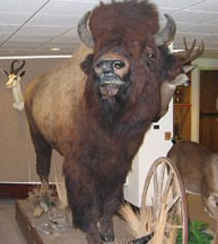
This stuffed bison was donated to the Abbey Museum Mount Angel Oregon back in 1993 and was taken down with “Black Powder” in Malheur.
BUFFALO WEST OF THE ROCKIES PORTLAND, Jan 11, 1887
TO THE EDITOR OF THE OREGONIAN
Within years, have buffalo or bison been found on the plains of Oregon or west of the Rocky mountains’ CARNEY
Many buffalo here been killed west of the Rockies within fifty years They were plentiful in Southern Idaho when that territory was part of Oregon, but it is not certain that buffalo were killed this side of Snake river Perhaps some pioneer knows and will tell.
Sightings:
Oregon, NW/Eastern, 1824, Great number between Snake River and Green River, diminished greatly by 1843
Peter Skene Ogden, who discovered Harney Lake and found buffalo heads there in 1826.
Oregon, Harney Co., Malheur lake, 40 skulls found, believed to be from a burn or death trap
1876 The late Dr. J. A. Allen, said that it was then “probably not yet half a century since it (the buffalo) ranged westward to the Blue Mountains of Oregon and the Sierra Nevada Mountains of California.” The Oregon record was from Prof. O. C. Marsh, who in 1873 found remains on Willow Creek in the eastern foothills of the Blue
Mountains.
Oregon, Crook Co, Prineville, Ore, skull of a bison was found on Ochoco creek
Oregon, Deschutes, Bend Ore, Bison material has been found in some of the caves near Bend
Oregon, Malheur, 1932, Bison bison Oregonus Bailey, Malheur Lake, 43° 5°N, 119°W Oregon.
Oregon, Blue Mountains, Central Ore lead into SE Wa. Texas History-AAB find source & 1912
Oregon, west side of the Blue Mountains, 1875, “Respecting its former occurrence in eastern Oregon, Prof. O. C. Marsh, under date of New Haven, February 7, 1875, writes me as follows: ‘The most western point at which I have myself observed remains of the buffalo was in 1887 on Willow Creek, eastern Oregon, among the foothills of the eastern side of the Blue Mountains. This is about latitude 44°. The bones were perfectly characteristic, although nearly decomposed.