Bison Bulls
& Their Buffalo Names
In several credible sources, I have read there was famous bison bull or bulls in history, that weighed 3000lbs. Buffalo Jones claimed his Jumbo weighed 3000, but did he? I think 2400 is pretty common for a huge bull. In fact, ‘Demise” aka Mr Big was such a bull, while he was living. I believe “Willy” in south Texas, is also 2400lbs. The most common bison bull weight would be 15-1800lbs. I have found not only one bull, but two, that weighed a little over 3000lbs, who lived in a very recent history. See Below
In 1978 there was a paper written about testing blood samples and comparing them to each of the Plains, Wood and a known hybrid herd. In the paper they were discussing size of the Wood vs Plains. They state in 1972 there was an anonymous Plains bull that weighed 1518 kg (3,346.62 lb) This bull had to have been “Jumbo”
Old Logan
1799-1800 Winter A Giant Coal Black Bull
A backwoodsman who saw them counted three hundred and forty-five in the procession, and probably a score of stragglers followed in the course of the next few hours. They were led by “Old Logan,” a coal black bull of immense size, which seemed to the settlers to have a charmed life. His spacious sides scarred with bullet marks and wounds left by attacks from wolves and half of his tail was missing.
The pioneer who counted the procession, of course, took a shot at the big fellow, but his gun miss fire, and on examination found it was out of order. That ended his hunt for the day, and he had to content himself with recounting his experience, without having a trophy to show for it.
At daybreak the buffaloes were at the foot of the mountains, grazing out over the dreary, snow-buried valley. There was a log cabin occupied by a young man named McClellan and his family about a quarter of a mile below where they were huddled together. The hearty young pioneer espied the brutes and lay in wait for them until they got into motion again and filed down the hollow of the stream which flowed from the mountains into Middle Creek.
When they reach a point opposite the cabin they were surprised by a fusillade which laid low first one, then a second, then a third, and a fourth of their number. More would have fallen had not the Hunter directed so many volleys at “Old Logan.” His impenetrable hide rolled off the bullets and he ambled away grunting amicably.
Four buffaloes before breakfast was a good bag, and the delighted nimrod set to work skinning them, and cutting out the choicest proportions of flesh, giving his most careful attention to the tongues. The four carcasses proved to be those of young cows, the meat of which was most highly prized, and there was less to leave to the wolves and ravens than had the victims been old bulls.
Half a mile below where they had been ambushed the bison fell into better luck. Martin Bergstresser, a recent arrival from Berks County, had cleared a nice sized farm by the creek, and his first seasons’ hay crop, a goodly pile, stood in the lea of his big log barn. It was needed to give feed for the winter to a number of cows and sheep, and team of horses, of which the former Berks County was the proud possessor. The animals were siding close to the stack when they scented the approaching buffaloes, and commenced lowing and bleating with terror.
Led by “Old Logan” the famished herd broke through the rail fence, and crushing the farm animals beneath their mighty rush, were soon making short work of the hay pile. Bergstressor was cutting trees nearly a mile away when the stampede occurred, and he had not heard the bellowing of his livestock, the screams of his wife and daughters would have brought him back. He dropped his axe, and picked up his gun, hurrying over stumps and rocks to the scene of the onslaught.
Like his neighbor, McClellan, he singled out “Old Logan, “ as the first object of his attack, but it was wasting ammunition. His eldest daughter, Katie, a girl of eighteen, brought out a fresh musket and shot too large buffaloes, which excited the herd so much that they turned away from the stack.
At this juncture, McClellan appeared and shot two more. Evidently, the animals possessed a strong communal feeling, for when they saw their companions kicking convulsively and covered with blood, they set up the most pitiful groaning imaginable.
“Old Logan,“ who had been more worried by the pioneers’ dogs then, by their bullets saw the time had come to move, and striking a trot, led his party out of the barnyard and up the creek. When they had gone it looked as if a cyclone had swept across the premises.
The barn was standing all right, but the fences, spring-house and hay stack had gone, and six cows, for calves and 25 sheep lay crushed and dead among the ruins. Luckily the horses were safe and sound in the stable, although one had become so excited he got cast in his stall and was rescued barely in time.
McClellan lingered around a couple of hours helping what he could to repair damages, and offering his sympathy to all the Bergstressers. Then he started homeward, but when he got within sight of his clearing he uttered a cry of surprise and horror.
Three hundred buffaloes were snorting and trotting around the lot in which his cabin stood, being so numerous that the house was obscured by them. Boldly the pioneer rushed through their rearing masses, only to find “Old Logan” standing guard in front of the cabin door. Too terrified to reason correctly, he aimed his musket and fired carrying an ugly hole in the big bulls throat.
Enraged by blood and pain, the monster wheeled about and plunged headlong through the door of the cabin. Being their leader, the herd were accustomed to follow him blindly, so when he disappeared into the cabin the rest strove to do likewise.
Vainly McClellan fired his musket, and when the ammunition was exhausted, he drew his knife into the beasts’ flanks to try to stop them in their mad course. Inside the cabin were his wife and three little children, aged five, three and one year, at least they weren’t there when he started on the hunt a few hours earlier, and he dreaded to think of their awful fate. He could not stem the tide, and the brutes continued filing through the doorway and tell they were jammed in the building as tightly as wooded animals in a toy Noah’s Ark.
No sound came from the victims inside, all he could hear was the snorting and bumping of the giant beast in their cramped quarters. The other bison outside stamped their hoofs, moaning with disappointment. Seeing he could do nothing more, he was about to go back to Bergstresser’s for help, when he saw his neighbor and three other men, all carrying guns, coming out of the woods.
They had heard the noisy animals a mile a way, and formed themselves into a posse. McClellan signaled them to remain where they were and ran towards them. They held a hasty council of war, deciding that the only thing to do was to tear down the log cabin, in the hopes that perhaps some of the family had hit in a corner, and were still living.
Two of the men ran back to the Bergstresser’s wife and daughters, twenty-five dead bison were lying in the lot. The live ones would not leave as long as “Old Logan” remained wedged in the cabin but remained stupidly clustered around the door.
The five men, armed with axes and with heavy poles for battering rams, repaired to the rear of the shack and began the work of demolition. It had been built to last, but the determined man soon made a generous opening, out of which the bison headed by “Old Logan” like giant bees from a hive.
The site of the King of the buffaloes with his bearded throat a mass of clotted blood was too much for McClellan. He seized a gun and shot the brute through the head. The old fellow was slow to die, running bellowing hideously for three hundred yards before he fell and became rigid. The entire herd followed him, and surrounded is prostrate form, the air resounding with their moans as they battled with one another to lick his wounds.
The men entered the cabin and were horrified to have their worst fears realized. On the earthen floor, crushed deep into the mud by the impress of the cruel hoofs were there remains of the unfortunate McClellan’s wife and three children. Strong man of the woods that he was he dropped down in a faint and it was over an hour before he could be resuscitated.
When he came in himself he was led, trembling like a leaf to the Bergstresser’s home, and put to bed. It was useless to follow the buffaloes anymore that day, as all the men were out of ammunition. They buried the mangled bodies of the family under the earthen floor and the log cabin, walled up the door and the opening that had been made to let out the buffaloes, leaving them to sleep their last sleep in what was so recently their home, but now their mausoleum.
When that bereaved husband and father recovered sufficiently he suggested to Bergstresser that they exterminate the surviving bison. Bergstresser was enthusiastic over the idea, and the two men started on horseback, one riding towards the river and the other towards the headwaters of Middle Creek, to invite the settlers to join a hunt of extermination.
Meanwhile, there was another heavy snowfall, that every man invited excepted with alacrity. About fifty hunters assembled at the Bergstresser home and marched like an invading army in the direction of the mountains. They were out two days before discovering their quarry as the fresh snow had covered all the buffaloes paths. The brutes were all huddled together up to their necks in snow in the great “Sink” in the White Mountains and the hunters, looking down on them, estimated their numbers at three hundred.
When they got among the animals they found them from cold and hunger, but they had been physically able they could not have moved so deeply where they “crusted” in the drift. The work of slaughter quickly began. Some use guns, but the most killed them by cutting their throats with long knives.
The snow was too deep to attempt skinning them, but the tongues were saved, and these the backwoodsman shoved into the pockets of their leather coats until they could carry no more.
After the last buffalo had been dispatched the triumphant huntsman marched down the valley, singing German hymns. It was a horrible sight they left behind them. Three hundred dead buffaloes stood upright in the frozen “crust,” most with jaws broken, and all with tongues gone, and the ice about them resembled a shoot of crimson glass.
Later in the season some of the hunters returned to see if they could procure a few of the hides, but the alternate freezes and thaws had rendered them worthless. In the spring and summer, travelers crossing distant ridges could notice one portion of the sky black with pinions of huge birds. They were the carrion-seekers, bald eagles, golden eagles, a half dozen kinds of hawks, buzzards, ravens, crows, which picked clean the bones of Pennsylvania’s last herd of bison.
Whether they deserve their awful fate because the dumbness of “Old Logan,“ their leader, caused the trampoline to death of a pioneer family is difficult to judge, but they paid the penalty, and their executioners were content to rob posterity of these valuable game animals. To this day the barren flat where the McClellan’s cabin stood is known as “The Buffaloes Field,“ and on winter nights it is averred that the tramp of hoofs is heard incessantly pounding the hard earth in a ghostly stampede.
**Note: This makes a great read, but is it true? I searched a little bit in Latter-Day Saints and census reports. I did find the names McClellan and Bergstresser, and several in that area with the last name, but no Martin. (which is not unusual) Remember the story says he came from Berks Co., recently. I looked in and around that area as well. I search the name and death date and found this recent book below.
“The Long Hunt: Death of the Buffalo East of the Mississippi” By Ted Franklin Belue (extract)
The so-called “great Pennslyvania buffalo hunt” took place in Union County on December 31, 1799. Shoemaker’s account, a wild epic of myth, mayhem, and hyperbole, is given here as he said it was told to him in the early 1900’s by Flavel Bergstresser, a descendant of Martin Bergstresser, who, it was said, “helped to wipe out the last herd of wild bison in the Keystone State.”
It continues like the story we all know, but he adds more details about the bison reported to be shot or seen in the area around that time. Another book published in 1919 called “Extinct Pennsylvania Animals” written by Henry Wharton Shoemaker, also accounts for the story.
There are many accounts of a few wild bison here and there in Pennsylvania, from as early as the 1700’s from credible people. But, as far as I know, no bison fossils have been found, that have been tested to be bison. Of all the bones said to be bison have been lost or destroyed. Pennsylvania Archeology site posted:
“In the East we do not have much data to address the issue of diet, but Pennsylvania has one of the few sites that does. The Shawnee-Minisink site, located along the Delaware River in Monroe County, is one of the few deeply buried Paleoindian sites in the East. It contains many tools and two fluted points dated to 12,800 BP. based on carbon 14 dating. Most significantly, one of the cooking hearths contained a variety of seeds, hawthorn plums, blackberries, and fish remains. There is little evidence that Paleoindians hunted any extinct animals such as in the western United States. Paleoindians were hunters but they focused on caribou, elk and deer. The Shawnee-Minisink site is probably more representative of their daily diet.”
Another good read. This Week in Pennslyvania Archeology
In September of 2020 it was in a local paper that when a little girl was just one year old found “well-preserved bison tooth fossil in Pennsylvania” The father states he researched it for years, brought it to horse doctors and state parks, and now believes it once belonged to a bison latifrons or bison antiquus at least 12,000 years ago. The girls father thinks the tooth was lodged in a glacier and brought north when the glaciers melted thousands of years ago. There are several accounts of bison in Pennsylvania, were they just traveling through? Several places are also named after “buffalo”, reading the history I found, buffalo swamp, buffalo river, etc…
Dr. Lewis E. Theiss ” Great herds of buffalos once roamed through Union county and it was their presence which prompted early settlers to name their fertile land “Buffalo Valley.”
West Texas spring of 1875 -“Old Bone Beater,” as they called him. This was a big shaggy old bull, of considerable age, whose running they could always distinguish among the biggest herd, because he struck his front hoofs together when he ran, making a loud rattling noise like a shod horse running over cobble stones. The older rangers had often heard this peculiar noise in different droves of buffaloes, for they could distinguish the rattling sound above the hoofs beats and bellowings of the largest herds , and had often wondered at it. Today they had heard it again, and the herd being small they had followed it until they got sight of the buffalo making the peculiar noise and had shot him, and found that the heretofore unaccountable clatter was caused by the big hoofs on its fore feet striking together as it ran.
Sir Donald 1872 – April 6, 1909 Manitoba Morning Free Press April 21, 1909

Story goes, he was captured about by James McKay circa 1872 and thought to be two years old at that time. They say he was with his herd for “upwards of 28 years” Around 1905 he was challenged by a younger bull, where he lost one horn and an eye. He was pretty much by himself after that and was found dead in 1909. I have read two reports, one says he died at 37, while the other says 39. I believe the discrepancy would be his age at the time of his capture.

Photo by Byron Harm
Measured about 151/2 inches between the eye sockets. The remaining horn is 18 1/2 inches long and its girth is 14 1/2 inches. He answered best to the Indian’s description of the buffalo, being short and very thick and deep in the body, with great bone and an extremely massive head and front. And he was undoubtedly a really pure-bred bison. (the article also says “measuring about 49 inches from tip to tip of the horns” )


The rest of his story can be found at Canada History
Read his story in an article written upon his death. (1/3 of page down)
Howard Douglas, speaking at Montreal on February 18, 1909, announced that the bull that had become for tourists and others the hero of his race was failing and park authorities had decided that the time had come for Sir Donald to be dispatched and allowed to join his forefathers in the mythical “sand hills.” In a few weeks, Douglas explained, he will be put to death and his body stuffed and mounted for museum display. Park rangers were not looking forward to putting their old friend to death and as it happened, they didn’t have to do it. (Sacred Buffalo)
It is with regret that I have to report the death of Sir Donald,’ the patriarch of the buffalo herd, whose tragic end occurred early in March, he having been gored to death by a number of young buffalo bulls.
For several years it had been the intention to preserve and take the best of care of Sir Donald’ as a matter of scientific historical interest in ascertaining the longevity of the buffalo race. For that reason, he was cared for until he became too decrepit from age to care for himself. When he was attacked by the younger bulls and knocked down, he was helpless to defend himself and the aged hero was gored and trampled beyond recognition, in which condition he was found next morning. There is not the slightest doubt that Sir Donald’ was the last specimen of the buffalo that a few years ago roamed the prairie at will in their wild free state. He was captured as a buffalo calf by the Indians in 1872 and was consequently in his thirty-eighth year at the time of his death. His history during his thirty-seven years of captivity has been one of romantic interest to thousands of people as the sole survivor of a noble type of animals, that in their wild state have become only a memory to Indians, buffalo hunters and old-time white pioneers.
Shortly after his capture he was sold by the Indians to Mr. James McKay, then chief factor for the Hudson’s Bay Company at Fort Garry, and afterwards became a part of and headed the herd of Sir Donald A. Smith (now Lord Strathcona) at Silver Heights. In 1898 Lord Strathcona donated the remnant of his herd, consisting of thirteen animals, among which was Sir Donald,’ to the National Park at Banff, to be cared for as the wards of the Canadian government.
It had been intended to have the skin preserved and mounted as a whole specimen for the new national museum at Ottawa, but unfortunately, his carcass was so gored and disfigured beyond recognition that this was impossible. The head has, however, been preserved and is now being mounted and will serve in a measure as a memento of the last and noblest specimen of the buffalo of the by-gone days.
Ole Sikes – Charles Goodnight 1877 or 1878-1886

“Old Sikes” Bronze by Douglas Clark
Old Sikes was a calf on the plains when Charles brought him home. He nursed on Texas cattle and later serviced them. He was always making the rounds and had to be brought home. He would get under a gate and lift it off its hinges and help himself to the grains. In a summer gather, they found him on the RO ranch and put him in the new buffalo pasture. He was horn tipped and cut. Later, Charles sent Henry Taylor out to pen him. When that failed and he was run out, Charles went to show’m how it was done. After much commotion, work, a bullwhip and fancy spurs and his horse Shystocker. They got Ole Sikes back to the ranch. Charles never said another word, but Christmas 1886 a large fat carcass (964lbs) was hanging beside the mess hall. The next day, the old-timers remarked it was better than beef.
Newton Daily Republican
Newton, Kansas, Oct 11, 1886
REMARKABLE GAME.
A Wyoming Hunter Brings Down an Almost White Buffalo Bull.
(Lander (Wy. T.) Special.)
Jack Gaylor, a well-known hunter, and trapper of the Wind mountains has slain a white buffalo bull, or one so gray that it can very easily be called white.
Jack bagged his phenomenal game about two weeks ago while on an elk hunt in the recesses of Wind mountains. By the merest accident he stumbled upon a small but deep basin, one of the most it hidden of haunts. In this, he found the gray or white buffalo. When the hunter came to examine his prize he found that it bore all of the marks of very old age. The horns, once so powerful and massive, were worn down to the skull and presented the appearance of bald, smooth spots on the head rather than the natural projections. The teeth were few and fragmentary and were almost even with the jawbones. Though living in the midst of the richest and most succulent grasses and herbs the patriarch hoar and gray was very poor in flesh. The appearance of the basin indicated beyond doubt that the bull had in that one spot seen many a summer’s sun and many a winters storm. In the course of nature his race was about run, and the snows of the coming winter would have covered his age-worn carcass.
Many here think the trusty rifle of “Hunter Jack” has slain the famous white buffalo of Shoshone and Arapahoe Indian tradition, and that tradition has thus been proved a fact. Others, or skeptical, think that the color of the slain bull is due entirely to his great age. This, however, is met by the very plausible suggestion that if the bull was gray in the dullness of his age he must have been pure white in the freshness of his youth. The lovers of the marvelous are in a decided majority, and a white buffalo has at last been slain.
Ben Harrison 1887
A big bull bison is on his way to Golden Gate Park. He comes all the way from Garden City Kansas where he was born and raised on a buffalo farm run by one Jones. He that is the – bison is four years old and or the genuine simon pure breed, his immediate predecessors having roamed the wild prairies and the mountains and vales of Montana. Wells Fargo & Co have charge of him at present and are bringing him here via Salt Lake.
As intimated in the Chronicle a few weeks ago the Park Commissioners have been trying to get some specimens of the now nearly extinct American bison for their collection in the park. It was their wish to secure a pair of them but after several months of seeking, they have come to the conclusion that a single buffalo was all they could afford. A pair of these shaggy monsters cannot be procured for less than $1200. The one just purchased by the Commissioners cost $350 exclusive of the neat little sum that Wells Fargo Co will want for his transportation. He is a splendid specimen of his kind though and well worth the money. He will soon be roaring and kicking up his heels along with the antelopes and deer in the big corral at Golden Gate Park. Superintendent end Commissioners expected a Lion and received a Lamb (se Golden Gate Park for the rest of the story)
Cleveland- 1888
PRIDE OF THE HERD
……while the bison at Bismarck Grove are splendid specimens of their class, ‘Cleveland’ is decidedly the pride of the herd and as grand a creature as ever trod the soil of Kansas on four legs. He is just six years old and is a perfect specimen of the kings of the plains. There is a royal blood in his veins and his code is finer than the imperial purple. It is not possible to get at him to measure his stature and weigh him, but as he stands in the past year he appears to be as tall as a thoroughbred Norman-Percheron stallion and as massive as an elephant direct from the jungles. He must weigh fully 3,000 pounds, and it is doubtful if there is today living on the face of the earth a handsomer buffalo bull then he. His fur is just now in its best state, even thick and compact, while the long hair on his neck and legs is of a glossy seal brown. As he turns and faces the visitor, one can imagine what it must have been to see countless thousands roaming on the plains and to hear the thunder of their hooves in a stampede. “Cleveland’s” disposition is not so ugly as Old Barney’s was, but at certain seasons he is very wild and there is no one venturesome enough to go into the enclosure. It is then not altogether safe to even look over the high in heavy board fence at him, for he is likely to make a run for the visitor, as the numerous holes in the fence where he has knocked off the boards will testify.
Colonel Stanton is very proud of his herd, particularly of Cleveland, and he has a right to be. He would rather lose his best hotel that his buffalo, nor would any cash price induce him to part with them. He will probably, in the near future, place them in a more convenient location and tend to breeding them and crossbreeding with cattle. He certainly has a splendid foundation to begin on and it is a lucrative business, a single buffalo been worth more than of whole drove of common cattle.
Buffalo Bill and Jim 1895
The workmen at the Park were treated to a lively scene Friday when the two mammoth bison bulls were transferred to different pens. These fellows, prior to January, were quite companionable, but one day that month their pugnacity was suddenly aroused and is stiff and counter was engaged in, resulting in “Buffalo Bill” seriously goring “Jim.” The latter was placed in a stable to allow his wounds to heal, while the other warrior was left with the herd. Being thus separated, the two only engaged complements at intervals in the way of bellowing, but a few days ago “Buffalo Bill” forest and entrance into the abode of his enemy, where an angry and counter was precipitated. It was a perilous task to attempt to make peace between the enraged animals. Finally “Buffalo Bill” was ejected, and “Jim’s” home was securely guarded.
Friday Keeper DeVry determined to give “Jim” the freedom of the yard and put his antagonistic in durance vile. Accordingly “Buffalo Bill” was lassoed after considerable trouble, during which ropes were broken and one of his horns was badly fractured. He was fastened to a tree while “Jim” was led out to the herd. Then after another tussle, the obstinate beast was led to confinement, where he will remain while his brother is taking an airing. However, negotiations were perfected Saturday for the purchase of three bisons for the zoological garden of Philadelphia. Keeper DeVry said that “Jim” would likely be one of the number.
It is interesting to know that this herd of 16 natives of the Western plains is the finest in captivity. The park has been successful in raising these animals. Some years ago there were but two bison; the rest are lineal descendants of this couple.
1893 Jumbo & Devilish Dick reported by C.J. Jones that Jumbo weighed 3000lbs

Two of the largest males of the herd are named Sullivan and Corbett, respectively, because of their belligerent qualities. The big buffalo Sullivan would as a calf rush out and knock a man over if he could, and now when full grown will go a mile to meet a man on horseback.
Jumbo, the monarch of the herd, weighs nearly 3000 pounds and in as fine a specimen as ever trod the western wilds, with a crest like a storm cloud through which flushes a dangerous light from his eyes when in anger. He has the beard of a prophet and a back like old Atlas that might bear aloft a world upon its broad expanse, his horns measuring 141/2 inches in circumference at the base.
Devilish Dick is black, with a head like the end of a box-car; he has a ring in his nose, and one cannot help wondering as he realizes the tremendous power of his massive shoulders and breast how it ever got there. This is the animal which killed its keeper in Oxford some time ago, the late Gus Cole. -Jones bought his herd Jan 1892.
The Times
Philadelphia, Pennsylvania June 10, 1895
BILL THE BISON KNOCKED OUT
A SENSATIONAL EARLY-MORNING BULL FIGHT AT THE ZOO.
NEW CHAMPION FOR BUFFALOES
The Bully That Has Long Held Full Sway in the Buffalo Enclosure Arouses His Companions to a State of Rebellion and After a Desperate Combat is Probably Fatally Injured and Dragged Off by the Keepers.
Visitors at the Zoological Garden early yesterday morning were treated to a sensation. This was a combat a la mort in the big buffalo enclosure that would have reflected credit upon the wildest regions of the Western plains in the good old traditional times.
The buffaloes at the Zoo are, for the most part, bona fide importations from the West, but they usually exhibit the deteriorating effects of Eastern civilization by lolling about their mock sylvan retreat or reclining lazily in the sun.
There has been one exception to this passive appearance of indolence and degeneracy unworthy of the traditional energy of wild bison ancestry. The ugliest looking buffalo in the herd, a creature of gigantic size, has always been an un-easy, restless, quarrelsome fellow, a terror to his companions, whom he dominated and bossed at his own eccentric will. He was the bully of the walk, as it were. All others had to budge at his pleasure and surrender possession of the softest and choicest spots in the enclosure whenever he chose to demand it. To the keepers, he was known as Bill and by them, he was dreaded almost as much by his own associates. With some of the others, the keepers have become tolerably familiar, but nobody has ever thought of making a pet of Bill.
BILL IN AN UGLY MOOD.
Like all bullies, Bill included among his execrable qualities the twin vices of selfishness and greed. He was always filling himself with the choicest of the food, the tenderest grasses, and his conduct at all times, particularly, it seemed, when crowds of visitors were gazing through fences, was such as would disgust any gentlemanly buffalo.
The keepers noticed early in the morning that Bill was in a more than usually disagreeable mood. He swaggered around the place, pushing the others about, disturbing various social little groups of the more companionable fellows, and taking particular delight in forcing anyone who had settled himself in an especially agreeable place for peaceful repose, to get up and hustle for others quarters. It was about the time when everybody except guards, keepers, and the lower animals are supposed to be engaged in religious worship that the garden was startled by a Wagnerian chorus of bellows and snorts from the buffalo yard. All the keepers and the few visitors who had entered the grounds rushed to the scene.
There, in the middle of the enclosure, stood Bill, his huge head close to the ground, which he was pawing in an ugly manner, while his tail swished in the air like a whip. In a semi-circle, but at a respectful distance, were half a dozen of the largest members of the herd, also digging into the earth and snorting belligerently, while the others of the colony were gathered in one quarter, with their shaggy whiskers almost touching the ground, but distinctly contenting themselves with bellowing at the top of their capacious lungs.
THE BULLY ATTACKED
it was evident that the bully had provoked his usually meek comrades to open rebellion. Active hostilities were not long delayed. Wild Bill stood half contemptuously returning the angry snorts of his enemies a large buffalo detached himself from the semi-circle and approached the big fellow slowly and apparently desirous of digging his way toward him through the earth with his nose. When about six feet distant, with the big glaring eyeballs of both animals fastened upon each other, the new champion sprang forward and their thick heads met with a crash like simultaneous bangs on the base drums of a score of military bands. The new champion recoiled before the superior strength of Bill, but he was game and he returned to the attack.
For more than five minutes the combatants hurled against each other, their horns frequently locked, and each striving with all his sinewy strength to force up the others head and get in a decisive blow with the keen horns in the softer flesh of the neck. Bill was steadily forcing his antagonistic back toward the fence when another large buffalo detached himself from the semi-circle and with head down and tail up charge directly upon the object of general hatred. The blow took effect in Bills tremendous neck, laying open the heavy flesh and coloring the thick mane red in an instant.
It was then that Bill showed what almost all bullies show when hard beset, the white feather. Disconcerted and perplexed, he turned from wind to the other of his assailants, striving to avoid the blows of each. He bellowed with rage and evident fear when still another buffalo joined the attacking party and thrust his sharp porn into his flank.
DISCOMFITURE OF BILL.
The issue of the battle was not long doubtful. With all his enormous strength Bill was forced about the pen, receiving numerous wounds in front and flank from the infuriated animals that were now crowding upon him. He made a last desperate stand near the fence and succeeded in hurling one of his foes to the earth and ripping open the side of another, that he himself was soon to week to maintain himself on his legs, and all seemed over for him, when head Keeper Mauley and a half dozen keepers, armed with pitchforks and clubs and rushed to his rescue. It was a difficult, not to say dangerous, thing to repel the enraged bisons, who had made up their bovine determination to destroy their oppressor in one good job, but they were finally beaten back long enough to enable the keepers to drag bill out of the gate.
While this was going on every animal in the Zoo possessing a strong voice was keeping up a musical accompaniment, in which the trumpetings of the elephant Bolivar and his unusually quiet companions and the roars and snarls of the big cats in the lion house were particularly prominent.
Bill’s injuries were found to be serious and it is possible that his unhappy fate will be to furnish buffalo cutlets to the carnivora. At any rate, he is not likely to be restored to the buffalo yard.
After Bills subjugation, the buffalo’s that had made the attack were noticed to bear themselves with a new air of self-importance. This was especially evident in the case of the one who had the courage to strike the first blow. He, of course, succeeds Bill as boss of the ranch, and in pointing him out the head keeper, who is of a classical turn, bestows upon him the title of “Campeador.”
1897


SUMMARY: American bison in the yard outside the Buffalo House at the National Zoological Park.

Received from Pablo, Montana on October 23, 1897. Died October 3, 1914. This is the bull drawn by Charles R. Knight for the $10 note. Male #2926.
Sullivan and Old Pete-1897
A Gallant Battle by a Bison Bull Against Three Cow-Boys
……The superb bison at the Zoological Gardens known as John L Sullivan broke his neck yesterday. He met his death after a heroic battle for freedom. The battle ground was in the Zoo and a thousand men, women and children paid to see the buffalo chase, while twice that number stood on the elevated roadbed of the Pennsylvania Railroad, which skirts the garden. The army of people were thrilled by the brave and spirited defense Sullivan made against the combined efforts of three stalwart cow-boys, three strong ponies, three lariats and the big thick rope. Sullivan was only conquered by death, after he had gored a pony, broke several lariats and made the cow-boys weary. While wintering on Staten Island the Wild West Show lost almost a dozen buffaloes, and as spring approached in the time for the departure of Buffalo Bill’s aggregation for England grew nearer Col. Cody began to look about the country for bisons. When he heard that Sullivan and Old Pete, the big bulls of the Zoological Garden, in this city, could be bought he closed a bargain at once, the purchase price being several hundred dollars.
THREE FAMOUS COW-BOYS
……The show sails on Thursday next for London, and Buck Taylor, Billy Bullock, and Joe, Esquirel, the well-known cow-boys, with three big ponies, came over yesterday morning from New York to lasso the buffaloes. Shortly after 11 o’clock the cow-boys succeeded in conquering “Old” Pete, and he was led with little difficulty between two horses to the stockyard of the Pennsylvania Railroad, in West Philadelphia.
Sullivan, a big, vicious bull, whose pugnacious nature led to his sale by the society, was to be tackled later on. Sullivan, a proud and spirited animal, had made a bad record during the year. He thrice had put his head through a three-ply fence, broken down gates, almost killed “Rocks,” a bull much smaller than Sullivan, and had periodically knocked silly big, robust Dominick McCaffery, an ambitious bison and former champion of the buffalo yard.
THE HUNT BEGINS
……It was just 2 o’clock when the three cow-boys, mounted, jumped into the yard at the northwest corner. They each carried a lariat. Buck Taylor was seated on “Chieftain,” a pretty bay with white marks. There were scores of dime novel readers there and they saluted the “King of the Cow-boys” in picturesque sentences. Taylor wore maroon colored shirt, embroidered, corduroy trousers, top boots and a white sombrero. A rich red and black silk handkerchief, which his girl had given him, was around his neck and a big diamond glittered on his black silk necktie. Billy Bullock and Joe Esquirel, who were less richly dressed, use the peculiar costume of the cow-boys. Bullock rode “One of a Kind” and “Streaks” was under Esquirel. The herd was gathered under the shed, discussing the abduction of Old Pete, when Buck Taylor through his noose at Sullivan’s head. It did not get there, but it started the battle. Sullivan and his relations dashed out from the shed, followed by the horsemen. Taylor led again but missed him, and Sullivan dodged the lariats of Bullock and Esquirel. Sullivan was mad and with “McCaffery,” Rock and the other bison on his heels dashed around the yard. Bullock put his noose over the horns of the swift-footed beast, but Sullivan quickly shook it off and turned toward “One of a kind.” Bullock got out of the way and then Taylor again headed for Sullivan.
IN THE HEAT OF BATTLE
……The noose shot through the air, and, with the spontaneous shout from the crowd, Sullivan came to us stand with such abruptness as to almost lift Taylor off his horse. While the people were cheering Sullivan made a dash across the yard and swung around the tree in the northwest corner. The infuriated bull and the combination at the other end of the line played a desperate game of see-saw. The other horsemen were hurrying to the assistance of Taylor when the maddened Sullivan made a fierce pitch.
……The line broke and in an instant, he rushed Chieftain and his rider. Taylor made an attempt to turn his horse when the bull swept down and with a wild toss of his head ripped open the right haunch of Chieftain with his sharp, curved horn. The bull made another plunge, but the crowd saw the blood streaming from Chieftain and gave a cry of alarm in time for Taylor to pull his horse away from the bull. In a second the gate was opened and Taylor and his horse dashed ahead of Sullivan and escaped from the bull. Billy Bullock and his partner made a dash for Sullivan and he was about to plan his horns into “One of a Kind,” when the Cow-boys were told to come out of the yard and Sullivan was left still champion of the Zoo. Dr. Huidekoper, dean of the veterinary school at the University, was in the crowd and he was soon by the side of Buck Taylor’s horse. The horn had opened an artery and torn muscles and flesh protruded from the wound, which sent out a stream of blood. Dr. Huidekoper immediately stuffed handkerchief into the wound, and then the horse was led to the stable, where the doctor filled the wound with oakum and had it bathed with cold water.
AN ATTACK ON FOOT
……Sullivan had to be captured, and Buck Taylor had mounted “Streaks” to return to the attack, when Agent O’Donnell, of the society to Prevent Cruelty to Animals, stopped him. Agent O’Donnell had agents Cox and Bowes with him. They said courteously, but earnestly that they would not allow the other horses to return to the yard. Sullivan was a mad beast of wonderful power and they believed that he would kill the other horses. “I don’t want to break your ____,” said Buck, “but we must take that buffalo, and I hope you won’t object to us doing it on foot.”
……“We won’t object to that, “replied agent O’Donnell, and then the towering “King of the Cow-boys” and smaller, but equally ____, companions sealed the fence of the buffalo yard. As Taylor’s smiling face was ___seen in the area he was given an enthusiastic welcome, like that which the _____ Mastantini is want to receive in the _____ pits of Spain. “Don’t git skeered, Buck, ____boy,” shouted a freckled face boy on the _____of a nearby tree: “were wid yer.”
……Taylor’s smile broadened, but he lost no time in hurling his lariat at Sullivan. The other Cowboys were on us Swift run at the ____ of Sullivan, when Taylor’s swung his lasso around the big neck of the bull, Sullivan dashed around, almost dragging Taylor ___feet. At last Billy Bullock and Esquirel caught up with Taylor and the ___ cow-boys slackened Sullivans speed gradually stopped him. Esquirel ____ his noose under the forefeet of the bull.. When it was drawn tight the cow-boys thought they had their buffalo, but Sullivan snapped the lariat. While he dashed about one side of the tree, near the shed, ___ cow-boys ran the other way. They looked for a rope, and “Weasel Bill” Loomis suddenly dashed into the arena with a thick rope. Esquirel, after several attempts, put the noose over the horns of Sullivan, and he madly plunged. The crowd sent up ___of victory, but at that moment, by a sublime effort, the bull for the ropes from the hands of the men.
A RUSH FOR COVER
……“Weasel Bill” was convinced that Sullivan was on to him and Loomis shot over the fence like the tail end of a cyclone. One lariat at was still clinging to the neck of Sullivan and the three cow-boys chased the buffalo for five minutes before Billy Bullock fished up the line. Two held him while Taylor hauled the rope again over the horns, and again Sullivan dashed about, finally getting himself tangled around the post of the shed. He was pulling down the shed when the skinned hands that held the ropes let him plunge free of the post. Sullivan was blind with madness and dashed around the northwest tree. In an instant, the cow-boys ran the ropes into the hands of the crowd of men at the bars and the plunging bull was tied fast, while the crowd shouted itself hoarse. The cow-boys had just left the yard and were preparing to lash to horses together to take Sullivan to the train when the bull grew fierce in his endeavors to free himself.
DEATH OF THE BRAVE BEAST
……With the wild plunge his forefeet caught the rope, and Sullivan dropped on his left shoulder blade. Buck Taylor thought the bull was choking, and with Dr. Huidekoper and the other cow-boys jumped into the buffalo yard. The noose around the neck was loose, but Sullivan was gasping his last breath. There was intense excitement, and the men began to blow into the nostrils of the fallen champion. It was of no avail. Sullivan would not go to England -he was dead. The poor beast in his fight for liberty had broken his neck. The tragedy caused great sorrow. Keeper John Ford, who knew Sullivan since his infancy, wept and Head Keeper Byrne stood at the side of the dead bison and spoke of his virtues. John L. Sullivan was born in the garden a dozen years ago. His sire was fresh from the prairies and his mother was one of the most respectable buffaloes that ever lived at the Zoo. When Sullivan’s three wives and other relatives saw that he was dead they gathered around him and licked his head.
BUCK TAYLOR’S SORROW
……“I didn’t expect all this,” said Buck Taylor. “That buffalo was one of the finest bisons I ever saw. As for my horse, I would rather have lost $5,000 then have him gored the way he was. I had no spurs on or I would have got out of the way. I want to take my pony with me to England. We must sale on Thursday next. Dr.Huidekoper says he thinks he can have him in fit condition to be taken to New York by that time, and I leave ‘Chieftain’ in his charge. He will have the best all over at the college and no expense will be spared in giving him comfort and the finest medical skill.” The cow-boys were cast down at their ill luck. Buck Taylor stood in the telegraph office and had wired to Nate Saulsbury, one of the owners of the Wild West show: Sullivan broke his neck. What will I do with his body?
Cleveland and McKinley 1900
Owned by William C. Whitney and gave them to Hornaday for the NY Zoological Park
1903- “Largest Living Bull”
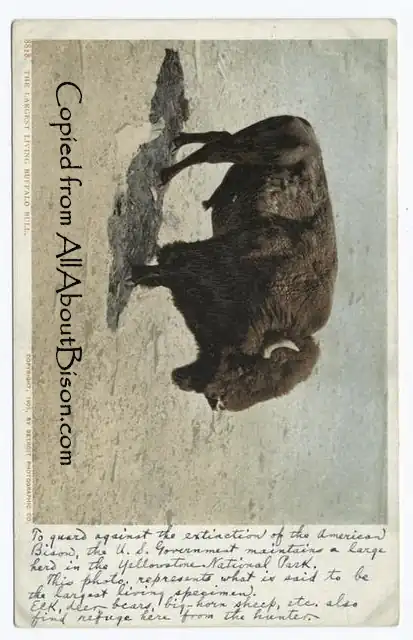

Kalispell Cheif-1909, is one name that stands out in the story of the Montana national bison preserve. Not a white man and not an Indian has the name, but a buffalo – a real monarch of his kind.
General Lawton 1904 ish -1930 (formerly Lone Wolf) ABS 1930 Wichita Wildlife Refuge
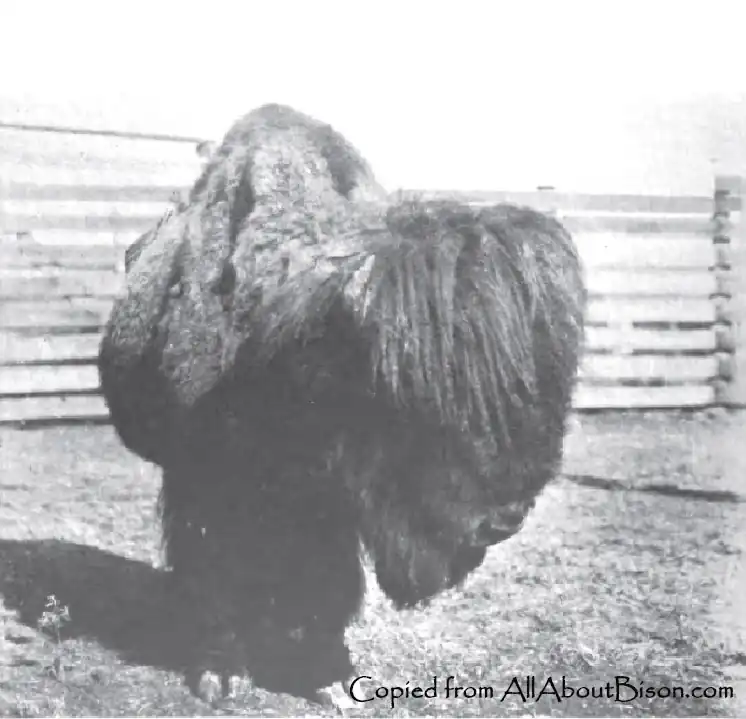
The only surviving member of the original fifteen shipped to the Wichita in 1907 is the buffalo bull “Lone Wolf,” subsequently renamed “General Lawton,” now over twenty-five years old, and on account of his age, he is kept in the exhibition pasture with four cows.
In 1929 two of the cows gave birth to calves, and as they had been separated from the main herd for two years, he is, therefore, the sire of both these calves, the oldest of which is a female and the other a male. A remarkable feature of this old bull is the long hair on his head which measures fully twenty inches in length, he is also a wonderful specimen of the American Bison. He obtained his title “General Lawton” August 2, 1916, while being exhibited in a street parade in Lawton, Oklahoma, during the City’s annual celebration. He was hauled in a crate and attracted considerable attention, in fact, so violent were his objections to being cooped up in that fashion it was thought that a sudden change in the programme would be likely to occur at most any moment, nevertheless the crate held him to the end of the parade where the attendant in charge was instructed to head at once for the Wichita and keep going until he had him safe in the enclosure at headquarters. His head will be mounted and placed on exhibition in the Oklahoma State Capitol.
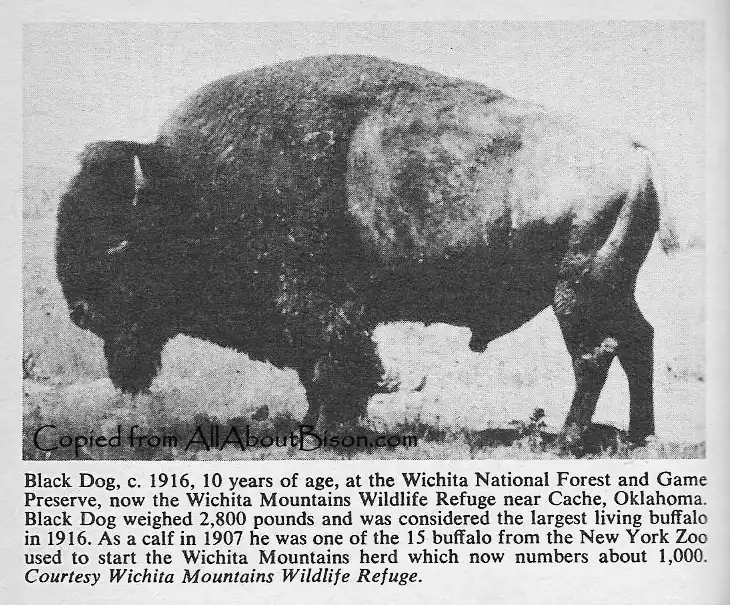
Black Dog 2800lbs – born in 1907


THE WORLD’S CHAMPION BISON . 1909
Mr. Harry V. Radford, who has been exploring in the Arctic regions for the past year entirely alone, except where he met and mingled with the Eskimos, has just sent us the above unique illustration. Mr. Radford has made a special study of the wood bison and his habitat, hitherto practically unknown to white men. He has been over much of their range with pack horses in summer and dog sleds in winter, conducting his investigations under a special permit from the Canadian Government to collect for scientific purposes. Such a permit has not previously been granted to any naturalist or sportsman. On December 1 he shot a magnificent wood bison bull (the first to fall to a white hunter), the head of which appears in the illustration. This bison is the largest of which any record exists, surpassing in size and weight the previous world’s record bison, killed by W. F. Hornaday, of the New York Zoological Garden, in Montana, in 1886, and which is exhibited in the National Museum in Washington. The engravings of this Hornaday bison appear on our ten dollar bills. The specimen of Mr. Radford’s, shown in the illustration, weighed 2,402 pounds. It was hunted down near Fort Smith in latitude 60 ° + N. after an exhausting snowshoe chase lasting most of the day. The temperature at the time ranged at 42 ° Fahrenheit,
The skin and head of the wood bison weighed in at 415 pounds. The largest buffalo ever recorded by a naturalist was an old bull shot in 1886 on the Montana plains by William T. Hornaday, noted for its extraordinary weight of approximately 2,100 pounds, which is 300 pounds lighter than the mammoth taken down by ‘Adirondack Harry.’ The pursuit of the wood bison incurred a cost of around $4,000.
Radford’s bison weighed an impressive 2,402 pounds, measured 9 feet 7 inches from head to tail, stood 5 feet 10 inches at the shoulder, and had a girth of 9 feet 9 inches behind the forelegs. The neck circumference was 6 feet, while the muzzle measured 2 feet 5 inches behind the nostrils. The tail hair extended 13 inches beyond the last vertebra, with one tail vertebra reaching an astonishing length of 19 1/2 inches.
Teddy- 1911 (catalo)
Several experiments in raising catalo have been conducted in the Dooly herd on Antelope Island. A cross between Hereford cattle and the buffalo has been obtained that is large and hardy. In every instance save one the catalo has been the of a buffalo cow, sired by a domestic bull. In only one instance has a catalo than the calf of the domestic heifer.
……This instance was a result of an experiment conducted on Antelope Island. I Hereford cow with considerable difficulty raised a monstrous hybrid, half buffalo and half Hereford. This hybrid was born on March 4, 1904, the date of the inauguration of Pres. Roosevelt, and was promptly christened “Teddy.” Recently his name, for some reason, was changed to “Boaz.” Perhaps his nature was not fierce enough to justify the name of “Teddy.”
……“Teddy” remained with his mother all of the time, refusing to run with the buffalo. He was large and in color resembled the Hereford. His coat was black, with an immense shaggy mane hanging low from his shoulders and extended over his head. His forehead was blazed and his horns short and blunt like the buffalo. He was constructed much after the buffalo within an enormous head and a large, on his shoulders. He was much larger than average buffalo and he was almost as large as the largest buffalo known. He was much larger than the other catalo heretofore produced and disposition was even more ferocious than that of the buffalo.
Keep Close to Mother
……When undisturbed this mammoth catalo would graze quietly with the rest of the Herford herd, always keeping close to his mother, who appeared tiny in comparison to her huge offspring who in three years time had become full-grown, but who still preferred to graze near his mother. “Teddy” resented the approach of man and was always ready to fly to the defense of his mother whenever he thought she was in danger.
……“Teddy” became quite an attraction at Antelope Island, especially for naturalist who examined him at a safe distance. He had upset all the “dope” because scientists had declared that no such animal could be so created. In the words of the farmer who viewed the hippopotamus, they declared emphatically:” it’s a lie; there ain’t no such animal.” Finally, they called him a freak and let it go at that.
……Finally, show people saw exhibition possibilities in “Teddy” and he was purchased for touring purposes. His capture was interesting. After he had easily snapped a number of rawhide lariats tossed by cow men about his shaggy neck and charged the Mustangs on which his would-be captor were mounted, it was decided to resort to strategy.
……A large cage was built and placed out on the range on the island. All sorts of tempting grain and feed were placed inside of the open cage and every effort made to induce the monster to go inside. For several days he disdained the temptations, but finally, he was attracted and stepped inside. The trap was so arranged that when “Teddy” once stepped inside he was a prisoner. This he did not seem to mind until the food supply was gone. Then he discovered that he was a prisoner.
Does Stunt in Show
……“Teddy” roared loudly and attacked the cage viciously. It was strong, however, and that protesting catalo finally wearied in his efforts to get out. He was hauled away in triumph by the show people. Then he was christened “Boaz” and began his tour about the country. In captivity he was measurably tamed. The man who brought him feed and water he soon looked on as a friend and he never protested when the keeper entered the cage. As far as can be learned no one else ever tried. Spectators at a safe distance from the cage were kept in a state of constant terror by the bellowing, threatening animal.
……The exhibition tour was not of financial success and on a judgment an Ogden man finally came in possession of “Boaz.” The appetite of the monster was enormous and Ogden creditor soon devoutly wished “Boaz” back with the show people. Finally, he was disposed of to another and amusement enterprise and is again touring the country and providing material for the lecture of the “harker.”
The transportation of ”Teddy” alias “Boaz” from Antelope Island was not the only transportation of animals from the island. A number of attempts, most of them successful, have been made to ship buffaloes from the island. Every year or two Mr. Dooley exchanges buffalo calves with the Montana herd in order to improve the strain of both herds. In most cases, these calves are separated by some ruse or another from their mother when they are very young and transported as quickly as possible. Experience has taught buffalo owners that healthy young buffaloes as they become older are hard to handle.
Starves Himself to Death
……Some years ago John E. Dooly decided to present the late John Sparks, Gov. of Nevada, with the young buffalo for his large stock farm. Mr. Dooly’s cowboys roped several young buffaloes, but each on finding himself taken captive through himself headlong breaking his neck. Finally, one was separated from the herd and driven to the barnyard. A cage was built for him and he was placed inside of it. Then he was transported successfully to Gov. Spark’s farm. There the young buffalo refused to eat. A vicious hunt forestalled all efforts of the ranch hands to make friends with him. On the range where there was excellent pasturage the young buffalo refused to eat and soon grew so weak and starvation that he could not stand. Still, he resisted all efforts to make him eat and he was finally shot to and his sufferings.
……The buffaloes at Antelope Island are theoretically in captivity. Actually, they are as wild as their forebears which roamed the plains long before the arrival of the white man. They live on the wild range and do not encroach on the cultivated portion of the island. The wild buffaloes Only a few have been domesticated and these few animals remain close to the ranch house, they are educated taste been satisfied by the domestic food that the wild provender of their roaming kin.
……The wild buffalo on Antelope Island have exactly the same traits that characterize their ancestors and__noted by the early naturalist who studied the wild buffalo. There is ___ ways a king for the herd, but his government is as unstable as that of ____ head of a South American republic.
Revolutions are constant and so ____as the King buffalo can put down ___insurrections he is the recognized _____r. When he fails he is not only ____ osed, but ostracized. Conflicts are constantly going on between the old buffalo who is leading the herd, and the younger Bulls who are ambitious to succeed him. Ungrateful great-grandson’s of the monarch are always leading as an attack against him. Long experience wise generalship and superb strength often wins for the monarch, but he grows older and his adversaries ____ powerful and skillful his ___ totter. Finally, the old bull is best and expelled from the herd and a new leader of the attack on the old bull is recognized as the king. The —-____ of the King buffalo is about the years.
Doesn’t Emulate Jeffries
……An ostracized and deposed monarch never tries to “come back.” He becomes grouchy and melancholy as ___ as very vicious. He ranges by himself and often lives to an extreme old age. Last winter in a buffalo hunt on the Antelope Island eight at bees ex monarchs were slain. They were all old, but despite their age and loss of power, they were in the full glory of ____ majesty of their beautiful heads and coats.
……One of these old bull estimated to be nearly 25 years old, was one of the largest buffaloes ever measured. His head, coat and bones were sent to the Smithsonian Institute at Washington D.C. Some of the others also will be mounted, while the robes of some will be made into rugs. All of the heads will be mounted.
Bronx and Black Diamond- dod 1915 (Buffalo Nickel)
Black Diamond was born in 1893 of a bull and cow given to the zoo by Barnum and Bailey (most reports claim his age to be 20 at the time of his demise) 
The popular Indian Head, or Buffalo, five-cent coin (nickel) was introduced February 22, 1913, Black Diamond was put up for auction June 28, 1915. However, no bids were received. He was purchased for slaughter in a private sale for $300 by A. Silz, Inc., a game and poultry dealer. He was slaughtered November 17 and “Black Diamond Steaks” were sold for $2 a pound. Fred Santer, a New York taxidermist, mounted Black Diamond’s head and turned his hide into a then-fashionable 13-foot automobile robe.
The model for the beastly figure on the reverse of the coin was Black Diamond, an American bison that resided at the Central Park Zoo. Some numismatic scholars theorize that the bison model may have actually been a herd leader at the Bronx Zoo named, appropriately, Bronx. In reading the article below, you to will wonder. Was it really Black Diamond?
The Patriarch of Michel Pablo herd
He survived the trip to Ravalli (read more)


Star Tribune
Minneapolis, Minnesota Mar 21, 1923
HUGE BUFFALO A PARK TERROR
Corp. Hope and I set out one morning from the patrol station In Yellowstone park, going after elk and buffalo pictures. Heading in the direction of Hayden valley, we encountered two buffalo cows and their calves crossing a half-bare opening, in the trees near the mud geyser.
We came upon the main herd farther down the valley. It was Old Tuskegee (Legendary), reputed to be the largest specimen of the bison Americanus in existence, whose picture I most cared for. The old fellow is estimated to weigh over 3,000 pounds, is covered with a network of scars from his lifetime of fighting, and has only one eye and the remnant of a tail left. He has been seen to give battle to three pugnacious bull elk at once and has killed numbers of them in single combat. Read more at YNP

1925 Boone & Crockett records.

The World’s Legendary Record bison was shot by the Park’s Chief Ranger Sam Woodring in 1926.

For years, tourists visiting Yellowstone National Park were awed by a bison skull displayed in the Chief Ranger’s office in Mammoth Hot Springs. The replica was based off the original skull that was stored in the Albright Visitor Center. Shot by Chief Ranger Sam Woodring in 1926, “Old Tex” was not taken for sport but in the course of reducing the Yellowstone Park herd in order to balance it with the land’s grazing capacity.
Hitler -1930’s
This is the South Park “battle front” scene as Hitler, 2000-pound buffalo was driven back toward his corral after defying
policemen for 12 hours. The little truck bumped along behind Hitler across snow covered fields, edging to the pen, the big bull bolted gain and was shot a few hours later.
The Digs


In his youth, he was just another shaggy headed, slump-shouldered nobody. He was anonymous. Truly anonymous. He literally had no name.
He did have a vice: envy. He wanted to be the bison boss. So one day he challenged Napoleon, head bull of the South Park buffalo herd.
Things didn’t work out so well for our nameless friend. He suffered a solid butt-kicking. As a result, gamekeepers decided to give the bull a moniker suiting his foolish ambition.
This was in the 1930s before the world knew of death camps and blitzkrieg. So when seeking an appropriate name for their silly bison, gamekeepers thought of the ridiculous man then at the helm of Germany, the guy with a silly toothbrush mustache and comb-over hair that flapped in his eyes when he ranted.
They dubbed the bull Hitler.
For years Hitler the bison nursed his wounded pride if indeed bison have such a thing. He sulked around the South Park game preserve, eating grass, chewing cud, napping and, uh, standing. And perhaps plotting in his bison brain.
Then, on the night of Jan. 20, 1940, Hitler and his one-time rival Napoleon made their move, butting their massive heads against the fence that enclosed their corral. Soon, the bulls crashed through and lumbered into a nearby woods.
Authorities caught up with the two the next day. Napoleon was lounging in an obscure section of the park where he was no threat to anyone, so police let him be.
But Hitler had invaded a snow-covered field outside the park, near Brownsville Road. Soon, the 2,000-pound bull was surrounded by 20 police officers, all sheltered in cars. Officers feared Hitler would, at any moment, attack them in a savage rush.
“This bull is tough,” warned game warden Hugh Q. Turner. “He’s mean. He’d be sure to get one of us if we went after him on foot. He could turn a car over like an empty bucket if he wanted to.”
Tension filled the frigid air. Hitler lay down and took a nap.
When he awoke, he sauntered toward a nearby intersection. Alarmed that the bull was nearing civilization, authorities took drastic action. First, they pelted Hitler with snowballs. Then they honked their automobile horns in an effort to frighten the wandering bull.
Hitler glared. Apparently annoyed, he strolled to an old schoolyard.
Four police cars bounced along after him. They stopped 15 feet from Hitler, who once again was lying in the snow. One vehicle ventured a bit closer. Hitler shook his head, awkwardly rose to his feet and moved toward the auto, which beat a hasty retreat.
Now authorities summoned their heaviest weapon — a two-ton truck, which edged in reverse toward the bull. Hitler lowered his head and lunged, putting a sizable dent in the vehicle. Satisfied, Hitler meandered away.
Police regrouped. They needed a new strategy. Perhaps food would entice Hitler back to the bison corral, someone said. But no one would volunteer to carry the food near enough so the bull could smell it. One officer suggested slinging a lasso around Hitler. That idea was scrapped when another policeman recalled that a buffalo with a lasso around its neck once did considerable damage to eight cowboys in Wyoming.
Hitler stood a distance away and watched as police gathered their wheeled armada, which now included two snow-scraping trucks, in a “V” shape and moved the wedge close to Hitler. This did the trick. Hitler moved the only way open to him — back to the park.
A mile from the corral, most of the vehicles dropped away from the chase. Only one little truck followed, veering left and right to keep Hitler on track.
Suddenly, as he neared his destination, Hitler lowered his head, turned and ran into the woods. This was too much for the frustrated authorities.
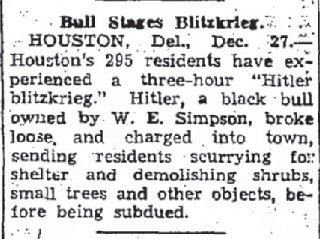
“If he gets into civilization,” warned a county police inspector named James Hoey, “we’ll put him out of circulation.” As if Hitler were an errant postage stamp.
Police and park attendants followed the bull in the gathering darkness. As Hitler neared the town of Library, an assistant park custodian ended the bull’s big adventure by pumping two bullets into its head.
The wily Napoleon, meanwhile, calmly returned to the corral. Now no bull was strong or mean enough to challenge his control. On this night, there would be no Waterloo.
http://newsinteractive.post-gazette.com/
News Interactive Post Gazette
1946 – 1954 Greys River Bull Wyoming State Museum It is known as the Governor “Doc” Rogers Bison.

A friend of mine was recently on vacation in Wyoming and he sent me this picture. So I reached out to the museum and found out a little history on this bison bull.
Jim Allison from the museum said,
Update sent to me by Jim Allison
Rapid City Journal July 22 1982
Wyoming’s Capital Buffalo Replaced
by Marguerite Herman
CHEYENNE, Wyo. – After 35 years of faithful service, the buffalo in Wyoming’s Capital has been replaced by a new, 5 foot 8 version from the state’s own herd at Hot Springs Sate Park.
The new buffalo was rolled into place just off the rotunda this week, and the old was taken to Frontier Taxidermist to be prepared for shipment to its new home.
The new buffalo weighed about 2,200 pounds when it was shot at the park and taken to Cheyenne’s Frontier Taxidermist, which has a worldwide reputation for its mounting of big game animals. The job and materials, including a stone platform for the animal and a brass plate noting its scientific name, “ bison bison bison.” cost $3,200.00
Taxidermist Roy Ostermiller said the 12-year-old bull’s horns were rated the fifth largest on record with the Boone and Crockett Club Record of North America Big Game Trophies, which ranks trophy sizes. The animal measures 5 feet, 8 inches from his foot to the top of his shoulder, he said Wednesday, a day after the new buffalo’s installation.
Ostermiller said the bull was shot “in the dead of winter when its fur was in excellent shape.” The animal was old and getting “onery,” and the park officials feared he may have had to be destroyed anyway to avoid problems, Ostermiller said.
The winter and spring were spent fitting the skin over a special model to fit the large animal.
Frontier Taxidermist also mounted the elk that stands in the Capital Building rotunda.
A crimson felt padded rope surrounds the buffalo to discourage people tempted to run their fingers through the woolly, black fur. Ostermiller said he’s urged state officials to do the same for the mounted elk, because of damage done by petting hands.
Elk fur is hollow, and when it’s rubbed the wrong way it breaks off, he said. The trophy the new elk replaced recently had a nearly naked flank from the friendly pets of visitors.
Buffalo aren’t as badly damaged by handling, but Ostermiller said fur on the buffalo replaced Tuesday was horribly matted from 35 years of well meaning handling. He said he could restore it for future display though.
The new buffalo, if left alone and periodically maintained by Frontier Taxidermist,” should last for 100 years, “Ostermiller said.
Nov 22. 1954
Capitol to Show Wyoming Bison ( Governor “Doc” Rogers Bison)
CHEYENNE, Wyo. Gov. C. J. (Doc) Rogers disclosed Sunday, after the first of the year a mounted, life-size bull buffalo will be placed displayed at the capitol. J. Bob White, Dubois taxidermist has been award the contract of the one ton bison.
The huge guy at 8 years old, come from a herd of 32 Buffalo in the Afton area. He had become aggressive recently and it was clear he needed to be removed from the herd.
In the last year, he had gored several elk and killed a bison cow, in the Grays River feeding area.
Rogers said it was fitting that he be shown at the state capital as he was a fine specimen and the bison is part of the state flag.
Mrs. A. C. Keyes of Casper, designed the Wyoming state flag, with the seal in its center as a brand on a large buffalo, and adopted by the 14th Legislature on Jan. 31, 1917.
I read another story a couple years prior to this one, where two cowboys out looking for stray cattle on the state land were cornered by two bison bulls and the distraction of the cowboys’ dog, allowing them time to escape.
Casper Star Tribune
Casper Wyoming Oct 29, 1951
Buffalo Bull Give Horseman Bad Time
Legendary Jumbo
In July of 1969 Don Lou Farm in Wisconsin purchased a purebred bison bull from Nova Scotia Properly named Jumbo, the real deal. Jumbo weighed 3340lbs. Don Thompson purchased the bull in an effort to bring back some character traits that he believed were missing. He also had plans to purchase a couple full blood registered bison cows from different herds. Just a short 2 years later, he sold Jumbo to the Flocchini Ranch. He was used 3 years on the Durham Ranch and his genetics are probably still in their herd today.

Mr. and Mrs Armando Flocchini at the Durham Ranch in Wy. and Durham Meat Co of San Jose, Cal. feeding Jumbo apples.
Jumbo was born cir. early 60’s
The Flocchini family- Durham Bison Ranch owned Jumbo for several years and he was a single sire bull for them and died of natural causes, and to this day his pasture still bears the name ” Jumbo”.
Special thanks to the family for sharing their Jumbo memories for the rest of us to know, yes he did exist!
In 1978 Judith Hebbring of Custer S.D. wrote that there was a semi-domestic bison bull that weighed 3800lbs. “Maximum record mass is 1724 kg (3800 lbs) for a semi domestic bull Hebbring 1978” Published in Mammalian Species 1986 by The American Society of Mammologist. – M. Meagher [ 1,724 kg vs 3800.769 lbs]
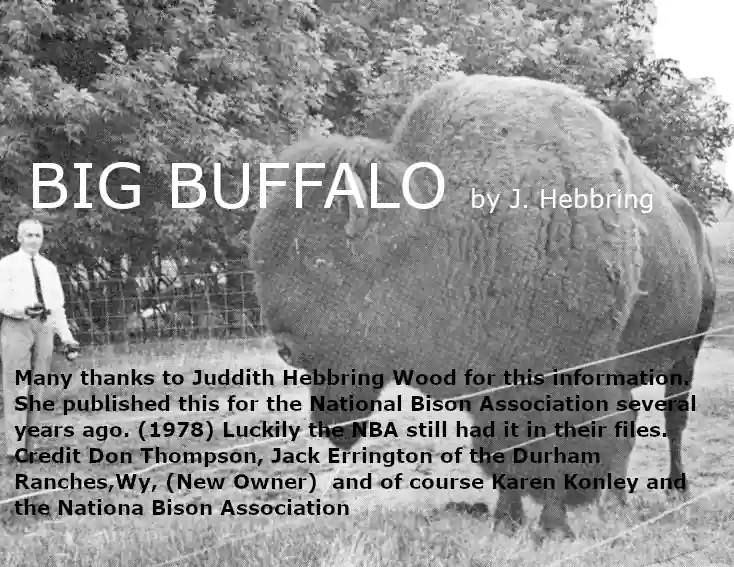
BIG BUFFALO! by Juddith Hebbring
(Thanks to Don Thompson for the photo and back ground material)
In 1972, in the first issue of BUFFALO!, a short piece was written on JUMBO the largest buffalo on record. In recent months this office has been in contact with the original owner of the big brute and he has supplied us with a photo of JUMBO. The original article stated that Jumbo was purchased by Jack Errington of the Durham Ranches. He was 10 years old at that time and his weight was reported as 3.340 lbs. That was his weight after shipping. At the time this photo was taken, shortly before he was sold, his weight was 3.800 lbs., which we will consider a record unless we hear otherwise.
Donald Thompson, the buffalo farmer from Mishicot, WI, who was Jumbo’s original owner gave us the details on this picture. It seems there is an interesting story behind it. At the time the photo was taken, there was a camera crew from a Wisconsin TV station doing a documentary on the buffalo. If you examine the picture carefully, you will notice some dug up dirt near Jumbo’s front feet. That is where a camera and tripod had been moments before. Jumbo had taken offense at the attention he was getting and demolished the camera. Mr. Thompson estimates that the film crew was around two blocks away at this time and still running. Don (pictured) was trying to settle the huge animal down by offering him apples, which he dearly loved. Mr. Thompson’s efforts at soothing Jumbo were successful, luckily, as the only thing keeping him in was a flimsy electric fence. Mr. Thompson stresses that buffalo are “predictably unpredictable and should be treated as a wild, dangerous animal for the safety of all concerned.”
Don has some large offspring from Jumbo, but none as large as the original.
Green Bay Press
Green Bay, WI Mar 30, 1986
Thompson, intrigued by the possibility of raising bison, bought some of the huge humpbacked animals at a South Dakota auction and became Buffalo Don.
He entered the annals of buffalo lore in 1969 when he sold a 3,340-pound bull named Jumbo. That was a record size for buffalo.

2004 Coby
The next monster on my list is this guy, weighing in at 3150lbs.
I am still waiting on further information about his life and I understand he has been head mounted. He was owned by a ranch in California.
Rocky Bison Ranch
Coby and his mother were purchased from Doc Jarbey in Adin, California about 2003. Coby was born 2004. He was our first born calf on the ranch. His daddy was a prize bull that Doc Jarbey purchased at an auction. When he died, he weighed 3150 lbs.
Mr. Big, weighing in at 2400lbs to possibly 2800lbs.When I asked about
him. I needed measurements for my sculpture, he stated his chest was about 36 inches.
Bill Bitner wanted to try and reproduce him and bought some of the bulls offspring from Durham in the early 80’s and line bred to try and recreate the bull. One calf he bought was Mr. Big, who grew up to be 2400-2800lbs. Bill kept him for about 10 years and sold him to Jack & Marie Evens in Saskatchewan. They kept him for the rest of his life. Much of his offspring was shown and won in Canada and the U.S. Cee Stumborg recollections from those days. They are known for their gentle nature.

Cee Stumborg who was friends with Bitner built his entire herd from this stock. He is the one who gave me the image of Big at 8 years old.