Listed Order: Texas, Okahoma, Idaho, Minnesota, Colorado, New Mexico, Nebraska and Arkansas
TEXAS
Cibolo Creek, South Central Texas

Prior to European settlement, Cibolo Creek was referred to as Xoloton by the Coahuiltecan Indians. The Tonkawa called it Bata Coniquiyoqui, as noted by Father Damian Massanet, who referred to the creek as Santa Crecencia in 1691. It is thought that Coahuila Governor Alonso de Leon had one of the earliest encounters with the creek in 1689 while on the first Spanish entrada to explore the French-claimed lands believed to lie beyond the Nueces River. Records suggest a camp was set up on the creek, identified as Arroyo del Leon, coined from the discovery of a dead mountain lion along the banks. Explorer Domingo Terán de los Ríos named the creek San Ygnacio de Loyola in 1691 during an expedition and Domingo Ramón referred to it as San Xavier in 1716. The first known use of the term Cibolo came from Marqués de San Miguel de Aguayo who identified the stream as Río Cibolo, or Cibolo River, in 1721. Cibolo is a Spanish and Native American term for American bison (buffalo),] which used to inhabit the area. The Native Americans are believed to have used the steeply banked bluffs along the creek as hunting grounds, chasing herds of buffalo into the bed where the creatures would fall to their deaths.
^ a b c Weinert, Willie Mae. “Cibolo, Texas”. Handbook of Texas Online. Texas State Historical Association. Retrieved 16 March 2010
^ a b c d “Cibolo Creek”. Handbook of Texas Online. Texas State Historical Association. February 22, 2010. Retrieved 15 March 2010.
^ Foster, p. 22 ^ Bandelier, p. 132 ^ Tarpley, p. 46
Bonfire Shelter- 
Coahuiltecans tribe or Paleo?
South West Texas,
At the Bonfire jump-site in southwest Texas, archeologists found the bones of hundreds of buffalo that plunged over a cliff to their death on a massive pile of rocks. Native American hunters in the area had used the kill site as early as 12,000 years ago! It is clear, however, that prehistoric hunters did not stage mass kills frequently. They were once-in-a-lifetime events for the hunters. There was evidence of perhaps only four successful jump-kills at the Bonfire site over its long history. Many other times hunters must have tried and failed to trick the buffalo into “falling for” their plan.
There were other methods for mass kills. Prehistoric hunters also herded buffalo into enclosed areas, such as box canyons, or into corrals made of poles where they would kill the trapped animals.
Hunters herded the bison and drove them over the cliff, breaking their legs and rendering them immobile. Tribe members waiting below closed in with spears and bows to finish the kills. The Blackfeet Indians called the buffalo jumps “pishkun”, which loosely translates as “deep blood kettle”. This type of hunting was a communal event which occurred as early as 12,000 years ago and lasted until at least 1500 CE, around the time of the introduction of horses. These hunts were never witnessed by European settlers. The broader term game jumps includes buffalo jumps and cliffs used for similarly hunting other herding animals, such as reindeer. The Indians believed that if any buffalo escaped these killings then the rest of the buffalos would learn to avoid humans, which would make hunting even harder.
Buffalo jump sites are often identified by rock cairns, which were markers designating “drive lanes”, by which bison would be funneled over the cliff. These drive lanes would often stretch for several miles.
Buffalo jump sites yield significant archaeological evidence because processing sites and camps were always nearby. The sites yield information as to how the Native Americans used the bison for food, clothing, and shelter. Plains Indians, in particular, depended on the bison for their very survival. Every part of the animal could be used in some way: hides for clothes and shelter, bones for tools, sinews for bowstrings, and laces. Hooves could be ground for glue, and the brains could be used in the tanning process for the hides. The extra meat was preserved as pemmican.
In one of his journals, Meriwether Lewis describes how a buffalo jump was practiced during the Lewis and Clark
Expedition: “one of the most active and fleet young men is selected and disguised in a robe of buffalo skin… he places himself at a distance between a herd of buffalo and a precipice proper for the purpose; the other Indians now surround the herd on the back and flanks and at a signal agreed on all show themselves at the same time moving forward towards the buffalo; the disguised Indian or decoy has taken care to place himself sufficiently near the buffalo to be noticed by them when they take to flight and running before them they follow him in full speed to the precipice; the Indian (decoy) in the meantime has taken care to secure himself in some cranny in the cliff… the part of the decoy I am informed is extremely dangerous.
Source: A Buffalo Jump, Discovering Lewis and Clark, The Lewis and Clark Fort Mandan Foundation
Mass Kills. Texas Beyond History. Wednesday, May 29, 1805. The Journals of the Lewis and Clark Expedition (Volume 4). Gary E. Moulton, Editor
Lake Theo – Texas, Folsom Bison Kill Site
Stone tool fragments were discovered in 1965 and 1972 on the shores of Lake Theo, named for former landowner Theodore Geisler. Archeological testing in 1974 revealed a campsite and bison butchering and processing area dating back to the age of Folsom man, between 10,000 and 12,000 years ago. Projectile points and scraping tools were found at a depth of four feet, along with over 500 bones from an extinct type of bison. Ponds in Holmes Canyon, now covered by Lake Theo, probably attracted prehistoric men to this area. (1978)
Lake Theo Folsom Bison Kill Site at the park became one of the most important archeological sites in the study of human-bison interactions. This 10,000-year-old archeological site yielded valuable information about Paleo-Indian culture and the methods used to hunt a now-extinct form of bison known as Bison antiquus. Bison leg and jaw bones were found in a manmade circular pattern at the site, illustrating the sacred, long-standing relationship between man and beast. The bones are on display at the Panhandle-Plains Historical Museum in Canyon.
Source:WikiMediaTP&W
Lubbock Avalanche-Journal
Lubbock, Texas Sep. 8th 1974
Rich Traces Of Folsom Man Revealed
QUITAQUE (Special)
Perhaps more than 10,000 years ago, Paleolithic men roamed the plains of the Panhandle, hunting giant bison and existing only through the strength of their legs and their flint tools.
Year of dirt brought by a changing climate hid the traces of them until recently when a team of three archeologists from the Panhandle-Plains Historical Museum in Canyon uncovered one of their bison kill sites.
The Lake Theo site, located near Quitaque on the south rim of Holmes Creek, has proved far richer in traces of the Folsom culture Indian than other sites worked in the region.
Bill Harrison, Museum curator of anthropology, and his assistants Henry Smith of Amarillo and Eddie Kiser of Canyon, both West Texas University students, have carefully unearthed more than seven Folsom period flint artifacts, including projectile points, butchering tools, and knife fragments.
Two of the Folsom points are complete, while another’s two neatly snapped segments were found seven feet apart.
An extensive bone bed of now extinct giant bison extends at least 115 feet back from the primary site and 60 feet wide, suggesting that the was once the flat rim of a playa lake where bison had mired or were trapped in the gummy bottom and the kill made.
“This is the second such find on the lower rolling plains below the Caprock,” Harrison said.
Frank Two, amateur archeologist from Amarillo, first reported the site to the museum in 1972. He had collected two Folsom point bases and several end scrapers with gravers from the eroded surface, Harrison reported.
In October 1972, the site was visited by Harrison and Ray Thompson, a Museum volunteer who collected more point fragments and another end scraper, while noting vast amounts of sun-bleached bone on the surface of the site.
Reports of relic hunters looting the site in May 1974. spurred the Museum personnel to action, and an appeal to the Texas Historical Commission yielded a $4,000 grant. Work began June 21, 1974.
Now, through painstaking excavation of 23 five-foot squares of surface worked to depths of six feet on the shelf edge and eleven feet more than 100 feet back, Harrison’s team has uncovered a rewarding glimpse of prehistoric culture, the Folsom era Indian, one of the oldest known inhabitants of North America.
‘‘In addition to a kill or butcher station,’’ Harrison’s report pointed out, “It appears that we have a habitation site.”
“We really don’t know much about the Folsom era Indians,’’ Museum director James A. Hanson said. “We know that they were nomadic hunters who traveled long distances since there is flint in the Lake Theo site from as far away as the Antonio area. They were also highly skilled at tool construction, and incredible hunters, for they killed these giant bison and mammoths.”
The descent to the bone bed began first with a shovel, with the dirt being carefully sifted through screens. Once reaching approximately one foot above the bed, the men began working with small trowels, wetting the surface and then scraping off the topsoil gingerly, when they touched the top of the artifacts, they used small brushes to uncover the crumbling surfaces,
Permission of Curtis Tunnel!, state archeologist, has now been received to remove the initial layer of bone and flint after grid photography and ink sketches have recorded their exact positions so that Harrison and his team can continue the search in the layers below.
The bones will be soaked in a solution of glue and water to strengthen them so that they can be moved to the Museum.
Plainview, Texas
Plainview points are Paleo Indian projectile points dated between 10,000–9,000 Before Present. The point was named in 1947 after the discovery of a large cache of unfluted, lanceolate spear tips with concave bases that were found in a Bison antiquus kill site along the Running Water Draw river, near the town of Plainview in Texas. The point is found primarily throughout the South Plains, however, this range may sometimes be misidentified, as “Plainview” was previously used as a general term to describe unfluted lanceolate points throughout the entirety of the Plains, as well as the eastern Upper Mississippi Valley.

PLAINVIEW — It’s not quite an arrowhead, but not quite a spearhead.
The Plainview point is a weapon all its own. The device has been the subject of a giant body of research since a pair of Boy Scouts found the first of its kind in the mid-1940s.
At its location along Running Water Draw on the south-central side of town, check out an arrangement of newly planted hackberry trees. Soon, if plans proceed, the Plainview Point Kill Site will also contain a gazebo, brick terrace, and herd of buffalo statues.
Nearby, a plaque and a Quanah Parker Trail arrow have stood for a few years now.
“It’s a registered archaeological site and a registered historical site, and we think if we can get this done we can pull some tourism,” Sam Van Hoose said. “And from an educational standpoint, for our kids, they can learn how people lived 8-9,000 years ago.”
Van Hoose teaches computer science at Wayland Baptist University and leads the university’s chapter of the worldwide, nonprofit service group Enactus. Wayland’s 12 or so Enactus members spent much of their free time at the park before the semester wrapped up, strategizing the project and planting the hackberry trees. They received the first three bison statues last week and anticipate the rest of the herd will arrive later.
The rest of the renovations committee consists of local civic leaders and other Hale Countians.
“I’m excited about it,” said Rodney Watson, director of Wayland’s Museum of the Llano Estacado.
Funding comes from various sources, said Andrew Freeman, Plainview’s assistant city manager, and another committee member. The 19 trees, for instance, came from a grant, and the bison were purchased through money left over from a previous fundraising project.
The “draw” in Running Water Draw refers to a sharp elevation drop near the Plainview point collection site. Its jump now is a few feet or so; Van Hoose suspects it was steeper thousands of years ago.
The fall probably wasn’t enough to kill the bison Native American hunters chased off it, but it could at least break their legs. The hurt bison at that point made easy prey for the hunters’ spears.
That first documented Plainview point preceded a collection of others. Diggers eventually found more at the site; others of its kind were later found elsewhere in Texas and the Midwest and into the Northeast.
“The largest collection was found here,” Watson said. “Most tribes as they migrated, families would teach their kids how to make points. Through the generations, tribes that migrated tended to have similar points. Each one would have similar markings and (other) similarities.”
The Boy Scouts who found that original point presented it to one of their fathers, who agreed it seemed a significant find. He sent it to the University of Texas for testing. Longhorn researchers have since made at least two trips to the kill site for excavation projects, Van Hoose said.
The committee is raising funds to build a gazebo at the kill site. For more information or to make a donation, contact Van Hoose at vanhoose@wbu.edu.
josephine.musico@lubbockonline.com
Josie Musico / A-J Media
May 20, 2016
Lipscomb Bison Quarry in the extreme northeast Texas Panhandle (Folsom bison kill)
Caprock Canyon, Texas – https://tpwmagazine.com/archive/2023/nov/ed_2_jump/
“These collective drives of bison as a way of hunting are a really dramatic thing that lingers really prevalently in the psyche of Plains Native Americans hunting,” says Gus Costa, an archeologist who’s working on the newly discovered site. “[Bison drives often] were an annual event where people were getting together, hunting bison, having a feast and doing lots of interesting social things.”
“The fact that we found this site is pretty incredible,” says Tamra Walter, an associate professor of archeology at Texas Tech University. “It’s a once-in-a-lifetime kind of site. It’s so incredibly rare.”
Carbon dating places the bones in two major jump events taking place in 319 and 1379 AD. Many Southern Plains tribes have passed through the area, so it’s not clear which groups might have used the site. The site lies on lands used by people whose descendants form the Kiowa, Comanche and Lipan Apache tribes as well as other groups.
“It’s pretty amazing and significant when you think about the continuous history of the buffalo nation of the Southern Plains being in this area of Caprock Canyons for thousands of years,” says Lucille Contreras, CEO and leader of the Texas Tribal Buffalo Project and a member of the Lipan Apache tribe.
OKLAHOMA
Flying W Guest Ranch: Sayre.Oklahoma

Has within its acreage a buffalo jump site documented as the largest and most complex bison kill site by Indians on the Southern Plains. At this site, the Plains Indians stampeded herds of bison over a cliff and into a canyon as an efficient means of slaughter. Archaeologists from the University of Oklahoma oversee the exploration and excavation at the Flying W Guest Ranch kill site, revealing the remains of an estimated 800 bison. The site is dated as being used by Native Americans between 300 BC and 300 AD.

600 YEARS OF BISON HUNTING At THE CERTAIN SITE FROM 300 BC TO AD 300 SPEAR WIELDING HUNTERS KILLED OVER 500 BISON IN THIS CANYON EARLY ON THE BISON WERE RUN OVER THE SANDSTONE CLIFF ON THE FAR SIDE OF THE CANYON BUTCHERING OCCURRED IN THE
CANYON BOTTOM AND SIDE GULLY LATER ON THE CANYON FILLED WITH SAND BURYING THE CLIFF AT THAT TIME BISON WERE RUN INTO THE FIVE SHORT DEAD END GULLIES AND KILLED BUTCHERING OF THESE ANIMALS OCCURRED IN THE SMALL GULLIES AND NEAR THE SPRING EXCAVATION BY ARCHAEOLOGIST AT THE OKLAHOMA ARCHAEOLOGIST SURVEY UNIVERSITY OF OKLAHOMA HAVE IDENTIFIED AT LEAST SEVEN SEPARATE KILL EPISODES THE SIZE OF THE SITE AND NUMBER OF KILL EPISODES MAKE THIS THE LARGEST AND MOST COMPLEX BISON KILL SITE ON THE SOUTHERN PLAINS
Badger Hole, Oklahoma along Beaver River
Bison kill site in Harper County, Oklahoma. 10,500-year-old Folsom Age site on a bluff near the Beaver River. Fifteen to 20 percent larger than modern bison, Bison antiquus bones make up the remains at the kill site. Skeletal remains of more than a dozen bison, some Folsom points — weapons used to kill bison — and some of the butchering tools Paleoindians used to cut up the animals. It dates back to right after the extinction of the mammoth at the end of the last ice age
Jake Bluff

University of Oklahoma, Norman, OK
The bison kill site at Jake Bluff, tentatively dated at about 10,750 years old, adds to a growing body of evidence that the Clovis had an eclectic diet and employed sophisticated hunting strategies. Two distinctive Clovis projectile points recovered at the site were fashioned of flint quarried in the Texas Panhandle, so the researchers know the group had traveled at least several hundred miles.
The bison kill site at Jake Bluff also adds to the evidence that as mammoth populations declined, Clovis hunting technology evolved accordingly.
Early mammoth hunters frequently preyed upon old, injured, or very young animals using the surround technique. The surround technique involved trapping an animal in a bog or swampy area, surrounding it, and spearing it to death. Only one or two animals were killed at a time, and the process could be extremely dangerous.
At Jake Bluff, hunters used the arroyo or nick point technique. A band of hunters herded 10 to 15 bison into a dead-end gully known as an arroyo; then, hunters sitting 8 to 10 feet (3 meters) above on the rim of the gully speared them.
Overkill versus Climate Change
Another point of contention is the role of Clovis in the extinction of the large mammals of the Ice Age, sometimes referred to as megafauna.
When the Clovis first arrived, North America was home to mastodons, beavers the size of bears, giant sloths, camels, mammoths, and other large mammals. Less than 1,000 years later, these giant creatures were on the brink of extinction. Proponents of the overkill theory argue that the animals were hunted to extinction by humans.
Others argue that the extinction resulted from the loss of food and habitat associated with climate change.
“The [Jake Bluff] bison kill provides ample proof that Clovis people were actively hunting bison. Why didn’t they become extinct?” said Russell Graham, a paleontologist and chief curator at the Denver Museum of Nature and Science. “We have no evidence that they were hunting camels or horses or many of the other Ice Age megafauna that did become extinct.”
The find “puts another chink in the armor of the overkill fight,” he said. http://news.nationalgeographic.com
The Jake Bluff Gully graphs. https://www.ou.edu/archsur/JakeBluff/jakebluff_res.htm
Bluff East
During the excavation of the Jake Bluff bison kill site (Bement and Carter 2010), an area of bison bone fragments was identified 50 m downstream from the Clovis and Folsom cultural manifestations and referred to as Jake Bluff East. Investigation into this deposit in 2004 identified a dispersed pile of butchered bison bone on a bench between two arroyos.
For more on this site please see K Carlson(roughly a 2-page paper with details of the findings)
Carlson and Bement report their findings in the journal PaleoAmerica.
Cooper
The Cooper Bison Kill Site is an archaeological site near Fort Supply in Harper County, Oklahoma. It was explored in 1993 and 1994 and found to contain artifacts of the Folsom tradition, including arrowheads. It is believed that these artifacts are the results of hunters killing bison in an arroyo. The hunters of this culture found the site continuously useful; the known artifacts are believed to be the results of three different hunts.
Archaeology in America described the Cooper Site as “…a gully feeding the North Canadian River,” which contained evidence of three separate kills, with between twenty and thirty animals in each kill.[a] All three kills occurred during late summer or early fall, and each kill contained the remains of cows, calves, and young bulls. Tools found at the site consisted only of projectile points and large flake knives.
The site has been dated to 10,900-10,200 BCE. In 2002, the site was listed on the National Register of Historic Places. A unique find at the site was that of a Bison antiquus skull, painted with a red zigzag. The Cooper Bison Skull is the oldest known painted object in North America. The skull is currently in the collection of the Sam Noble Oklahoma Museum of Natural History at the Norman campus of Oklahoma University. (source)
Bull Creek Paleoindian Camp, Oklahoma Panhandle
IDAHO
Idaho Heritage
The Challis Bison Kill site and its associated Quill Cave provide one of the best-known archeological complexes in central Idaho. It has been an important site for the development of models of bison ecology and the role of the bison in the local native economy. It is on the National Register of Historic Places.


Bison Kill Site
Challis, Custer County
Grant: 2007
Location: Located near Land of the Yankee Fork Visitors Center, Challis, Idaho
Five Fingers Buffalo Jump SW Idaho
“Y” Buffalo Jump SW Idaho
In a 1976 paper, Agenbroad described the Five Fingers and “Y” Buffalo Jumps in southwestern Idaho. The features are described as Classic Plains Bison Jumps (bison kill site) . This paper evaluates Agenbroad’s contention in view of the archaeological and ethnographic data for southwest Idaho as it relates to bison. Further, a recent reexamination of the faunal remains from the Five Fingers Jump is reviewed. The sites are interpreted as probable artiodactyl hunting facilities.
MINNESOTA
Blue Mound State Park, Minnesota (possibly)
Located in southwestern Minnesota on the Iowa and South Dakota borders. The cliff, one and one-half miles long and up to ninety feet high, appeared to be blue in color to the early Euro-American immigrants who saw it from a distance.
Plains Indians depended on the bison to survive. Different weapons were used to kill bison including the lance, and the bow and arrow. It is not known if the park’s quartzite cliffs were used by the Plains Indians to stampede the bison off the cliff. Local rumors have persisted for years on the existence of large quantities of bison bones piled at the base of the cliff.
No evidence exists today to substantiate these claims and stories. The large rock outcrop, first known as “The Mound,” has provided the park area with an exciting past. The cliff appeared blue to settlers going west in the 1860s and 1870s. They named the prominent landmark, the Blue Mound. The mystery of the Blue Mound is not restricted to the cliffs. At the Mound’s southern end is a 1,250-foot long line of rocks aligned in an east-west direction. Who built it and why is unknown. It is known that on the first day of spring and fall, the sunrise and sunset are lined up on this stone alignment.
Itasca, Minnesota Nicollet Creek
Granite Falls Kill Site est. 6000 BC (Known as the Peterson Site)
Found in Aug 1988 by LeRoy Peterson , owner of the land. Now known as the Peterson site, it has been recognized as one of the oldest known bison kill sites in Minnesota, and one of a handful of Early Plains Archaic bison kill and processing sites in America.
Not only did archaeologists uncover ancient bison bones, but they also found the spearheads that were used by the hunters to bring them down, in addition to the knives and chopping tools that were used for processing their meat and hides.
COLORADO
Jones-Miller Bison Kill Site, Colorado, in the northeast, was a Paleo-Indian site where Bison antiquus were killed using a game drive system and butchered. Hell Gap complex bones and tools artifacts at the site are carbon dated from about ca. 8000-8050 BC
Remains of 300 bison were found in an arroyo, or draw, above the Arikaree River basin. It was believed that the bison were strategically driven into an area difficult for the bison to traverse and easier to kill on three occasions. Because many of the animals were nursing calves, it is estimated that the kills occurred in late fall or winter. The bones from the bison kill were piled into many stacks, indicating that there were several butcher sites.
Olsen-Chubbuck Bison Kill Site
The Olsen-Chubbuck Site is in an old arroyo about thirteen miles southwest of Cheyenne Wells and sixteen miles southeast of Kit Carson in Cheyenne County. It lay under land owned by rancher Paul Forward until the late 1950s, when erosion caused by several years of drought revealed a clear outcropping of bones. On December 8, 1957, Jerry Chubbuck noticed the outcropping while driving by. A quick investigation yielded a Paleo-Indian projectile point and an end-scraper. Chubbuck notified Joe Ben Wheat of his find, but Wheat was busy with another dig and could not immediately visit the site. In the meantime, Chubbuck and Sigurd Olsen of nearby Kit Carson began to excavate. In addition to the bone bed, which soon yielded fifty skulls, they found human artifacts including two dozen projectile points or point fragments and several stone tools.
In April 1958 Wheat visited the site, recognized its importance, and asked Chubbuck and Olsen to relinquish their digging permit. They did, allowing Wheat and the University of Colorado Museum to excavate the site thoroughly in the summers of 1958 and 1960.
As the excavation proceeded, the shape and extent of the bison bone bed gradually became clear. The bone bed occupied an old arroyo channel that cut across the locally normal drainage pattern and was probably formed from an eroded bison trail. At its narrow end it was one to three feet wide and one to three feet deep, and it grew to maximum dimensions of about fifteen feet wide and seven feet deep. The bone bed stretched for roughly 170 feet within the arroyo, with an average width of five feet and a maximum depth of six and a half feet. The bones in the arroyo had apparently created a natural dam that trapped sediments in runoff water until the bones were completely covered and the arroyo filled in. source-more info
Roberts Buffalo Jump in northern Colorado (Private ranch)
The Roberts Ranch Buffalo Jump in northern Larimer County is a Protohistoric period (1540–1860 CE) bison kill and butchering site that dates to about 1663–84 and represents one of the southernmost bison jump sites on the Great Plains. Discovered in 1957, the site was excavated in the late 1960s by amateur archaeologists from Denver and students under the supervision of W. James Judge of Colorado State University (CSU). Starting in 2012, Christopher Johnston of CSU reanalyzed the site and its artifacts using recent research to reconstruct the spatial division of task areas at the site. source- more info
NEW MEXICO
Folsom site in northern New Mexico designated by the Smithsonian trinomial 29CX1, is a major archaeological site about 8 miles (13 km) west of Folsom, New Mexico. It is the type site for the Folsom tradition, a Paleo-Indian cultural sequence dating to between 9000 BC and 8000 BC. The Folsom Site was excavated in 1926 and found to have been a marsh-side kill site or camp where 23 bison had been killed using distinctive tools, known as Folsom points. This site is significant because it was the first time that artifacts indisputably made by humans were found directly associated with faunal remains from an extinct form of bison from the Late Pleistocene. The information culled from this site was the first of a set of discoveries that would allow archaeologists to revise their estimations for the time of arrival of Native Americans on the North American continent.

s a historian of science, I am interested in determining who gets credit for scientific discoveries and why. Sadly, credit often goes to the powerful and connected, not to the people who actually do the work. Gender, race, status, and age discrimination often play a role in these narratives.
Examples of scientific injustice are finally entering more of the public’s consciousness, however. One well-known example is the 2016 Hollywood film Hidden Figures. It tells the story of Katherine G. Johnson, Mary Jackson, and Dorothy Vaughan—three African American mathematicians who were instrumental in the success of the 1960s Cold War space program but did not get the credit they deserved.
January 22, 2022, marks the 100th anniversary of the death of George McJunkin, an African American cowboy in northeastern New Mexico during the late 19th and early 20th centuries.
Why is the anniversary of McJunkin’s passing worth celebrating? He discovered what became known as the Folsom site, an ancient bison bone bed where scientists came to accept the idea that Native Americans lived in North America during the last ice age—thousands of years earlier than most scientists then believed. McJunkin is also important to many Black people today because he is one of many historical figures finally gaining credit for their myriad contributions to science, politics, and other disciplines over the centuries. In 2019, George McJunkin was inducted into the Hall of Great Westerners at the National Cowboy and Western Heritage Museum.
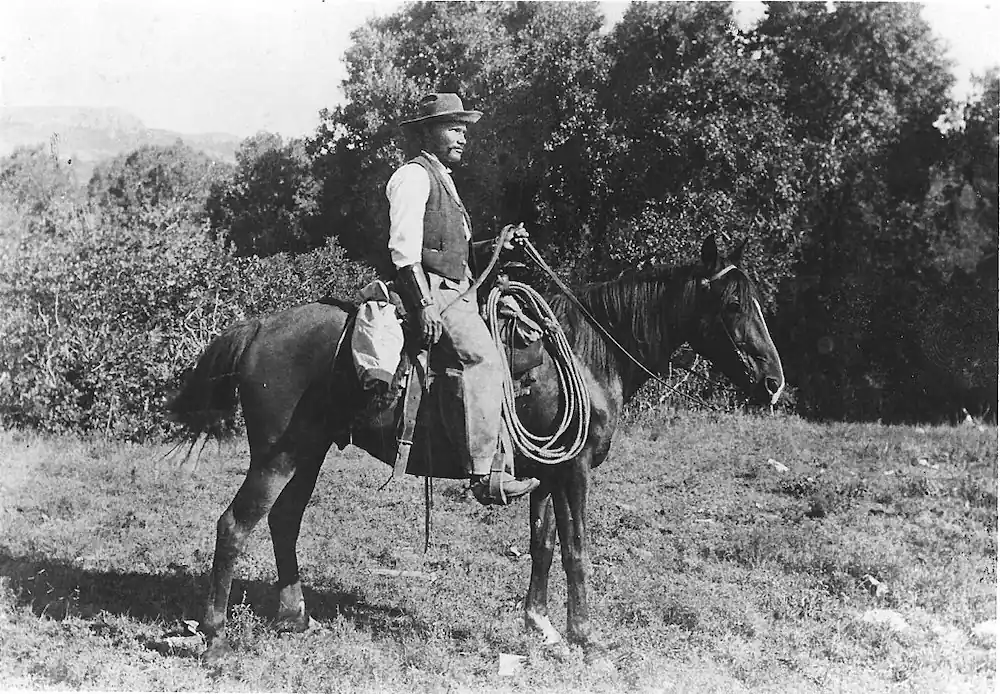
George McJunkin, a self-taught naturalist, found numerous ancient stone tools, ceramics, and animal bones while working in New Mexico. Kokopelli-UK/Wikimedia Commons
But what exactly did George McJunkin discover? A quick Google search on “George McJunkin” yields dozens of articles and books—and their statements range from vague to conflicting.
Many, like a National Park Service brochure, give him credit for making “an incredible discovery that changed the world of North American archaeology forever.” A recent story in Science for the People claims, “McJunkin made a pivotal discovery that resulted in an archaeological paradigm shift worthy of celebration as a ‘scientific revolution.’” An Arkansas Archeological Survey story suggests McJunkin found human-made artifacts at the Folsom site. Others give McJunkin credit for discovering the Folsom site while glossing over the question of whether he knew it contained evidence of ancient humans.
To paraphrase the famous question from the Watergate scandal of the 1970s, it is instructive to establish what McJunkin knew and when he knew it. Only then can we fully appreciate him. Only then can we do his scientific legacy full justice.
On August 27, 1908, when McJunkin was manager of the Crowfoot Ranch, an unusually strong summer thunderstorm dropped 13 inches of rain on Johnson Mesa, several miles northwest and upstream of what we now call the Folsom site. A flash flood swept through the region, wreaking havoc and downcutting arroyos.
They understood why McJunkin had been excited: The bones were huge and unlike those of any modern animals.
After the storm, McJunkin ventured out to repair broken fence lines. He noticed large bones protruding from the newly eroded base of Wild Horse Arroyo. With his knowledge of animals and natural history, McJunkin determined the bones belonged to bison much larger than any modern bison he had encountered. He collected some bones and took them back to his cabin, where they took pride of place on a mantle.
From then until his death, a period of nearly 14 years, McJunkin tried to get friends and associates out to see the site. But none came. The trip required an arduous two-day horseback ride that most were unwilling to endure, and few, if any, people in the region had a car.
Then in 1922, Carl Schwachheim—a blacksmith and amateur naturalist from Raton, New Mexico, whom McJunkin had told about the bones—convinced banker and car owner Fred Howarth to make the journey. On December 10, 1922, nearly a year after McJunkin’s death, the two drove to the Folsom site. They immediately understood why McJunkin had been so excited: The bones were huge and unlike those of any modern animals.
To learn more about the bones, on January 25, 1926, Schwachheim and Howarth met with Jesse Dade Figgins, the director of the Colorado Museum of Natural History (CMNH) in Denver. Several weeks later, CMNH honorary Curator of Paleontology Howard Cook confirmed the bones were those of Bison antiquus, an extinct ice age bison. Figgins immediately committed his museum (now the Denver Museum of Nature & Science, my current employer) to further work at the site.
Excavation at the Folsom site began in May of 1926. Everyone involved initially believed it was a paleontological dig—not an archaeological dig searching for human-made artifacts. The team’s charge was to look for reasonably complete and intact skeletons of ice age mammals for display at the museum.
That said, Figgins had long been interested in the scientific problem of ancient humans in North America, and he told Howarth and Schwachheim to keep their eyes open for the possibility of finding stone tools. However, it was only that: a possibility.
On July 14, 1926, the team unexpectedly found a stone spear point. It was unlike any other then known. But because they found it in a pile of excavated dirt and not in its original burial context, Figgins knew the archaeological establishment would not accept it as proof that humans lived with ice age animals in North America.
The museum conducted a second excavation season in 1927. On August 29, the team discovered another stone spear point, this time embedded in the ribs of a bison. They left it in place, contacted prominent archaeologists via telegram, and waited for them to visit the Folsom site to confirm the discovery in person.
As I pointed out in a previous column, this was not necessarily a “eureka!” moment. But it did ultimately lead to scientific and public acceptance of the idea that Native Americans were present in North America far earlier than these groups previously believed. It also appeared to confirm what Native Americans had been saying all along—that they have been here since “time immemorial.”
To correct some of the public narrative: George McJunkin could not have known the site he found would revolutionize science. For 14 years, he knew he had discovered an interesting scientific locality based on the unusual bison bones, but he wasn’t aware it contained stone tools, and therefore evidence of ancient humans. Confirmation of that finding happened more than five years after his death.
It is unclear whether Schwachheim or Howarth ever mentioned George McJunkin to Figgins or Cook; neither of the latter men acknowledged McJunkin in their scholarly articles. (Figgins was a registered member of the Ku Klux Klan in the 1920s. It, therefore, seems unlikely he would have given McJunkin credit even if Schwachheim or Howarth had suggested it to him.)
It is important to celebrate how McJunkin’s initial discovery and advocacy for the site set in motion the later work that led to the new history of humans who lived during the ice age in North America. And it is admirable that a broader public is now celebrating rather than hiding the contributions made by people who too often have been left out of history books. But somewhere along the way, for some reason, McJunkin’s initial find morphed into the subsequent scientific breakthrough.
The earliest scholarly mention I can find regarding McJunkin’s Folsom site work is University of New Mexico archaeologist Frank C. Hibben’s 1946 book The Lost Americans, in which he gives McJunkin credit, without citing evidence, for finding arrowheads at the Folsom site in 1925 (three years after McJunkin’s death), an obvious discrepancy. Archaeologist George Agogino published “The McJunkin Controversy,” a short article in New Mexico Magazine intended to address, through systematic research, what McJunkin actually did at the Folsom site.
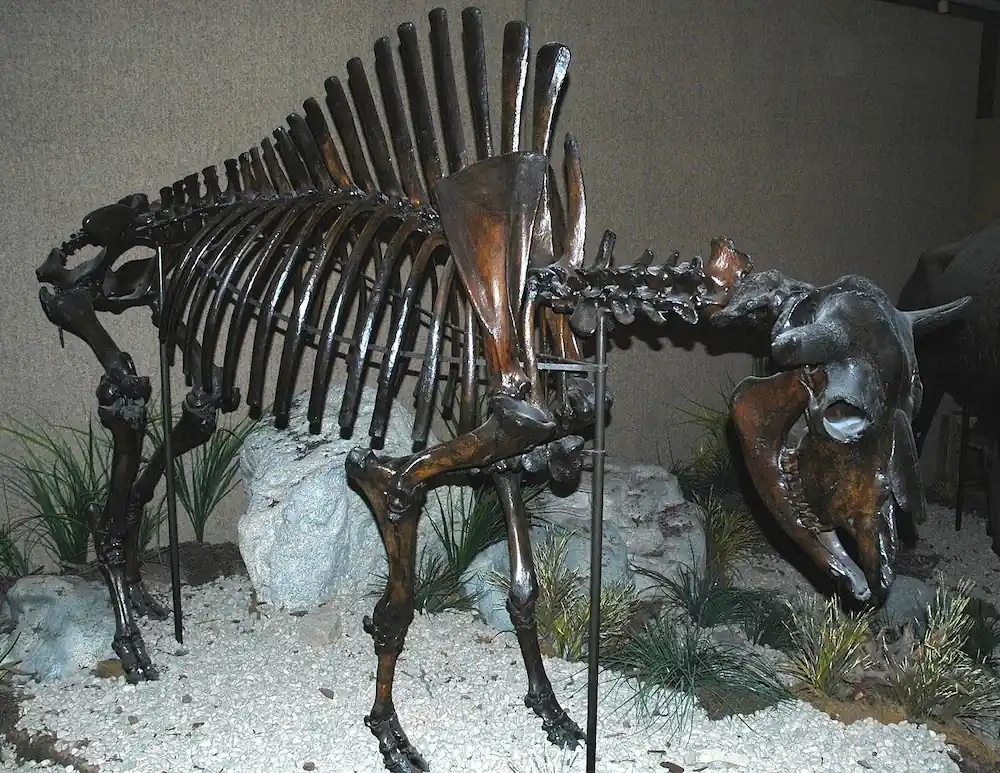
A skeleton of Bison antiquus, the ice age species George McJunkin found at the Folsom site, is on display at the Carnegie Museum of Natural History. James St. John/Wikimedia Commons
In that article, Agogino reviews findings based on archival research and oral histories collected by Adrienne Anderson, Mary Edmonston, Gail Egan, and Mary Doherty in the late 1960s. They confirmed that McJunkin discovered what later became known as the Folsom site. Agogino stated emphatically that McJunkin did not know about artifacts at the site: “[None of the archives] has a single sentence suggesting that McJunkin found, or even considered, the hand of man in the destruction of the bison.”
On the next page, however, Agogino concludes with a sweeping, dramatic, and ambiguous statement: “[George McJunkin’s] discovery at Wild Horse Arroyo was the start of a new and thrilling chapter in American prehistory, the story of the Paleoindian who entered the New World by way of the Bering Strait well over 12,000 years ago.”
To summarize, Hibben opened the door in 1946 to the idea that McJunkin found artifacts and bison bones at the Folsom site. Agogino appeared to close that door in 1971 but reopened it with a scientifically imprecise conclusion. In so doing, he inadvertently set off another half-century of uncertainty.
Histories get rewritten all the time, usually when new information comes to light. As a naturalist and collector committed to uncovering hidden histories himself, I like to think McJunkin would want his own story rewritten so that it can be told accurately. In any case, George McJunkin can be celebrated as an extraordinary man whose inquiring mind, intrepid spirit, and perseverance instigated finds that would transform archaeology.
A Black cowboy named George McJunkin, who died 100 years ago, found a site that would transform scientific views about the deep history of Native Americans in North America.
Proceedings of the National Academy of Sciences
-
Contributed by George C. Frison
The High Plains Paleoindian Chronology
Our knowledge of the chronology of Paleoindian hunting groups is based on stratigraphy and radiocarbon dates as well as on morphological and technological changes in weaponry and tool assemblages. The data are recovered in locations of human activity or sites named after a variety of situations, including their geographic locations, landowners, and individuals first credited with their discovery. Four stratified, multi-component sites, Blackwater Draw in eastern New Mexico (16); Hell Gap in southeast Wyoming (17); Agate Basin in east-central Wyoming (18); and Carter/Kerr–McGee in central Wyoming (19), complement each other in establishing and confirming the chronology. There are also numerous other sites with radiocarbon-dated dated components that augment this database (Fig. 1).

Figure 1
Locations of Paleoindian sites referred to in the text. 1, Agate Basin; 2, Blackwater Draw; 3, Carter–Kerr/McGee; 4, Casper; 5, Cattle Guard; 6, Colby; 7, Cooper; 8, Dent; 9, Finley; 10, Fletcher; 11, Folsom; 12, Hell Gap; 13, Horner; 14, Hudson–Meng; 15, James Allen; 16, Jones–Miller; 17, Lange–Ferguson; 18, Lindenmeier; 19, Lipscomb; 20, Mill Iron; 21, Olsen–Chubbuck; 22, Plainview; 23, Scottsbluff.
We do know that bison in Paleoindian times were larger and had different skull characteristics (Fig. 4 a and b) than the modern subspecies (Fig. 4 e and f). One important body of data on changes in Northern Plains bison comes from an arroyo kill radiocarbon dated at ≈6,500 years ago in the northeast Wyoming Black Hills with animals intermediate in size (Fig. 4 c and d) between modern bison and those of the late Pleistocene and early Holocene (31). The Black Hills of South Dakota and Wyoming during the period 8,000–5,000 years ago may have served as a refugium for bison while their numbers on the Plains declined. It is possible also that the Paleoindian bison hunting lifeway continued there during this period.

Figure 4
Male (a) and female (b) B. antiquus skulls; male (c) and female (d) 6,500-year-old intermediate type bison skulls; male (e) and female (f) Bison bison skulls.
This website has quite a bit of info (Abstract, Faunal Studies, Prehistoric Hunting and more)
and, if you’d like further reading, here is their link.
Thank you PNAS.org
Nebraska
Hudson-Meng site in western Nebraska
Buffalo Jump diorama displayed at the National Museum of Natural History, Native American Hall. From 35mm color slide. Smithsonian Institution Archives images 88-16885-88-16888


Arkansas
Curtis Varnell: Thousands of buffalo once lived in the Natural State; they left their mark in names of rivers and town
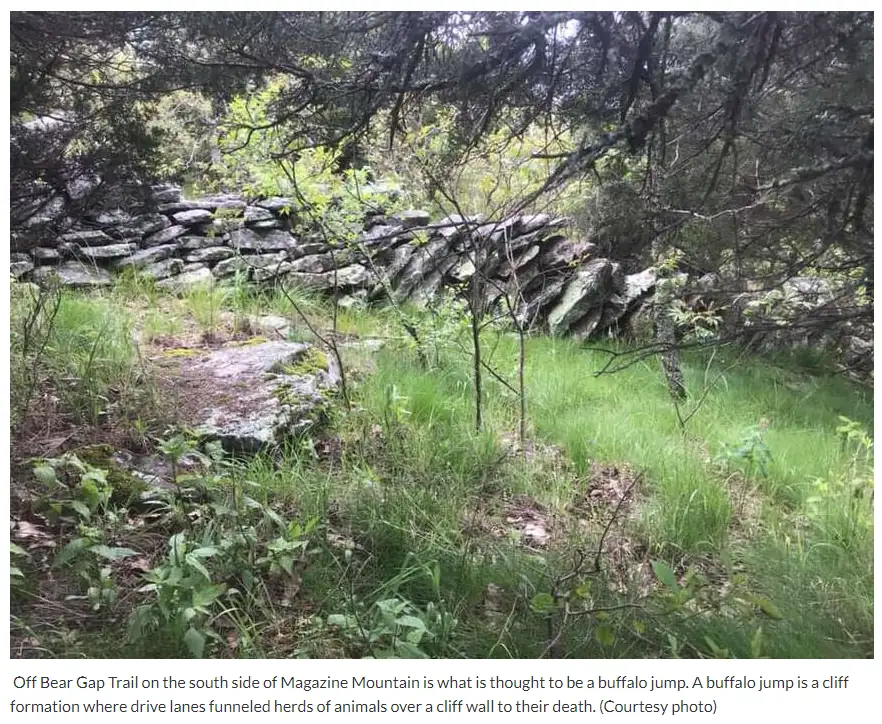
Both Woodland and plains buffalo were found in Arkansas. Both were hunted by the Native American tribes and were a major source of food. Off Bear Gap Trail on the south side of Magazine Mountain is what is thought to be a buffalo jump. A buffalo jump is a cliff formation where drive lanes funneled herds of animals over a cliff wall to their death.
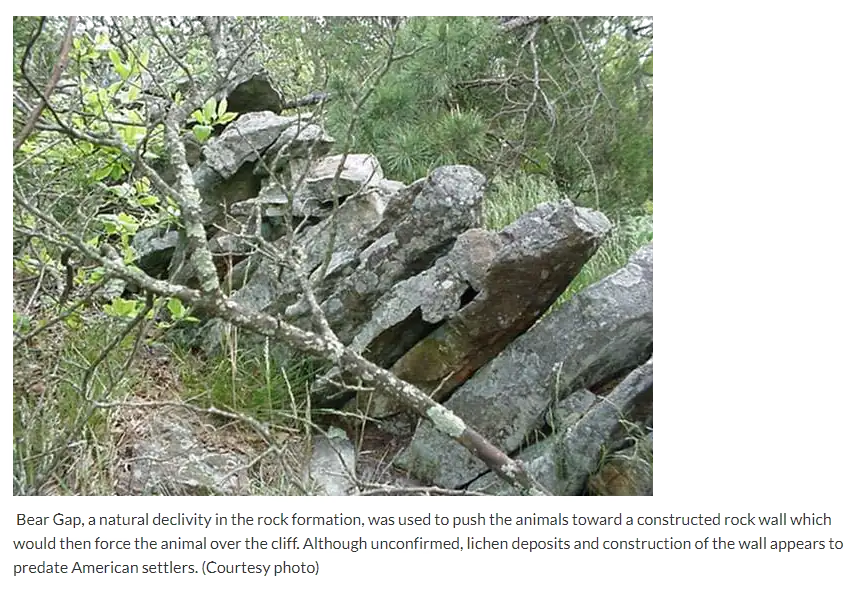
Bear Gap, a natural declivity in the rock formation, was used to push the animals toward a constructed rock wall which would then force the animal over the cliff. Although unconfirmed, lichen deposits and construction of the wall appears to predate American settlers.
The Grand Prairie of Franklin and Sebastian counties once contained large numbers of buffalo. Both Spanish and French trappers visited the area and exchanged beads and trade goods for the meat and hides from the buffalo. The exchange or trading port on the Arkansas River was called Lavaca, cow in Spanish, and led to the naming of the present day town.
The river bisecting Sebastian County is called Vache Grasse, the French name for fat cow. In both instances, the cow they were referring to was the buffalo.