I’ve always wanted to write about what I understand about the language of American bison. It’s important to remember that it may only be worth my own perspectives and my own experience with thousands of bison in hundreds of scenarios. If you disagree with any of my perspectives, you might be correct, and most definitely are correct if how (you) understand (your) bison differs. So, I will state what I think and what I have learned because I took “five minutes time “to listen, learn, and understand. The point I make is that we all learn from our experiences and develop something functionally correct. Or not, and if that’s the case, spend more time with the teacher, the Buffalo.
Frasier Bison LLC
The complexity of the language of bison includes vocalization, posturing, facial expression, head positioning and movement, tone, volume, and of course an individual recognizable voice. All of these coalesce to communicate throughout a ‘day in the life’ of an American bison. Here’s what I find exciting and interesting. Whereas it is a foregone perspective for me that the bison haven’t changed the basic way they communicate for at least an eon since the last phylogenic split, we are given the window of opportunity to observe something ancient and pure. For me, that’s so cool!
Basics of bison communication
Vocalizations
Posturing
Facial expression / Eye Contact
Head position and movement
Vocal volume and inflection
Can we communicate with and/or to them?
Do they communicate with and/or to us?
Who cares? And what does it matter?
I will discuss how bison speak with each other and how people and bison communicate with each other.
How people communicate with bison and how the bison responds, lays the foundation for all possibilities. No different from how we interact with each other. When visiting a bison ranch, one can discern through the bison whether they are being well handled based on their behaviors. I say this only because I was visiting a ranch over 20 years ago and was heavily warned about the bison. Since all those years ago managing bison has changed all over North America, it seems everyone has learned and is still learning the best management practices. It’s changed to low-stress handling and concern for healthy happy bison. I rarely hear a person call them “big & dumb” anymore, though there are still a few out there.
There was an instance when I was assisting someone in training their colts, and he shared his past difficulties with other trainers. I responded, emphasizing that the horse itself conveys all the necessary information. Horses are honest creatures; if displeased, they will express it via a change in behavior or acting up. The key lies in our ability to observe and interpret these signals.
In bison there are subtle signs, knowing your bison helps you read those signs. Observations can be as a group or herd behavior and individual behaviors. Every bison has their own personality, they are not all alike.
Note: Some forms of behavior seem to be innate or predisposed by genes.
My 2¢- Bison Behavior
Unraveling the Secrets of Bison Behavior
Much like our canine and equine companions, bison express themselves through body language. When alarmed or uneasy, their tails rise, and as the situation escalates, their heads lower. Persisting threats provoke aggressive responses such as pawing, approaching with a lowered head, or even shaking. It’s fascinating to witness a bull feigning disinterest while stealthily closing in on a potential threat. Now that’s intelligence!
Yellowstone National Park offers a unique glimpse into bison behavior. You may have seen images or footage of people casually approaching these gigantic creatures, treating them as if they were gentle pets, but don’t be fooled! The bison’s lack of movement signifies its confidence in its ability to overpower you in an instant. It assesses you as a non-threat and surveys its surroundings for escape routes — but this mindset can change in a heartbeat.
During mating season or “rut,” it is crucial to maintain a safe distance from these animals. Even experienced bison handlers exercise caution during this time, knowing full well that some have lost their lives or sustained serious injuries despite taking all necessary precautions. The seemingly docile bison can catch you off guard with disastrous consequences.
While it’s true that some bison appear desensitized to human presence and may allow for close interaction, it is essential to remember that they are not domesticated animals. Treating them like pets is a dangerous mistake — beneath the surface lies a primal force that must be respected. Most, if not all, North American bison are likely desensitized to people to varying degrees.
Recall how historical hunters would carefully conceal themselves downwind of their prey and use the environment to their advantage, all in an effort to avoid spooking the herd and losing their chance for a successful hunt. Nowadays, the fear factor has diminished significantly for these magnificent creatures.
In conclusion, it’s up to humans to act responsibly and demonstrate respect toward bison, as their behavior is heavily influenced by our actions. Always be vigilant and cautious when interacting with these majestic, yet unpredictable animals.
Annual Rites of Spring Include Buffalo Births & Renewals May 24, 2024
In a very recent article published by KMUW.org, Rebecca Tanner (Beccy Tanner) who writes a column -Hidden Kansas visited the 43,000-acre Z Bar ranch in Barber County, Kansas. Where she spoke with Eva Yearout, who with her husband manage the bison ranch. One topic they covered was bison communications. Becca was so kind to allow me to share those comments here:
For people who have not grown up with buffalo, her visitors were curious about how the prairie sounds when the mommas speak to their babies. Do they have their own special language when the newborns are running around?
“They definitely have a language,” Yearout said. “I mean, bison grunt, where cattle will typically bawl.
“They will grunt for their calves and will grunt back and forth. During breeding season, the big bulls will growl. It’s a real deep … so, they definitely have their own language.”
As the buffalo gather near Yearout’s truck, these sounds are surprising — the pickup dropping the cake cubes, mammas talking to babies, and the deafening silence of 2,000-pound animals slipping through prairie grass and munching.
The grunts are loud — so are the snorting sighs as the babies answer back to their moms.
“It’s just kind of like you and I talking,” Yearout said. “It’s how they communicate. You can tell when one is getting into a fight. They make noise and sounds — they communicate — and they let you know there’s life on the prairie.
“You may hear them before you see them, depending on the height of the grass.”
But always, always keep your attention on the animals.
“They are a wild animal,” Yearout said. “There is no such thing as a pet buffalo. They have horns, they know how to use them.
I reached out to Graeme Mr McCrady to see if he’d be interested in sharing his insights, given the considerable time he dedicates to observing the herd at Elk Island. His grasp on the nuances of bison behavior is something I respect — it’s his keen eye that catches those delicate shifts among the herd. Together, we acknowledge that our perspective on bison is rooted in our personal encounters with these majestic creatures. With that being said, this is one of the stories he let me share.
Elk Island National Park “Family Matters”
“Poor thing… you can see that she was struggling.
This is the story of the little lame cow and the two brave bulls who came to her rescue. I’ve always known that bison watch out for their own, but seeing it play out like this in the wild was absolutely amazing, and I wanted to share this experience with you.
It was early December, and as I entered a meadow I came across an injured cow who was having difficulty walking. The herd was grazing about 200 metres away, and she was trying to keep up. She was in no immediate danger until I showed up, and that’s when two young bulls sprang to action.
The first bull to arrive took charge of the situation immediately, throwing several serious glances my way. Less than a minute later he was joined by another bull, and the two of them walked over to the injured cow together. After a good sniff followed by some grunts and head nods, the bulls escorted the injured cow away from me and back towards the herd. They did not force her but rather guided her gently back to safety.
I don’t know how this cow got injured, or the extent of her injuries, but I do know this: her chances of survival in Elk Island are far greater than, say, Yellowstone. Why? No wolves, that’s why. Also no grizzlies. Add to that the fact that we’ve received very little snow this winter, and you can see that there is some hope. And let’s not forget her herd – her family – who will risk their lives for one of their own. Note: Photos captioned for context. “
“The first bull to arrive. He was the more dominant of the two bulls. At one point he attempted to mount the other bull just to prove how dominant he was.”
“The two bulls with the cow between them. Note that they are facing me and she is not. They see me as a potential threat, while she is injured and stressed. She was waiting for them to make the first move.”
“They walk around her, and each other, to get reacquainted. Things are being communicated here that we don’t fully understand.”
“Some head nodding here.
Bulls often do this when sizing each other up.
We good? Yeah, we good.”
“A good sniff. Do I know you?”
“Off she goes with one of her escorts leading the way.”
“Here they are taking her back to the herd, some of which can be seen over by the trees. It would appear chivalry is alive and well in the bison world.” – Graeme Mr Crady
Social Behavior of the American Buffalo (Bison bison bison) by Tom McHugh Jackson Hole Biological Research Station, Moran, Wyoming Special thanks to the author and the Smithsonian- Biodiversity Heritage Library -Zoologica: scientific contributions of the New York Zoological Society
Sources of Information
Observations. Most of the observations reported here were made on three buffalo herds, with additional data gathered from six other herds. The various herds are listed in approximate order of their importance as contributions to this paper in the following discussions of their size, origin, and range:
Yellowstone National Park: The Yellowstone Park Herd contained approximately 1,360 animals when a census was made by air in 1951. These buffalo inhabit grassland areas which are divided into four main sections by natural barriers of forests and mountains. The four herds remain fairly distinct with only occasional intermingling:
Hayden Valley Herd 440
Lamar Valley Herd 380
Pelican Valley Herd 340
Lower Firehole River Herd 200
Yellowstone Park herds were observed during periods from March through November, 1951; in January and August, 1952; and in March, July, August and November, 1953.
Systematic observations in Hayden Valley were possible only from May through October or November. Inaccessibility at other times was due to snow cover and the closing of all park roads. One trip was nevertheless made into Hayden Valley in March, 1953, in two snow planes. The Lamar Herd was followed during the winter months from November to May. Access to this herd is possible by a road which is kept open throughout the year.
Jackson Hole Wildlife Park: The herd in the Jackson Hole Wildlife Park at Moran, Wyoming, was composed of 22 animals in 1951. About the same number was maintained in later years by removal of surplus buffalo. The herd was kept in the fenced “Display Area” of 133 acres from June to September. Tourists drove through this area to observe and at times disturbed the animals. The buffalo were moved into a fenced “Winter Area” of 380 acres from approximately September to June. Hay and prepared concentrated stock feed were provided from September or October through part of May—a period when available natural forage was scarce or buried under as much as four feet of snow. This Wildlife Park Herd was established in 1948 with 20 animals brought in from the Lamar Herd of Yellowstone Park. Observations were made during periods from February through November, 1951; in February and May, 1952; and in March and November, 1953.
Wind Cave National Park: The Wind Cave Herd of approximately 500 animals was enclosed in a fenced area of 28,056 acres near Hot Springs, South Dakota. U. S. Route 85A passes through part of the park. The original 14 animals were shipped from the New York Zoological Park. Observations on this herd were made during periods from May through August, 1952, and from June through October, 1953.
Approximately 350 buffalo were observed in the Wichita Mountains Wildlife Refuge near Cache, Oklahoma, during July and August, 1953. The herd was kept in a fenced area of 54 square miles. It developed from 15 animals originally shipped from the New York Zoological Park.
The 700 buffalo in the Crow Indian Reservation live on 34,000 acres of grassland at an elevation of 6,000-7,000 feet in the foothills of the Big Horn Mountains of Montana. They are enclosed by one mile of heavy log fence and the precipitous cliffs adjoining the canyon of the Big Horn River. The Forest and Range Division of the Indian Service manages the herd for the benefit of the Crow tribe. The herd originated from buffalo shipped from Yellowstone National Park (Lamar) and the National Bison Range. It was observed during periods in August and September, 1953.
Additional incidental observations were made on herds in the following four areas: National Bison Range at Moiese, Montana; Custer State Park at Hermosa, South Dakota; R. B. Marquiss’ Little Buffalo Ranch near Gillette, Wyoming; and Fort Niobrara National Wildlife Refuge near Valentine, Nebraska.
Literature. The amount of historical literature on buffalo exceeds that of scientific treatises. This is because the pioneers in the West were virtually the only observers before the millions of buffalo on the Great Plains were slaughtered.
Such historical material contains many casual observations on behavior and can at times be very useful but can also be most misleading if not carefully evaluated. I have cited pertinent historical evidence in this paper, regarding it as supplementary to actual observations and not necessarily of great scientific value.
Methods
Observations. Stalking under cover was used most often in approaching the herds in Hayden Valley and occasionally in other areas. Several devices aided observations. An automobile was used either as a blind or as a convenient and maneuverable base in Wind Cave, the Wichita Refuge, the Wildlife Park, the National Bison Range and the Crow Reservation. In winter in the Wildlife Park a canvas blind was used for warmth and concealment. Two platforms in trees about 15 feet from the ground facilitated viewing aggressions of buffalo feeding on hay.
Most observations were made with the aid of 7 X 50 binoculars or a 27 to 60 power spotting scope. Telephoto lenses up to a focal length of 16 inches were used to record various activities on 16 mm. motion picture film. Later analysis of the film in a viewer supplemented the original observations.
Movements of herds were noted on mimeographed maps of Hayden Valley, the Wildlife Park, Wind Cave and the Wichita Refuge. A hand counter was used at times to make a census of herds.
Identification of individual buffalo. Natural differences in the physical features of the various animals in a herd served to distinguish them as individuals. All of the 16 animals of the Wildlife Park Herd were identified by sight in this fashion. Identification of individuals in other herds was more difficult because more animals were involved. Individuals were often followed during a continuous daily observation but were seldom traced from day to day.
Damaged or misshapen horns were the surest features for identifying individuals in large herds over long periods of time. Even the slight natural variations in horns served to identify individuals in the small, confined Wildlife Park; the main characters of horn structure in six mature cows were still obvious after a two-year lapse in observations. The different positions of ear tags on these animals served as a further absolute check on identity.
Natural distinctions between young animals of the Wildlife Park Herd were occasionally inadequate for individual recognition, making supplementary marking with white paint necessary.
Two methods were used to mark six calves, two yearling heifers and a pair of two-year-old heifers.
In the first, arrows were fitted with rubber balls covered with layers of absorbent cloth. The ball was dipped in paint and fired at the buffalo from distances of 50 to 100 feet. The herd became irritable after one or two animals were marked and soon stampeded away.
In the second technique, hay was used to lure the buffalo close to the slatted doors of a shed. A stick was tipped with absorbent cloth which was dipped in paint and thrust between the slats to daub different patterns on their heads. This method was simpler and quicker than the bow and arrow but could be used only during periods when no natural food was available.
Aging of buffalo. Ages of buffalo were estimated by techniques considered adequate for the purposes of this paper. These were largely an expansion of the methods described by Hornaday (1889). Further refinement of technique would be desirable for detailed population studies. Much additional research could well be done on herds where ages are accurately known and easily determined from brands on all animals. This condition applies in the National Bison Range and the Wichita Mountains Wildlife Refuge. Such brands are difficult or impossible to read in winter because of concealment by thicker fur. Variations in the location and scarring of these brands are also helpful in identifying individuals.
As with cattle (Pope, 1919), the age of buffalo may be estimated by the development and subsequent wear of the permanent incisor teeth on the lower jaw. Age up to and including five years is estimated by the appearance of each pair of incisors. Beyond five years the age is approximated by the leveling or wear on the incisors. The correlation with cattle is similar but was not determined exactly.
Age may also be estimated by counting the number of growth rings on the horns, but any determination based on the number of rings should be increased by approximately three years to allow for the juvenile period when no obvious rings are formed. An alternate method is to estimate the amount of horn growth in this period by comparison with the horn of a known three-year-old. Aging by such rings can be only an estimate.
Most determinations of age for the purposes of this paper were reached by a visual examination of the physical features of the buffalo, chiefly the size and shape of the horns. Bulls were aged accurately up to five or six years and approximately up to about fourteen years. Cows were aged accurately up to three years.
Plate I, Figures 1 & 2, demonstrate the technique of aging by size and shape of horns more completely than any written description. Aging was most easily accomplished when the horns were viewed head-on and was more difficult in profile views. Complementing the horns as indicators of age were several other physical features of the buffalo. These included relative size, profile of the body and head, size of the hump and the amount of hair on the crown, forehead and forelegs. The size of the chin “bell” was a helpful indicator that was sometimes indefinite since some animals wore it off in grazing.
Colonel Dodge records a remarkable incident in illustration of the manner in which the bull buffaloes protected the calves of the herd. “The duty of protecting the calves devolved almost entirely on the bulls. I have seen evidences of this many times, but the most remarkable
instance I have ever heard of was related to me by an army surgeon, who was an eye-witness.
‘He was one evening returning to camp after a day’s hunt, when his attention was attracted by the curious action of a little knot of six or eight buffalo. Approaching sufficiently near to see clearly, he discovered that this little knot were all bulls, standing in a close circle, with
their heads outwards, while in a concentric circle at some 12 or 15 paces distant sat, licking their chaps in impatient expectancy, at least a dozen large gray wolves (excepting man, the most dangerous enemy of the buffalo)
“The doctor determined to watch the performance. After a few moments the knot broke up, and, still keeping in a compact mass, started on a trot for the main herd, some half a mile off. To his very great astonishment, the doctor now saw that the central and controlling figure of this mass was a poor little calf so newly born as scarcely to be able to walk. After going 50 or 100 paces the calf laid down, the bulls disposed themselves in a circle as before, and the wolves, who had trotted along on each side of their retreating supper, sat down and licked their chaps again; and though the doctor did not see the finale, it being late and the camp distant, he had no doubt that the noble fathers did their whole duty by their offspring, and carried it safely to the herd.”
II. FUNDAMENTALS OF BEHAVIOR Stances
Loafing positions of the buffalo included standing, lying flat on the side with legs and head outstretched on the ground and lying on the belly with legs tucked under or alongside. In the latter pose the head was sometimes rested on the ground. The eyes were partially or completely closed at times in all of these positions.
Attitudes of “fear” were reactions to disturbance by strange objects, usually human beings. The buffalo stopped and stared for several seconds with ears brought forward and head directed toward the disturbance. This happened before running away or midway in the retreat. In a more accentuated alarm position, the head was raised above the level of the hump.
Another stance involved the positions of the tail. Switching of the tail back and forth flushed insects from the rear of the buffalo. Yet frequent tail-switching also occurred in a variety of situations when there was no apparent function of insect removal. It was prominent during playful battles and other types of play such as chasing and bounding. Elevation and switching of the tail also occurred during the violent battles of the rut. Tail-switching was general during nursing, more frequently by the calf than by the cow. It was seen among calves during herd movements when they were hesitating between staying with the calf subgroup or moving on with the cows. It was observed in a cow as she resisted each approach of a tending bull. Tail-switching may have been a “displacement activity” (Tinbergen, 1952:24-6), particularly in the latter two cases.
Photo by Graeme McCrady Elk Island NP
The tail was raised and stiffly held 0° to 90° above the horizontal—most frequently at least 45 “—during the following circumstances: ( 1 ) In some trotting, running or bounding, such as during playful chases, stampedes and short charges; (2) While moving toward or investigating unfamiliar objects, such as the vulva of a cow, a new bull or bull group, a new calf, human beings and a dead buffalo; (3) During moments of tenseness or excitement, such as moving through the herd in rut, before each attempted mount, “mock battles” (Section VI), disturbance from human beings, pauses in or before battles, play, anger and irritation.
In the stance of bucking, the buffalo kicked its legs up or out to the side. Bucking usually involved the hind legs, singly or together. It occurred frequently during play.
Arched back involved the humping of the back up into an arc. Bulls arched their backs during vicious battles, during some “mock battles” (Section VI) and while walking among the rutting herd or, more typically, in a bull subgroup during the rut. Arched backs during the last two occasions were usually accompanied by tail lifting and bellowing.
Grooming Behavior
Buffalo commonly rubbed their heads, necks and sometimes their sides on stumps, large low branches and trunks of trees. They also occasionally used smaller bushy pine trees, pine branches, boulders, sage-brush bushes, earth and earthen banks and snow banks. On trees, rubbing smoothed but did not remove the bark, although persistent rubbing could conceivably wear through the bark. Rubbing trees removed tufts of shed winter fur, yet this was not the sole purpose of rubbing since it occurred during all seasons.
In addition to rubbing against trees, buffalo often horned lodgepole pine by stripping bark with the ends of their horns. The horning was sometimes accompanied by eating of bark and rubbing. Buffalo preferred horning the bark or branches of previously horned trees rather than starting on fresh material. Most horning occurred during the rut (Section VI).
Photo by Graeme McCrady Elk Island NP-Wallowing
Buffalo wallowing usually consisted of one to three actions: a sniffing of the ground, a preliminary pawing, followed by rolling on the ground. Although the first two actions were sometimes omitted, rolling never was. In rolling, the buffalo lay down on one side and then kicked the legs so as to roll onto the back. Buffalo were never seen to roll completely over. The action of the legs, particularly the forelegs, and the rolling of the body stirred up much dust. Wallowing was preceded or followed by horning or rubbing the head in the earth, and a type of “neck-crooking” where the neck was stretched and flexed and the horns occasionally scratched against the back. Some buffalo wallowed once on one side, stood, then wallowed on the other side. One or two rolls as an incomplete wallow sometimes preceded the arising of a lying buffalo. Most wallowing was done in places where previous wallowing had broken the sod. Such wallows were scattered thickly over the entire range, as noted by aerial survey. Buffalo also wallowed in eroded or other natural bare areas, on prairie dog mounds, in wet mud holes, occasionally on snow and during the rut on any area. Wallowing among calves, first seen at the age of 1 3 days, lacked the skill of adult wallowing for at least the first month. The calves lay down and stretched or raised their legs slightly but did not roll thoroughly. Although both sexes wallowed during all seasons, wallowing was most noticeable among bulls during the rut (Section VI). I was not able to correlate rubbing or wallowing with the peak of concentration of mosquitos or black flies in Hayden Valley. The correlation of other authors (Garretson, 1938: 34; Goodwin, 1939: 367; Hornaday, 1889: 413; Roe, 1951: 100; Soper, 1941: 385-6, 394) may have been genuine or may have been confused with the increase in wallowing among bulls during the rut.
Feeding Behavior Buffalo grazed most commonly in meadows but also in open lodgepole pine and aspen to some extent. Browsing was infrequent. The Wildlife Park Herd fed on aspen bark only rarely. Buffalo in the Crow Reservation barked aspen extensively only during one severe winter when the range was depleted. Both cows and bulls in the Wildlife Park and Hayden Valley infrequently stripped and ate bark from lodgepole pine at all seasons.
When there was a thin snow cover of only a few inches, buffalo clipped off the exposed forage within one inch of the snow. In deeper snow, the buffalo pushed their noses into the snow and then cleared a trench down to the forage by swinging the head. The side of the head and even the neck were used to clear very deep snow. Pawing with either front hoof aided this nosing only infrequently. Considerable feeding by nosing snow resulted in shortened hair around the mouth and crusted snow conditions produced raw noses. Buffalo fed by these techniques in snow up to four feet deep, leaving large pits as evidence of their work.
Buffalo went to water at least once each day in all herds observed. Water in these areas was always rather accessible in springs, streams, lakes or rain-flooded puddles. The Wind Cave Herd sometimes stayed near water for one or more days when watering holes were scarce. The Superintendent of the National Bison Range found that the most heavily grazed areas were near water holes and the most lightly used areas away from water. He established new water holes to effect more even use of the range.
When water holes froze in the winter, buffalo ate snow. If both snow and open water were available, however, they preferred water. When ice-covered small puddles, they broke through with their noses or front hooves. They had no aversion to drinking the very brackish water found in stagnant pools.
Both the Wind Cave and Wildlife Park Herds regularly visited the salt blocks that were put out for them. Other herds occasionally ate the mud from natural salt licks.
Vocalizations Observations on several herds showed that vocal expression consisted mostly of grunting and some snorting and sneezing sounds. The variation in grunts was extensive, difficult to describe, and was correlated with a variety of responses from other buffalo. The frequency of grunting increased during group movements, such as stampedes or direct movements, and was noticeable when the Wildlife Park Herd was temporarily split by a fence.
During feeding on hay, the dominant cow in the Wildlife Park frequently uttered threat grunts as she advanced on nearby buffalo. These subordinate animals yielded to her. She also gave the threat grunt when other buffalo or human beings approached within a few feet of her new calf. This threat grunt was quite similar to the usual buffalo grunt, such as the one she used to call her calf. Threat grunts were also heard from one bull in the Wildlife Park and two others in Yellowstone Park. They would be noticed in wild herds only under ideal conditions of close observation.
During periods of intense play, buffalo infrequently uttered a loud short sneeze, a loud belching snort, or a bellow-like grunt. Calves or juveniles who were hit by the full force of a charge from another buffalo uttered a loud screaming or bellowing grunt. Buffalo ground their teeth together to produce a squeaking noise. Waving of hands stimulated this from cows enclosed in a small corral in the Lamar Valley. Bellowing and snorting will be discussed later (Section VI)
Reception
Buffalo apparently relied most on an acute sense of smell for detecting danger, raising their heads to test the air when new odors drifted in. Whenever scenting human beings, the Hayden Herd stampeded without hesitation even though the source of scent was not visible. They reacted to scent carried at least one mile, but Inman (1899: 246) stretched this distance to four miles. Two authors stated that buffalo scented water when it was “five miles or more” away (Garretson, 1938: 46) or “miles distant” (Inman, 1899: 247).
Vision was evidently not as acute nor relied upon as much as scent. It should not be underestimated, however. Buffalo in the Crow Reservation spotted our moving jeeps when they were more than a mile distant. Buffalo in the National Bison Range paid no attention to horses yet became restless as soon as they spotted a horse and rider. One herd immediately became restless when a horse and rider appeared on the skyline 0.8 mile distant (oral comment from Supt. John Schwartz). The Hayden Herd paid little attention to people walking more than 0.5 to 0.8 mile from them if neither noise nor scent were detected. They would become alarmed by a closer approach. Closer approach often went undetected, however, if there was no movement or slight camouflage from sagebrush or tree shadows. Sometimes the buffalo would momentarily stare, only to start grazing again. Small groups of buffalo were stalked in open view by moving only when all were grazing or facing away and by “freezing” whenever any animal looked up.
Temper.—I have asked many old buffalo hunters for facts in regard to the temper and disposition of herd buffaloes, and all agree that they are exceedingly quiet, peace-loving, and even indolent animals at all times save during the rutting season. Says Colonel Dodge: ‘The
habits of the buffalo are almost identical with those of the domestic cattle. Owing either to a more pacific disposition, or to the greater number of bulls, there is very little fighting, even at the season when it might be expected. I have been among them for days, have watched
their conduct for hours at a time, and with the very best opportunities for observation, but have never seen a regular combat between bulls. They frequently strike each other with their horns, but this seems to be a mere expression of impatience at being crowded.”
In referring to the “running season” of the buffalo, Mr. Catlin says: ‘‘ It is no uncommon thing at this season, at these gatherings, to see several thousands in a mass eddying and wheeling about under a cloud of dust, which is raised by the bulls as they are pawing in the dirt, or engaging in desperate combats, as they constantly are, plunging and butting at each other in a most furious manner.”
On the whole, the disposition of the buffalo is anything but vicious. Both sexes yield with surprising readiness to the restraints of captivity, and in a remarkably short time become, if taken young, as fully domesticated as ordinary cattle. Buffalo calves are as easily tamed as domestic ones, and make very interesting pets. A prominent trait of character in the captive buffalo is a mulish obstinacy or headstrong perseverance under certain circumstances that is often very annoying. When a buffalo makes up his mind to go through a fence, he is very apt to go through, either peaceably or by force, as occasion requires. Fortunately, however, the captive animals usually accept a fence in the proper spirit, and treat it with a fair degree of respect.
“A bull thus raised was for a number of years owned in my immediate vicinity by a farmer living on the Monongahela, adjoining Mason and Dixon’s line. He was permitted to roam at large, and was no more dangerous to man than any bull of the common species. But to them he was formidable, and would not suffer any to approach within two or three miles of his own range. Most of the cows I knew, were descended from him. For want of a fresh supply of the wild animal they have now merged into the common kind. They were no favorites , as they yielded less milk. The superior size and strength of the buffalo might have improved the breed of oxen for draught; but this was not attended to, horses being almost exclusively employed in that quarter for agricultural purposes.” Albert Gallatin 1836
Play
Play among buffalo consisted of battling, mounting, frolicking, or, more generally, a combination of these. Bucking was quite typical of all play. From an anthropomorphic viewpoint, these activities were assumed to be pleasurable and non-utilitarian, two features discussed by Beach (1945: 524) as charateristics of playful behavior. This play also fits the description given by other authors. Schein & Fohrman (1955) stated that playing in cattle “is an activity engaged in solely for the sake of the activity itself and not for the normal end result of the activity.” Thus, battles among buffalo would occur for the sake of the battle itself and without the emotion of competition over a specific object. Mountings occurred without the specific emotion of a sexual drive. Racing occurred without the specific emotion of fleeing from an enemy or reaching a goal. Such reasoning makes a satisfactory hypothesis for play, yet the actual recognition of these activities in the wild is often virtually impossible without relying on a subjective interpretation.
Numerous observations revealed that play was most frequent among calves, frequent among yearlings, common among two-year-olds, and occasional in older buffalo. There was more play —chiefly battling—among bulls than among cows in the group two to three or more years old. Most play occurred during the period of evening dusk. Play was also common during direct and semidirect group movements (including stampedes) and just after feeding, particularly in the Wildlife Park. (Play occurring during dusk may have followed feeding, but the weaker light was adjudged to be a more important stimulus than removal of hunger since the period of evening play was more intense than that after any diurnal feeding period.)
Two Young Bulls Playing -FBLLC
Buffalo battled in play by butting and twisting their crowns together or by hooking horns with some pushing back and forth or circling. Calves butted their small horns against the opponent’s shoulder, neck or head (Plate II, Figure 3). Many battles were started when one opponent approached another, shaking its head or bucking up and down on its front legs. Pairs of yearlings and calves “shadow-butted” by facing each other with heads low and then quickly shifting sideways so that each “butted” the space his opponent had just vacated. Since battles occurred between a variety of sexes and ages, many opponents were unevenly matched, yet viciousness or severe routs were rare. The latter two qualities characterized battles that were not considered play (Section VI). Occasional battles involved just one buffalo who butted a trunk of a tree or a springy sapling that “fought back.”
Mounting as play occurred without regard to sex, age or dominance. It consisted either of attempted mounting where the chin was placed on the partner’s rump or of complete mounting where the buffalo clasped its forelegs around the flanks of its partner and rode for several seconds (Plate II, Figure 4). Attempted mounting was sometimes a complete act with no intention shown of proceeding further. Unsheathing of the penis or thrusting actions were very rare. Mounting among calves was first noted when a 15-day-old calf made three feeble and unsuccessful attempts. A 20-day-old calf mounted another for four seconds. Such mounting during play was probably not based specifically on sexual motivation (Carpenter, 1942: 198; Nissen, 1951:439).
Mounting and battling were often coupled in play as one frequently initiated or followed the other. Frolicking included the aimless racing of one or several animals, playful stampedes and “race-and-hide.” Most aimless racing was done in the bounding or galloping gaits as one animal or small groups dashed back and forth, in circles, among the group, or in short charges. The bounding of one animal away from the group usually resulted in the quick following of another and then the aimless racing of the pair. Some juveniles raced in these games for so many minutes that they finished with tongues hanging out and panting heavily. Calves as young as one day trotted, ran or bounded in 15-50 foot circles from their mothers. Some racing took the form of playful stampedes as the entire group or subgroup dashed aimlessly about. In still another form of racing, race-and-hide, single animals galloped for some distance and then abruptly lay down. The pattern sometimes repeated, and there were indications that some animals lay down near certain other individuals. Grooming behavior—mainly wallowing with occasional rubbing— occurred so commonly with play that it should be considered an accessory to play or sometimes a form of play itself.
Investigative Behavior Patterns
Curiosity was well developed in buffalo. They thoroughly investigated new or strange objects such as an observation platform, recently shed elk antlers, a skeleton, horses, a porcupine, prairie dogs, and a human being lying or sitting after the buffalo were used to seeing him standing. Juveniles were more curious than adults. Herd members moved in to investigate, sniff and lick new calves. Older calves were particularly curious about new calves. Older calf checking out new calf. FBLLC
Exploring further manifested the development of curiosity. It was uncommon and restricted mainly to the Wildlife Park Herd. Subgroups moved several hundred feet away from the main herd to investigate various objects and then returned. Entire herds also explored. This exploring may have been a type of play since it was often accompanied by activities discussed previously as play.
In earlier times, investigative behavior may have played a part in the creation of what hunters called a stand at which entire herds were slaughtered by methodical shooting from under cover. There are numerous historical references to this (Allen, 1876: 212; Dodge, 1877: 135-7; Garretson, 1938: 44, 116-7; Hornaday, 1889: 466-9, 1922: 143; Inman, 1899: 261-2; Mayer, 1934, II: 36-7; et al.).
Three instances of shooting in present-day herds are of interest in this connection. Rangers in Yellowstone Park successively shot all seven members of a cow group and another bull group by approaching so the buffalo could neither see nor smell them. The groups did not stampede away when their members started to drop. Some cows in the cow group started to walk gradually away, but the motion was slow and without panic. When a hunter in the Crow Reservation shot from cover, the buffalo did not run away but milled around and sniffed the first slaughtered animal. Mr. Q. Marquiss killed 20 animals each year in his herd of 150 by driving up to it and shooting the desired animals one by one. The herd was not afraid of cars or human beings and did not run away during the shooting, remaining instead to mill about the dead buffalo. Buffalo Hunter Takes Aim 1880’s “Stand”
In discussing stands such as these, several authors mentioned the attraction of buffalo to dead animals or blood. Mayer (1934, II: 36) stated, . . they would begin what we call ‘milling.’ They would nervously smell the wounded animal, then hook her with their horns, then smell her again, bewildered . . .” Hornaday (1889: 476) noted that “They cluster around the fallen ones, sniff at the warm blood . . .” Allen (1876: 212) told how “The hunter must drive away the stupid creatures to prevent the living from playfully goring the dead!” Dodge (1877: 135-6) mentioned how “Attracted by the blood they collect about the wounded buffalo.”
Similar incidents in present-day herds are interesting. Buffalo milled around and sniffed the spot where an elk calf was born. Another herd milled about, looked at and sniffed the carcass of an old bull killed in battle. Butchering of buffalo in the Wildlife Park was twice impeded by the herd, which pressed close to sniff and lick the viscera and carcass. During one of these butcherings, the two older bulls pawed the snow and engaged in a vicious battle. Buffalo in the Lamar Herd mauled and gored a dead mature elk. If Mr. Q. Marquiss’ slaughterers did not immediately move into each killed buffalo, the herd milled about and horned it. When buffalo were killed from cover in the Crow Reservation, the group remained about and sniffed the carcasses. The grass in the National Bison Range surrounding a buffalo carcass was very well trampled. All buffalo sniffed another area where blood was spilled on the ground. Bulls pawed, rolled in and horned this spot.
Charging
Buffalo are potentially dangerous animals and should always be approached with caution. On six occasions I was faced with situations in which danger was latent, and was charged at five other times. Each charge was a bluff, ending with the buffalo stopping a few feet distant. There is no reason to believe that this would be a constant pattern, however.
III. HERD COORDINATION, INTEGRATION AND MOVEMENT
Locomotion
Gaits. Buffalo progress by means of four different gaits, walking, trotting, galloping and bounding. The detailed description of gaits in various animals was pioneered by Muybridge (1907) , who analyzed them with a series of photographs. I have relied heavily on his work, using his definitions combined with my own observation and analysis of motion picture film of moving buffalo.
The descriptions of the four gaits are dependent upon a few definitions: The step of a moving buffalo is an act of raising, thrusting and returning one hoof to the ground so that it can reassume the complete or partial support of the body. The normal stride of a buffalo consists of a sequence of four steps as each hoof is lifted and again placed on the ground. For brevity, the sequence of steps is listed by the number of each hoof, according to the following system: 1. Left anterior 2. Right anterior 3. Left posterior 4. Right posterior
In walking, the sequence of hoof movements is 3, 1, 4, 2. This was a standard sequence for all quadrupeds investigated by Muybridge. The support during each stride of an average walk falls on two or three hooves. The slowest walk, such as the “hesitant gait” of bulls during the rut, involves the movement of only one hoof at a time so that the support during each stride falls on three or four hooves. In the fastest walk, an amble, the buffalo supports its weight alternately on one hoof and then two hooves.
Trotting is the next faster gait in buffalo. The sequence for limb movements is 1-4, 2-3 with each diagonal pair of limbs moved more or less simultaneously. During each stride, the buffalo advances twice with all four feet off the ground.
Galloping or running is the most rapid gait. The sequence here is 1, 2, 3, 4, making the type of gallop of buffalo a “transverse gallop.” Other animals showing this same type are horse, goat, cat, bear, raccoon and hog (Muybridge, 1907: 156), in contrast to a lesser number of animals showing the “rotary gallop” (1, 2, 4, 3). Some slower speeds of galloping in buffalo show a forward-backward rocking motion.
Bounding – Pronking – FBLLC
Bounding is a less commonly seen gait in which the buffalo springs ahead by the more or less simultaneous flexing of all four legs. It is similar to bounding in mule deer. This bounding type of gait was observed mainly under two conditions. It was frequent during periods of play, accompanying such actions as battling, butting, mounting, frolicking and bucking (Section II) . Buffalo often bounded in their playful chases or races and it was first seen among calves at an age of two months. Buffalo also bounded when frightened or suddenly surprised. The approach of a human being, especially if abrupt, resulted in the fleeing buffalo using this gait. The animal characteristically stopped at a distance of 20 to 100 feet, looked back, and then continued in a walk, trot or gallop.
Speed. Herds of buffalo chased by a jeep in the Crow Reservation maintained a steady speed of 30 miles an hour. The jeep could not go faster over the uneven ground of these meadows, and on one occasion a group spurted from behind and passed the jeep, traveling at about 35 miles an hour.
Cottam & Williams (1943) measured the speed of a three-year-old bull on level ground as 30 miles an hour and stated that older and younger animals were slower. Howell (1944) timed the top speed of a two- or three-year-old buffalo at 32 miles an hour.
Buffalo generally increased their speed on downhill sections of a path when proceeding steadily and directly toward some goal, such as water or food, or when stampeding. If the group was walking at the time, they trotted or galloped downhill and for a short distance out onto the level. If galloping, they increased their pace still more.
Buffalo moving toward a goal sometimes increased their speed as they neared their destination. This happened with animals returning to a herd after being temporarily separated and with those joining new herds. It also occurred in groups moving toward water or food. Trails. The trails of buffalo have been described in a glowing and often exaggerated fashion. Garretson (1938: 57) states that “The buffalo was the best natural engineer the world has ever known . . .” Hornaday (1889: 417) believes that “The trail of a herd … is usually as good a piece of engineering as could be executed by the best railway surveyor. ”
The more reserved opinions of Allen and Dodge better describe the extensive system of trails which I saw in Hayden Valley. Allen (1876: 63) says: “. . . a buffalo trail can be depended upon as affording the most feasible road possible through the region it traverses.” Dodge points out that “. . . though a well-defined buffalo trail may not be a good wagon road, one may rest well assured that it is the best route to be had.”
The extensive network of trails in Hayden Valley included good routes from any one section of the valley to any other. The trails were almost invariably the most practical routes available, but they were not necessarily the best-engineered routes. Main trails traversed rolling country with a minimum of wasted climbing. They cut through corners of timber for a more direct path. They veered around the edge of marshy areas containing quicksand. Fords of streams and creeks had gradual approaches and shallow water. Direct approaches were made to the only feasible crossings of an almost impassable canyon. Trails cut about one-half mile through large areas of timber in a fairly direct line from one meadow to another.
The buffalo took a gradual route up hills if such a route was essentially direct, but they had no aversion to steep climbs. If there was a choice between a longer, more gradual incline and a shorter route through a steep-walled ravine, the buffalo took the latter. The route over the Mary Lake Divide was so steep that a horse with rider could negotiate it only by following a series of switchbacks superposed on the buffalo trail.
The only impractical choice of route by the buffalo that I observed occurred on the trail over the southern divide in Hayden Valley. A 1,800-foot section of this was very difficult to traverse because of fallen timber. Another side trail, seldom used by the buffalo, was 700 feet longer but completely avoided the tangle of fallen timber.
Trails through timber had many shunts and were occasionally hard to detect. Trails through meadows were usually more clear-cut and easily followed, although seldom-used trails sometimes disappeared in large meadows.
Buffalo sometimes started new trails from eight inches to several feet to the side of the old ones. These were started under the following conditions: (1) Trails on hills became trampled and eroded to considerable depth. Erosion in particular produced a trail that was deep yet very narrow, and thus difficult to walk in. Similar narrow trails also occurred in soft, marshy areas. When these trails became deeper than about one foot, the buffalo started new parallel paths. (2) Trails pushed through areas with thin topsoil over a rocky subsoil soon eroded down to the rocks. Such rocky trails were abandoned for new parallel routes.
Buffalo can at times wear down trails with surprising speed. On one occasion when the soil was muddy, 265 buffalo passed over one trail and thereby cut it one-half to two inches deeper and from 12 to 15 inches wide on this single trip. Buffalo soon trampled a path through rotten logs lying across trails, yet large, recently fallen logs were either crossed or bypassed. Maneuvering in snow. Snow accumulated in Hayden Valley to a depth up to four feet in the ravines, level meadows, and forests but was largely blown or melted from the ridges and some south-facing hills. The buffalo spent most of their time on such bare or near-bare areas and also on thermal areas, where the snow was melted by the heat of the ground.
Maneuvering in snow. Snow accumulated in Hayden Valley to a depth up to four feet in the ravines, level meadows, and forests but was largely blown or melted from the ridges and some south-facing hills. The buffalo spent most of their time on such bare or near-bare areas and also on thermal areas, where the snow was melted by the heat of the ground.
They showed a distinct aversion to travelling through deep snow. A group of five bulls chased by a snow plane refused to go into the deeper snow of a ravine; a bull dashed six feet in front of the plane to take the shortest route to a bare spot. In summer the buffalo in Hayden Valley characteristically took flight when the observer was 1,000 feet distant, yet they were not this wary in winter. In one case a group of 26 cows rushed through snow six inches deep within 30 to 50 feet of the author rather than move through snow farther away that was one to two feet deep. One bull galloped through the cold, shallow water of a stream rather than plunge through snow two or more feet deep on the surrounding ground.
A complex system of well-packed trails through deep snow connected the ridge tops so that the buffalo could move almost anywhere in the valley without plunging into deep snow. The warm water of Alum Creek melted snow for one to two feet along the bank and this bare area was used as a trail. In making new trails, the buffalo tended to follow in the hoofprints of the leader, but older trails lost most of this pitted pattern. Buffalo headed directly toward the proper trail when leaving a bare area, suggesting that they were well aware of the system of trails.
Although the buffalo avoided plunging into unbroken snow whenever possible, they were still able to negotiate deep snow. When an airplane frightened a group of 25 in Hayden Valley, they blindly ran off a bare spot over a cornice twenty feet deep. The group floundered badly, and one buffalo even clambered over the back of another. They still plodded through. In another case, two bulls struggled through snow four feet deep. The lead bull broke trail by climbing up on the snow with his front feet and then plunging down. Travel was very slow and was interrupted with frequent periods of rest of a minute or so. On another occasion, a cow group of 30 moved single file or occasionally two abreast for 4,000 feet across unbroken snow 40 inches deep in a large meadow. The extremely slow speed of the cows under such conditions would allow Indians to approach closely and slaughter them, as recorded by Catlin (1876, I: 253) and Seton (1929, I: 271). In March, 1945, rangers trailed a group of 54 buffalo that moved six miles through snow 42 inches deep from the Nez Perce meadows to Violet Springs in Hayden Valley (recorded by Chief Park Naturalist David Condon).
Swimming. Buffalo seldom hesitated to enter water yet were usually hesitant about crossing swift, deep streams. When the Wind Cave or Wichita Herds waded out to drink in a lake, occasional animals swam out into deeper water. Buffalo in the Wichita Refuge also swam across ponds in their movements even though wading or walking around them would have added little extra travel. Buffalo in Yellowstone Park regularly waded and swam the flood-swollen Lamar River in spring.
Coordination during Movements
Leadership. Leadership during travels of a herd was apparent when one or a small group of animals initiated or directed the movement, usually from in front of the herd. Leadership during movements of the confined Wildlife Park Herd of 16 buffalo is tabulated in Table 1. Three cows accounted for 66% of the leadership, with no cow acting as the exclusive leader. All individuals led the herd at least once, and leadership sometimes varied during each movement. Frequent changes in leaders also occurred in free-ranging herds.
Leadership depended upon cooperation. The lead buffalo characteristically looked back to see if the rest of the group was following and usually advanced alone no more than about 100 feet. In the occasional cases where the group balked and did not follow, the leader either turned back to become a follower or waited several minutes until some individuals began to follow.
During situations of disturbance by human beings, one animal was able to initiate movement in the entire group by moving in one direction in a steady walk. Leadership under such conditions was not balked.
Leadership was not readily detectable in many group movements, particularly during grazing. This mass-action type of travel, where the group moved as one unit without any obvious leader, seemed to be based on several factors. Contagious behavior was important and especially noticeable when all animals were facing in the same direction and moving at the same rate.
Dominant animals in the center or rear of the group seemed to direct the procession by moving all subordinates ahead of them. The leader or leaders were not conspicuous because of the close coordination of their actions with the mass of the group. Movement was also based on a high degree of cohesiveness within the group. The advance of a group of buffalo from the main herd was more apt to result in the remainder following and joining than in separation into two or more groups or the return of the first group. Large groups of 100 or more sometimes moved by the successive and repeated closing of gaps between subgroups. Some movements were so random that leadership probably never existed.
Stampedes.
Stampedes involved the sudden and usually simultaneous trotting or, more typically, galloping of a group of buffalo. Clouds of dust rose up around and sometimes completely enveloped the stampeding group. The noise of a stampede resembled a continuous rumble, the rush of wind, or the rain-like patter of hooves. Stampedes through timber were characterized by the very clamorous breaking of branches and hitting of hooves against fallen trees.
The following notes on stampedes are based on numerous observations in all herds studied. In addition, I spent thirteen days in the Crow Reservation in Montana with the express purpose of starting and filming as many buffalo stampedes as possible. During the latter part of this period stampedes were started by parties of hunters who chased the buffalo in jeeps to carry out the annual program of herd reduction.
Stampedes were started by the sudden trotting or galloping of one or a group of buffalo, with the herd usually taking the direction of the first group. Some stampedes started so abruptly that the initiating group was not evident.
Stampedes were often caused by the disturbance of a wary group. They also occurred in all herds for reasons of seemingly insignificant importance.
For example, stampedes were started by the sudden running of one animal which voluntarily decided to join the group from the outskirts or which was scared by a sudden snap of a twig. Subgroups stampeded to rejoin the main group when there was no apparent reason for such a burst of speed. The sudden flight of elk, deer or a pair of mallards near the herd caused the buffalo to stampede in the same direction, even though they may never have seen the reason for the flight. Such stampedes as these, covering only a few hundred feet, were shorter than those resulting from the approach of human beings toward a wary herd.
At the start of a stampede, all the buffalo in the area usually massed together quickly and then galloped away. After this initial burst, the herd either stopped and looked or continued moving. The continuation of the stampede was made at a gallop, a trot or a fast walk. The same massed pattern was held, or, more commonly, the herd strung out as a column of groups, a long continuous column or single file.
Stampedes initiated by the presence of human beings, were not a blind fleeing from the disturbance. Rather, the path of these stampedes was regulated mainly by the end-point, which was usually a small timber-secluded meadow or timber itself.
One stampede observed in the National Bison Range was, however, quite directionless. A severe hailstorm in August, 1954, completely covered the ground with stones up to half an inch in diameter. A group of 150 buffalo was loosely spread out into many smaller subgroups when the storm arrived. They quickly massed and then galloped at intervals in an aimless fashion. Despite rather frequent stampeding, they circled in no more than a quarter square mile. Playful stampedes observed in the Wildlife Park were also rather directionless.
Herd In Movement – 1880s Nebraska Historical Society
Three incidents were observed where animals fell under the herd during a stampede. The first occurrence was observed by Gordon Powers when a motion picture company was attempting to film a stampede in the Crow Reservation. Stationary lines of vehicles and of men were supposed to funnel the herd past the camera. As a group of jeeps started to drive the herd of 400, the buffalo headed directly for the line of men. When they were only 50 feet away, the four lead animals suddenly turned back. They were trampled under the rest of the herd, which could not turn so abruptly. None was killed, but one animal walked away stiffly as though badly bruised. A similar incident occurred when a stampeding herd suddenly caught sight of a group of hunters in the Crow Reservation. Three lead animals were trampled as they turned abruptly. In another case, a buffalo fell in front of a stampeding herd. Other animals jumped over or passed by this buffalo as it made one complete roll and got up again.
Wariness. Wariness varied greatly in different herds. The Wildlife Park herd was in constant contact with people and would allow approach within three to five feet. The Wind Cave animals allowed approach of cars or people within 25 feet. The Wichita herd tolerated the approach of cars within five feet or less but persons could approach only to within 30 feet. Disturbance by cars or people caused the herds to move no more than a few feet. Buffalo in the National Bison Range permitted the gradual approach of cars to within five feet or less, yet would usually stampede away if the occupants got out.
Further discussion of wariness hinges on a definition of flight distance. It is here defined as the distance between an approaching disturbance and the herd, measured at the time when the herd takes flight.
The Crow and Hayden Herds had little contact with human beings. Either herd stampeded several miles when disturbed by cars or people. The flight distance for the Crow Herd was one mile or more on some occasions. It lessened, however, after the fifth day of chasing and hunting. This herd used to be relatively tame and allowed approach of people to within 15 to 50 feet. Gordon Powers of the Bureau of Indian Affairs noted that the herd grew progressively wilder in the past seven years as jeeps were used to chase and hunt it. Flight distance varied seasonally in the Hayden Herd. In the summer it was 1,000 to 1,500 feet, and the herd would also move away upon catching human scent. In November, when there was no snow, the flight distance was 300 to 600 feet and the retreat of the herd was slower and covered less distance than in summer. It was still less in winter, sometimes as low as 200 feet. The herd was slower in starting to move away, particularly if on a bare spot surrounded by deeper snow.
Other herds in Yellowstone Park were less wary than the Hayden Herd. Both the Lamar and Firehole River Herds had more contact with cars or people and also had shorter flight distances than the Hayden Herd.
Historical literature shows instances of wild or wary herds (Audubon & Bachman, 1849: 47; Catlin, 1876, I: 254-5; Parkman, 1903: 91-2, 404-5; Long, 1905, XV: 255-6, XVI: 140, 288; Hornaday, 1889: 536; Inman, 1899: 57; and Roe, 1951: 131-8). There are also records of relatively tame or unwary herds (Dodge, 1877: 120-1 and 1885: 283; Hornaday, 1889: 389, 404-5, 465, 471; Long, 1905, XVI: 153; Parkman, 1903: 423-5; and Roe, 1951: 131-8). The herds became notably wilder as their numbers decreased near the end of the period of slaughter (Hornaday, 1889: 430; Roe, 1951: 139-140). This survey of historical literature on wariness shows that probably none of the original freeranging herds were as tame as those in the Wildlife Park, Wind Cave or the Wichita Refuge. There are records of wariness comparable to the wilder Crow or Hayden Herds.
The Daily Round
The daily round, consisting of behavior during an entire day, was divided into two main types of activity: (1) Feeding behavior which included short periods of walking to select and eat natural forage or hay, and (2) non-feeding behavior which included much loafing behavior such as lying and standing, and also ruminating, traveling, watering, licking salt, playing and grooming.
Feeding usually commenced sometime after dawn, but the exact time varied. Throughout the day, cycles of feeding alternated with those of non-feeding. This is quite similar to grazing behavior in cattle (Hancock, 1953: 3). Feeding activity sometimes declined during periods of high temperature around noon. Groups continued feeding into complete darkness at times. A period of feeding and traveling occasionally occurred at any time during the night in all herds. These periods of nocturnal activity were relatively short when compared with the greater amount of time spent loafing. Nocturnal periods of feeding were usually singular and there was no evidence of any cyclic rhythm. It should be realized, however, that nocturnal observations were too meager to support any general conclusion.
The daily radius (Leopold, 1947) was that distance traveled by a group of buffalo in one 24-hour period. The average daily radius during the rut for five group-days of travel in Hayden Valley was two miles, with a range from 1.5 to 2.4 miles. The maximum daily radius was recorded during a stampede over the southern divide, when the group traveled at least nine miles.
The average daily radius for 20 group-days of travel during the rut in the Wichita Refuge was 2.1 miles, with a range from 0.5 to 5.8 miles per day.
The average daily radius during the rut in the Wildlife Park was 1.7 miles, but the 133 acres of this park probably reduced the radius to less than that for wild herds.
The daily radius for herds in areas where water holes were scarce would be expected to be considerably greater than any of the above averages. In late summer, the Wind Cave Herd sometimes made daily round trips to water of at least six miles.
Hancock (1953: 8) surveyed the literature for daily radius in cattle. A free-ranging herd traveled 3.0 miles per day, while herds enclosed in 1.0 to 5.5 acres moved from 1.4 to 1.7 miles per day.
Home Range of Free-ranging Herds
Text-figure 1 pictures the home range of the Hayden Herd. It was approximately 12 square miles in summer and extended to 36 square miles in winter (October-November through April-May). This extension in winter coincided with a cover of snow and an absence of tourist traffic on the main highway. The Hayden range was largely confined by lodgepole pine forests on all sides. The herd nevertheless often penetrated part way into this border. It moved into all small meadows that jutted out into the timber from the main meadow and also went through the timber to reach isolated meadows. The timbered border on the north and south of the valley still proved to be an effective barrier against egress to new range. The highway on the east stopped most egress or ingress in summer, yet there may have been some interchange between the Hayden Herd and the Pelican and Lamar Herds toward the east in winter. The only known interchange of any extent occurred to the west across a 3.6 mile trail through the timber over the Mary Lake Divide. Interchange over this trail took place between the Hayden Herd and the Nez Perce Herd, which was part of the Lower Firehole River Herd.
The Lamar Herd moved each year about 10-25 miles from meadows at 8,000-9,000 feet to the lower Lamar Valley at 6,500 feet with the advent of fall snows. It returned to the higher meadows again with the disappearance of snow in May or June.
Integration of the Herd
The high degree of cohesiveness of the Wildlife Park Herd was demonstrated when the herd was artificially split. A fence divided the herd into a group of five cows, one yearling and one bull, and another group of five cows, three yearlings and one bull. The two groups regularly lay down as one herd in spite of the fence. There was much exchange grunting between them. They also paced back and forth along the fence, a type of behavior which was not seen at other times. Their daily schedule of activity was almost identical. Other groups of buffalo also lay together as one on each side of the fence separating Wind Cave from Custer State Park.
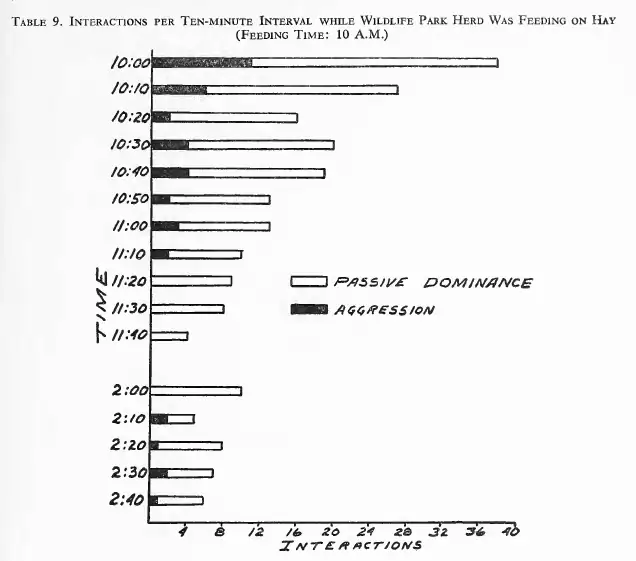
This high degree of cohesiveness in the Wildlife Park was remarkable in view of the great amount of aggression between members of the herd, particularly during feeding on hay (Section V). Mutual toleration must have overbalanced aggressive behavior in this group, as shown objectively by its tendency to aggregate (Collias, 1944:89).
A high degree of cohesiveness was shown by individuals who became temporarily separated from the main group through differential movements. When they discovered their isolation, they abruptly ran back to join the group.
Herds also displayed a high degree of cohesiveness during drives and stampedes. If one animal broke through a line of men driving them, the rest of the herd would quickly follow. During direct movements or stampedes, the path chosen by the first member of each subgroup or by the first member of the herd was followed closely by every succeeding buffalo, even though men shouted from a short distance away. Interesting in this respect are Dodge’s (1877: 121-2) references to the derailing or the stopping of trains by the insistent passage of herds.
Different degrees of cohesiveness were observed during movements of herds. Herds were most compactly bunched during direct movements and stampedes. Either of these movements was also characterized at times by a herd strung out for more than a mile in small groups or a column of several animals abreast. Direct movements were frequently single file. Single file was the usual pattern on trails through snow and through timber, and was also common on trails through broad meadows, yet it did not depend on the presence of a trail.
The cohesiveness of a herd depended on a balance of centrifugal (dispersive) and centripetal (gregarious) forces. Grazing was a centrifugal factor since the distance between members of a herd characteristically increased when the herd arose to graze. Centripetal factors included the occurrence of localized shade or bare areas that brought herd members closer together when lying in them. Other factors were moderately dense or loosely spaced timber, and rain or falling snow. Herds were usually more closely grouped when loafing while standing or lying. Disturbance from foreign objects such as man caused a massing of the herd. Stampedes and some direct movements were also centripetal factors.
IV. HERD COMPOSITION
Bull Groups and Cow Groups
I classified groups of buffalo into two types according to their composition: (1) Bull groups contained males with an infrequent female. (2) Cow groups contained a majority of females and a smaller number of males. During the rut, the increase in group size and the fusion of some bull groups into the cow groups did not create a third classification. Such groups were still classed as cow groups since their nature was essentially matriarchal. The bulls here were largely followers and had little effect on group coordination.
Composition. Table 2 analyzes the size of bull groups. They were small groups of one to 12 members. The average size in Yellowstone Park increased slightly from 3.3 to 4.7 during the calving season (May) and decreased greatly to 1.2 during the rut when most bulls entered the cow groups. Most members of bull groups were four years old or older and the groups included some three-year-olds and occasional two-year-olds. Two- to four-year-old bulls were more commonly distributed in the groups of three or more members than in smaller groups. Solitary bulls were sometimes several miles from any other buffalo. The only cows attached to bull groups were rare cases of one to four old, barren cows.
Table 3 analyzes the size and composition of cow groups. Group size (average about 23) remained rather constant during the non-breeding season but varied more during the calving season. There was a great increase in size during the rut as many groups in Hayden Valley coalesced and were joined by bull groups. Cow groups during the non-breeding season were composed of cows, yearlings, calves, two-year-old bulls, some three-ear-old bulls, and rare bulls four or more years old.
Cow groups virtually never had an equal socioeconomic sex ratio (that ratio within groups— Carpenter, 1952: 236). The mean of males in these groups was 24% in the Lamar in January-March and 31% in May, 17% in Wind Cave in May, and 44% in Hayden Valley during the rut. All of these percentages were calculated using data for animals two or more years old. Much of the inequality in sex ratios is accounted for by bull groups living outside these cow groups.
Numerous observations on cow and bull groups in several areas were examined to formulate the following trends; behavior in the two types of groups is contrasted in each category:
Leadership. Older bulls tended to lead bull groups more often than younger ones, but there was great variation. Cow groups were led principally by older cows and seldom by younger cows or bulls. Leadership changed among these cows.
Irritability. Cow groups were more wary, more watchful and showed a greater flight distance than bull groups. Flight distances in Yellowstone Park were usually under 300 feet for bull groups and 200 to 1,000 feet or more for cow groups. Some bull groups were so obstinate that approach within ten feet and tossing of stones did not move them.
Winter range. The winter range of bull groups from all four Yellowstone Park Herds extended into areas in which cows were not seen. This included the Mary Bay thermal area for the Pelican Herd, the area around Mud Volcano and the Yellowstone River for the Hayden Herd, meadows along the Madison River for the Firehole River Herd, and the Hellroaring Drainage, lower Lamar Valley and upper Lamar Valley above Soda Butte for the Lamar Herd.
Daily round. Cow groups showed greater uniformity of activity during any one-time interval than bull groups; that is, almost all of the members were more or less simultaneously engaged in grazing, loafing or the activity of the moment. Intermingling. Cow and bull groups occasionally intermingled during the non-breeding season for a few hours or less. Intermingling during the rut was, of course, frequent.
Integration. At times during the entire season, various groups joined together into larger units, and separated into smaller ones either by differential drifting or by direct withdrawal. This splitting and joining occurred in both cow and bull groups and even involved solitary bulls. There were indications that the stability of bull groups with one or two members was greater than in groups of larger bulls and cows. One pair of bulls remained together from December 10 to March 15 in the Lamar Valley.
Cohesion. Bull groups (with the exception of some pairs) showed a low degree of cohesiveness, and cow groups a high degree. The average distance separating members of bull groups was greater and more variable than that for cow groups. Cow groups moved as more compact units while bull groups sometimes strung apart for 100 to as much as 2,000 feet, the lead animal disappearing from sight before the last buffalo started to move.
Photo by Graeme McCrady Elk Island NP-Bulls
Closed groups. There were a few indications that some bull groups and possibly some cow groups were closed groups. Such observations were unusual compared with the frequent observations of random coalescing and splitting of cow or bull groups.
Among bull groups there were three cases where they approached closely yet did not join and two cases where newcomers were challenged. Included in these cases was a pair of two-member bull groups in the Lamar Valley which remained within a few hundred feet of each other for three months, occasionally grazed within sight of each other, yet did not join.
Cow groups showed fewer indications of being closed, yet the following three incidents are of interest: A group of 33 cows moved single file through a scattered group of 48, and a group of 27 trotted through a group of 16, both without any loss or gain in members (Hayden Valley, March, 1953). One group of six cows in the Lamar Herd picked up three new members while wandering through a group of 14.
Subgroups
Wild groups of all sizes and types readily broke into smaller subgroups that were spatially distinct from other clusters in the group. Some subgroups contained a random cross-section of ages and sexes. Others, particularly in larger cow groups, showed tendencies toward bulls, barren cows, cows-with-calves, calves and yearlings, with some two-year-olds. The bull subgroups tended to be on the edges of the herds, and the last animals in herd movements were regularly bulls. The presence of bulls on the flanks and in the rear of herds was noted by several authors (Allen, 1876: 55; Aubrey, 1908: 216; Audubon, 1849: 41; Bradbury, 1904: 147; Inman, 1899: 231; Parkman, 1903: 423). There was no evidence that these peripheral bulls were sentinels, as proposed by Inman (1899: 231).
The more distinct subgroups in the Wildlife Park Herd were delineated by repeated observations of such close groupings over a period of time. Maps of the patterns of lying in the herd aided this study. There were three main subgroups: juveniles, mature cows and the older bulls. The subgroup of cows-with-calves was much more distinct than that of prepartum mature cows. The subgroup of older bulls (two animals) commonly stayed aloof from the cow group, yet joined them during the rut. When these two bulls were divided temporarily by a fence, the five-year-old repeatedly returned to the fence in search of the six-year-old. The attachment between two yearling heifers was the closest in the herd. Subgroups of new calves were first noted at an age of two to four weeks. Calves alternated between calf subgroups, their cows, or a cow-with-calf subgroup. There was no evidence of closed groups in the Wildlife Park Herd.
Clans
The preceding description of subgroups and closed groups contains no more conclusions than my observations permitted. Four authors went further, however, and stated that subgroups were blood relations, family groups, or clans (Grinnell, 1904: 129; Inman, 1899: 234; Seton, 1929: 693; Soper, 1941: 391-2), while Mayer (1934, II: 36) thought that small groups remained “separate and apart” in spite of coalescing and splitting. All of these authors failed to give conclusive evidence. I have noted several cases where yearlings and two-year-olds, particularly heifers, followed cows, but such groupings could not be construed as clans.
Garretson (1938: 59) did not believe the clan theory and Dodge (1877: 123) called the formation of subgroups “entirely accidental.” From the present study of group composition these last two authors would appear to be correct. I believe, as merely a personal conclusion, that subgroup or group formation was flexible and depended little on blood relations beyond the age of one year.
V. THE DOMINANCE HIERARCHY
Display of Dominance
The herd in the Jackson Hole Wildlife Park was studied intensively for information on social organization. The outcome of interactions between individuals delineated the social structure of this herd. It was a linear type of dominance hierarchy with dominant individuals exercising a virtual constancy of success in interactions. Subordinates recognized dominants quickly and avoided them.
I distinguished the herd members as individuals by physical differences or painted markings. Their interactions were divided into passive dominances and aggressions. Out of 1 ,027 interactions recorded, 72.8% were passive dominances and 27.2% were aggressions.
Passive dominances were the more gentle of the two types of interactions. They were characterized by a lack of any obvious show of force or threat. Typically, the dominant individual walked toward and displaced the subordinate with no aggressive action. The most subtle passive dominance took place when one animal avoided another while moving through the herd.
Aggressions occurred when the dominant individual displaced a subordinate by force or by threat. Threat usually involved an intention movement (Tinbergen, 1951: 79) of an aggressive act. The most gentle form of threat involved a mere look toward the subordinate, causing it to move away. The most common form was horn swinging, where the horns were swung up and down or sideways toward the subordinate with occasional contact. Partial or complete charges were also used to displace subordinates. The dominant animal appeared to be trying to impale or gore the subordinate, but actual contact was uncommon. Occasional violent charges threw the victim for several feet or tossed it as much as twenty feet. One mature bull hooked a cow on his horns and tossed her over his back, where she fell to the ground ( in a corral at the Lamar Buffalo Ranch). She was able to walk away, but subsequent autopsy revealed two broken ribs and a punctured, collapsed lung.
Battles were tabulated as aggressions. They consisted of hooking of horns and pushing back and forth that lasted a few seconds or several minutes. The loser usually either moved away or was pushed back a few feet, yet many battles were indecisive. They were started by dominant or subordinate individuals and occurred between younger bulls and between calves, yearlings, and two-year-olds. Most battles in the Wildlife Park occurred between one-year-old bulls and two-year-old cows. This may have been correlated with a later change in rank between these two groups. Battles between cows were rare.
Another indication of dominance was the intention movement of mounting, seeming to occur without any sexual motivation. This was tallied as an aggression if the subordinate moved out when the dominant placed its chin on the rump of the subordinate. Both the intention movement for mounting and genuine mounting also occurred as play, apparently with no regard for dominance. Attempts by a subordinate to mount a dominant resulted in a prompt reversal of the same behavior, playful battles, or other forms of play. This mounting during play produced no withdrawal by the subordinate and was not tallied as an aggression.
Situations in Which Dominance Was Displayed
More than 90 percent, of the interactions in the Wildlife Park were recorded during displacements on the feeding grounds. These buffalo were fed on hay from November to May, approximately. Practically no natural food was available during most of this period. Since the hay was spread in piles over at least 100 feet of ground, there was a surplus of piles at all times except in the first few minutes of distribution. Most buffalo fed from separate piles of hay. They continually shifted every few minutes, even though there was little difference between various piles. A shift of one dominant animal might eventually cause a shift in more than half the herd as the move was passed down the line.
Dominance was also recorded during interactions over special objects as follows: (1) an item of curiosity, (2) a spot for lying, (3) a wallow, (4) a water hole or puddle, (5) a tree for rubbing or horning, (6) choice grass, (7) a salt lick, (8) shade under a small group of trees (dominants clustered in the shade and subordinates were in the sun), (9) sniffing the vulva of a cow, (10) a cow in heat.
Dominance was evident during group movements as well. Most commonly, a dominant animal in the rear or middle of the group pushed subordinates in front or stopped those directly behind. When two dominants stopped on a packed snow trail, subordinate animals wishing to press ahead had to flounder around through deep snow (March, 1951, Wildlife Park). Dominance was also occasionally recorded during grazing.
The preceding paragraphs discuss dominance that was usually traceable to interaction over a certain object, yet much aggressive dominance also occurred apparently independent of any inciting situation. In these cases, one member of a herd suddenly and inexplicably interrupted its feeding to charge another member. This happened most frequently between a cow and juvenile, occasionally between two cows.
Structure and Dynamics of the Dominance Hierarchy in the Wildlife Park
Factors influencing dominance. Table 4 illustrates some factors that determine dominance. Distinct differences in size and weight insured dominance. Seniority in age usually insured dominance, yet one seven-year-old cow was subordinate to two five-year-olds. Within groups of similar size, bulls were dominant over cows; aggressiveness or certain undetermined factors were more important than slight differences in size.
Reversals. Out of 726 interactions in the spring of 1951, there was only one temporary reversal when F4* displaced F3 by a swing of the horns. Occasional reversals were attempted by cows which horned either Ml or M2, yet these bulls did not yield. The two-year-old heifers did this most frequently. It was classed as play. Schein & Fohrman (1955) recorded 248 reversals in 4,935 interactions among 163 dairy cows.
Permanent changes in the dominance hierarchy resulted from the differential growth of bulls and cows. Previous to July and August, 1951, M3 and M4 were slightly smaller than F8, F9 and F10. During those two months, M3 and M4 grew to be approximately the same size as these two-year-old heifers. The exact time schedule for the advance in dominance of M3 and M4 is not available, since it occurred during the summer and fall when interactions were uncommon. By September 12, both M3 and M4 had advanced above F8, F9 and F10. By October 9, both had moved above F6 and F7.
*Nomenclature of individuals refers to sex and position in hierarchy. Thus, M2 was the second in position in the hierarchy
By February 4, 1952, M3 and M4 had advanced still farther up the hierarchy, as shown in Table 5. Both M3 and M4 were dominant over all cows except FI, F4 and F5. The irregular gain in dominance of M3 and M4 produced eight triangles (Table 6). By the following summer the advance of M3 and M4 over all cows eliminated these triangles.
The dominance hierarchy was checked during November, 1953, to finish a survey of almost three years. During that period there was no permanent reversal among the two bulls or the top seven cows. There was a dominance hierarchy in the remaining five mature cows, all progeny of the first seven. None had moved ahead of their parents.
Dominance hierarchy among calves. Dominance among calves developed
slowly. Although they were alert to advances from adults within three weeks after birth, no dominance hierarchy among calves was detected during the first two months. The first definite signs of dominance were noted at an age of four months. At that time, the only male calf in a group of six was dominant over others and there were interactions among female calves.
I was not able to determine the complete dominance hierarchy among calves until February, 1952. Even during this period of feeding on hay, when there were numerous interactionsamong other adult herd members, interactions between calves were infrequent. Table 7 shows the hierarchy among calves.
The male calf was dominant over all females and accounted for 41.4% of the interactions in the entire calf group. There was no correlation between the position of dominance of the calf and its seniority in the calf group, small yet noticeable size differences, or the position of dominance -of its mother. There was one reversal out of 70 calf interactions when D displaced B with an aggression.
Table 7. Dominance Among Six Calves in the Wildlife Park Herd, February 4 to 9, 1952 (Computed from 70 interactions)
There were no triangles among the four calves in the herd one year previous on March 15, 1951. On this basis, one would expect the five triangles in the 1952 calf group to straighten out in a few weeks.
Factors affecting frequency of interactions.
The number of interactions among certain animals or during certain time intervals varied with the factors discussed in the following paragraphs.
Table 8 shows the tendency for dominant cows to have more interactions with the cows immediately below them than with the less dominant cows. “Probability” indicates the probability of getting such a skewed distribution if a column of values was picked at random. It was computed by chi-square. The distribution of interactions for FI and F2 are statistically significant. While the remaining columns are not, they still show the same distributional trend. Schein & Fohrman (1955) statistically analyzed similar interactions in a herd of dairy cows. They found that “fight contests involved cows closer together on the social rank scale than do threat or butt contests.”
The total number of interactions and the percentage of aggressive interactions for each individual
are listed in Table 4. Bulls Ml and M2 had fewer interactions than any other herd member. With this exception, the more dominant animals tended to have more interactions. This is in line with findings on pigeons (Masure & Allee, 1934: 327), chickens (Allee, 1951: 135), and canaries (Shoemaker, 1939: 404). An analysis of the percentage of aggressions shows just the reverse tendency. The percentages increased distinctly among the less dominant juveniles.
Hunger and palatability of food caused variations in the frequency of interactions. Table 9 shows the pattern for a typical day of feeding on hay. There was a high peak of interactions and aggressions during the first 20 minutes of feeding. Fewer interactions and no high peak occurred during the afternoon feeding period, when the herd was not as hungry. This positive correlation between hunger and number of interactions was further verified on days when a surplus of hay remained from the previous day’s feeding. When fresh hay was put out under such conditions, there were fewer interactions than usual. In addition to hay, the herd was also fed concentrate on some days. The buffalo preferred the concentrate, as evidenced by their quick withdrawal from the hay to feed on it. Even though the concentrate was fed about one hour after the hay, the initial peak of interactions sometimes doubled the initial peak for hay on the same day. The interactions over concentrate were also more aggressive.
Various disturbances also increased the number of interactions in a herd. They increased greatly in any group enclosed in a corral or pen. Interactions were increased by disturbance from the presence of a strange object, such as a car, a recently shed elk antler, a human being or a person concealed under a buffalo hide. One cow in the Wildlife Park Herd increased the frequency of interactions by her numerous aggressions which resulted in a chain reaction of interactions. The herd was noticeably more calm after the cow was removed.
Quality of dominance. Rough or gentle displays of dominance varied with age and sex. Comparatively gentle displacements were made by bulls over cows, by a mother over her calf, among juveniles, among calves, and occasionally among bulls outside the rut. The dominant buffalo used moderate force, and the subordinate moved away slowly for no more than a few feet. The subordinate sometimes returned to feed with the dominant. More forceful displacements were made by cows over yearlings, by a cow to a strange calf, among cows, and among bulls during the rut. The dominant was more aggressive and the subordinate moved faster, farther, and did not return.
There were no obvious behavior characteristics correlated with rank in the hierarchy. Subordinates showed no unusual amount of fear. All buffalo showed a keen awareness of the identity of the animals near them. The approach of a dominant from almost directly behind the subordinate resulted in a passive submission with hardly a glance at the dominant.
Derived dominance. Some buffalo derived a higher status in the dominance hierarchy by associating with a more dominant buffalo. Calves thus benefited from the positions of their mothers. The calf was elevated to her status when close to her and if tolerated by her. The mother sometimes pushed close subordinates away from her calf. Most of these instances of derived dominance occurred during hay feeding. Derived dominance was also recorded once during the rut in Hayden Valley: A seven-year-old bull stopped chasing a cow when she started to follow an older bull closely.
Dominance in Wild Herds
The extent of development of dominance hierarchies in wild herds could not be determined because enough individuals could not be recognized. Animals in wild groups frequently exhibited passive dominances and aggressions. The frequency of these interactions never exceeded half those recorded for the Wildlife Park Herd during hay feeding. It was usually considerably less. The highest frequency occurred in a cow group of 15 that was feeding in deep snow (Lamar Valley, January 24, 1952). Displacements were frequent as each buffalo moved into an area recently cleared of snow by a subordinate. The more dominant buffalo would be expected to have a particular advantage in a severe winter.
A dominance hierarchy was noted in the above cow group and in a bull group of eight (Madison River, March, 1953) and of five (Hayden Valley, March, 1953). A wild group of 55 that was fed on hay in a Yellowstone Park corral showed numerous passive interactions. But the fact that groups of two to four cows were regularly observed feeding from the same hay pile would seem to indicate a lack of a completely developed hierarchy.
Interspecific Dominance
Free-living buffalo sometimes interacted with other species on the same range. These species included elk, antelope, mule deer, bighorn sheep and coyotes. In the Wildlife Park, buffalo fed during the winter in the area with a herd of 29 elk and some pronghorn, mule deer, whitetail deer, moose and horses. In free-living or enclosed herds the number of interspecific interactions greatly exceeded the number of intraspecific ones. The buffalo were dominant over all these species with only occasional reversals among elk and horses.
Elk. In the Wildlife Park, month-old buffalo calves were always successful in observed attempts to displace six-point elk bulls. Interactions involving younger calves were not observed. The buffalo herd completely dominated the hay feeding circuit and could push the elk from any section. They occasionally stampeded back and forth on the hay feeding circuit in order to force the elk into deeper snow. They also chased the elk in a steady, rapid walk during grazing in summer. Buffalo and elk sometimes fed within three feet of each other, but the elk soon became wary of the buffalo and moved farther away. Although elk nervously watched buffalo and usually dodged all charges, the violent charge of a cow buffalo threw one yearling elk three feet into the side of the hay shed.
Five-or six-point elk bulls were dominant over a buffalo cow or yearling in rare cases. The displacement always occurred on the edge of the buffalo herd. Such reversals were considered temporary since the aggression of any buffalo never failed to move the largest elk.
The buffalo herd chased the elk herd on three occasions when a new elk calf was present. The speed of the chase was so fast that the elk calf dropped behind within a few hundred feet. The buffalo then milled about the calf. In the first incident the calf was bruised, cut behind the ear, and bleeding at the mouth, yet still able to walk back to its herd. The buffalo herd bruised the calf again on the next day. It had no broken bones yet was so badly mauled it could not stand. It died in spite of careful nursing by the attendants of the Park. A second calf was rescued just before the buffalo herd reached it. They milled about and smelled the spot where the calf was born. When this calf moved out with the elk herd a few days later, the buffalo followed and slowly chased the elk.
Groups of elk and buffalo in Yellowstone Park moved within 30 feet of each other and even intermingled. The buffalo occasionally charged the elk, but the wary elk withdrew quickly. Buffalo disrupted the elk trapping program since elk would not enter a trapping corral if buffalo were inside or nearby. One incident was observed in the Lamar Valley where the buffalo killed an elk calf they found in hiding. Rush (1942: 225) and Chapman (1937: 148) mention deaths of elk in Yellowstone Park due to buffalo.
Superintendent John Schwartz noted a few cases of dominance of elk over buffalo in the National Bison Range. One elk raised on a bottle showed an attachment for two buffalo bulls at an age of eighteen months despite the presence of other elk. When two and a half years old, he rounded up a group of 15 buffalo cows and bugled. Another bull elk assembled a harem of cow elk during the rut and belligerently chased any buffalo that wandered near. This same elk rammed a tine of his antler through the palate of a yearling buffalo. The buffalo bled profusely and died from this injury within an hour.
Pronghorn. Buffalo in the Wildlife Park occasionally charged pronghorns (antelope) which wandered near the herd. They killed one eight-month-old pronghorn buck. Pronghorns in Wind Cave passed near or through buffalo groups, and the latter occasionally charged them, but the alert and agile pronghorns easily out-maneuvered these attacks. A two-month-old buffalo calf chased one pronghorn buck for almost a hundred feet. The walking of a buffalo group within 150 feet of resting pronghorns caused the pronghorns to rise and watch the group. Bryant (1885: 132)
observed in Wyoming that “The deer and antelope are compelled to frequently shelter themselves from the attack of wolves under the strong protection of buffalos and you sometimes see herds of buffalos and antelopes mingle in grazing together.”
Mule deer.
One charge of a buffalo cow in the Wildlife Park tossed a mule deer ten feet. The attack left the deer lying on the ground, but it arose and rapidly moved away when the cow charged a second time. Another charge by a cow knocked a mule deer to the ground.
Moose. When a moose calf was placed in the Wildlife Park in August, the buffalo sometimes chased it. The buffalo killed the calf when it was seven months old. One rib was broken and the chest was pierced with a hole two inches in diameter (oral comment from James R. Simon).
Horses. Two draft horses were dominant over all cow and yearling buffalo during interactions at a salt lick in the Wildlife Park in October, 1951. The horse made no passes toward the buffalo, which moved slowly away as the horses came in to the salt. In March, 1953, the draft horses had lost some rank with the buffalo and were dominant over only a minority of cows and all yearlings. All buffalo were dominant over one saddle horse.
Head Animal Keeper David Pierson recorded one death of a horse in the Lamar Valley in 23 years of observation. This horse was ranging free in the valley at the time. He also noted three other horses and one mule that were gored by buffalo.
Bighorn sheep. Cy Young observed three cases in the National Bison Range where an older bighorn ram associated with a buffalo bull during the summer.
Dominance hierarchies. The interspecific dominance hierarchy among the big game species in the Wildlife Park was determined for the period February-May, 1951. With the exception of reversals noted below, the order was as follows: adult human beings, buffalo, elk, mule deer, pronghorn, moose and whitetail deer. The exact order of the last two species was not known.
The man who fed these animals maintained his dominant position by the use of a pitchfork. Tame elk, mule deer and pronghorns enjoyed derived dominance over the buffalo when they followed this man closely. The elk exercised dominance by charges, by swinging antlers or by rapid downward strikes of the forelegs.
The mule deer involved in this hierarchy included two tame bucks and a tame and a wild doe. They used short charges or rapid downward strikes with the forelegs to display dominance. Bucks were dominant over does. The mule deer bucks dropped below the pronghorn buck in dominance when they shed their antlers. The horns of the pronghorn were becoming larger and harder at the same time. The reversal was not absolute; both deer occasionally resisted the horning of the pronghorn buck and drove him away. The pronghorn buck later gained dominance over the tame mule deer doe.
All pronghorns were tame. Pronghorn bucks dominated pronghorn does and other species by horning them. One buck was dominant over a castrated buck of the same age.
VI. THE RUT AND SEXUAL BEHAVIOR Development of the Rut
A marked increase in or the onset of certain behavior patterns in bulls marked the beginning of the rut or rutting season. These activities included sniffing of vulvas, tending of cows, bellowing, wallowing, horning, vicious and nonvicious battles and incomplete and fertile mountings. Section IV discussed the changes in group composition during the rut—the great increase in average group size, the union of groups in Hayden Valley and the almost complete dissolution of the bull groups as they mingled with the cow groups. This pattern of aggregation during the rut was not as well marked in Wind Cave or the Wichita Refuge. Groups here were larger than at other seasons but combined into one gigantic group only rarely. The fusion of smaller groups on the Great Plains and elsewhere into larger masses during the rut was mentioned by several authors (Bradbury, 1904; Branch, 1929: 7; Catlin, 1876-1: 249,11: 13; Hornaday, 1889: 415-6; Long, 1905-XV: 246; Soper, 1941: 390).
The rutting season in Hayden Valley ran from about June 15 to September 30, with less activity during the first and last two weeks. The rut in Wind Cave ran from about June 23 to September 14. The sporadic birth of calves outside the main calving season (see Section VII) would depend on occasional rutting activity at any time of the year.
There was more general activity in the herd during the rut than during other seasons. This was most obvious among bulls tending cows but was also typical to a lesser degree of other bulls and the rest of the herd. Peaks in rutting activity occurred just after dawn and at dusk. Any disturbance that altered the organization of the herd also increased the rutting activity. This included traveling and the approach of a car into the center of a herd. During periods when the herd lay down, bulls tending cows often remained standing. Bulls bellowed at times during the
entire night.
Sniffing and Extending Neck with Upcurled Lip
Sniffing of cows’ vulvas by bulls was observed during all months but increased greatly during the rut. Extending of neck with upcurled lip commonly but not always followed the sniffing (Plate III, Figure 5). There were indications that this was omitted after sniffing cows which showed no sign of heat. Some bulls remained with and tended one cow after sniffing several. In other cases, a bull displaced a subordinate which was tending a cow, sniffed the cow, and then moved on through the group to inspect others.
Bulls made methodical checks by sniffing all cows of a group in their paths. New bulls sniffed cows after first entering the group. Lying cows were prodded into standing so that the bull could sniff them. Urination by the cow was a stimulus for sniffing by nearby bulls, and sometimes the extended neck and upcurled lip of one bull after sniffing was a stimulus for another close one to move in and sniff. Interactions resulted when as many as three bulls sniffed the same cow consecutively. The subordinate bull or bulls moved back only a few feet and still kept the neck extended and lip upcurled.
In sniffing, the bull often moistened his nose from the liquids exuding from the vulva or licked this organ. If the cow was urinating, he wet his nose or licked his tongue in the stream of urine and then sometimes continued to lick the vulva after the stream stopped. When separated from cows, some bulls even wet their noses with or sniffed cow’s urine on grass and then extended their necks with upcurled lips.
This sniffing activity was not restricted to bulls or the stimuli of vulvas. Cows extended their necks with upcurled lips at times after sniffing or licking the vulva or stream of urine from another cow, a rotted skeleton, the bloody urine on snow from a cow about to calve, human urine on a tree, a new calf—either her own or a strange one—the vulva and stream of urine from her own calf, her own urine on grass or the torn scrotum of a bull. Both male and female calves (45 days or older) and yearlings also extended their necks with upcurled lips after sniffing urine or the vulva of another buffalo. A two-year-old bull extended his neck with upcurled lips after sniffing a new calf.
The Tending Bond
Technique. The bond between the bull and cow during the rut is here called the tending bond. The bull kept alongside or behind a particular cow at a close distance—usually from one to five feet but sometimes touching the cow. When more than one tending pair was operating in a group, each pair was generally on the edge of the group with the bull maneuvering so as to keep the cow peripheral. The tending pair also occurred in the center. Only two instances were observed in which the tending pair completely separated from the group.
Bulls took either a passive or an aggressive part in the tending bond. Some followed the cows closely, turning around or moving forward with each move of the cow. Others guided the movements of the cows at times by swinging their heads or by moving back and forth in front of the cows. The only two observed cases of extreme control by the tending bull involved young bulls three or four years old. They isolated or completely restrained selected cows by running alongside or ahead and cutting back in front of them whenever they started to run back toward the herd.
In spite of the efforts of the bull, the tending bond was still essentially matriarchal. The cows usually moved anywhere by momentarily dodging from under the pressure of the bulls. For example, during stampedes the cows moved off and the tending bulls followed close alongside. Of regular occurrence were cases where one cow dashed several hundred feet from the group, followed by at least one bull. As many as eight bulls chased after a cow in this fashion. One chase in the National Bison Range continued intermittently for three hours, at the end of which time the cow appeared completely exhausted, with tongue hanging out. Other cows regularly resisted the advances of the bulls by threatening with motions of their horns, by horning the bulls or by kicking out with one hind leg. The bulls either ignored these attacks or moved one or two feet farther away.
Exceptions to the customary tending bond of one bull and one cow were rare. Cows were sometimes shared consecutively yet exclusively by more than one bull as a more dominant bull displaced the current bull by threat or battle. This tending bond lasted for no more than a few days—usually much less. Among buffalo it can be said that there is, therefore, a temporary monogamous mateship. Some bulls were promiscuous because they successively served several cows in any one season.
While tending cows, many bulls showed intolerance toward surrounding group members of either sex which ventured close. Most intolerance was displayed toward nearby bulls, which were repelled by threat, aggressive charges or battle. The tending bull also kept away even the calf or yearling of the cow he was tending. Other behavior accessory to the tending bond is discussed later (attempted mountings, bellowing, wallowing, horning and sniffing the vulva of the tended cow or other nearby cows).
Age of tending bulls. Almost all of the tending in Hayden Valley was done by bulls ranging in age from six to at least fourteen years, with bulls eight or more years old being most active. Bulls one to five years old usually were not successful at tending due to pressure from other bulls. Two-year-old bulls often failed because many were subordinate to cows, and this was even more true of one-year-olds.
Yet tending bonds among younger buffalo still occurred. There were various combinations among yearling or two-year-old bulls and heifers and those between three-year-old bulls and females two or more years old. Such yearling heifers probably were not in heat. It was also doubtful whether the other females were in heat, since older bulls paid no attention to them. These tending bonds among younger animals were comparatively short-lived and were often characterized by more resistance than usual on the part of the female.
In the Wichita Refuge, most tending was done by bulls six to eleven years of age with some done by five-year-olds. (There was only one bull older than eleven years in this refuge).
Tending in the National Bison Range was done mostly by bulls four or more years old, slightly by three-year-olds, and rarely by two-year-olds. (Observations of John Schwartz and Hugh Wilmar). Yearlings tended momentarily when they got a chance, as older bulls left temporarily or were absent. The composition of this herd was unbalanced since there were very few bulls five or more years old. Interesting in this area was the pattern of tending in the exhibition herd of about seven cows and two bulls. In 1952, a bull 13 or 14 years old dominated the nineteen-year-old bull and did all the tending. In 1953, the twenty-year-old white bull dominated a five-year-old bull and did all the tending.
The despot six-year-old bull in the Wildlife Park tended any cow that was in heat. The five-year-old bull was able to tend or mate only when more than one cow was in heat.
The preceding notes on ages of tending bulls are interesting when compared with data on sexual maturity and physical growth. At least one bull was sexually mature at an age of 14 months, since a domestic cow bred by this bull aborted midway during pregnancy. The testis of a twenty-one-month-old bull killed in January in Yellowstone Park showed no spermatogenesis, but this does not necessarily mean that the bull could not breed with the advent of the rut. The testis from an eighteen-month-old bull killed in the Crow Reservation in September also showed no spermatogenesis. A three-year-old and possibly a two-year-old sired eight calves conceived in the Wildlife Park in 1948. Both two-year-olds and three-year-olds have successfully bred cows in or near the National Bison Range (oral comment from George Mushbach, John Schwartz, and Cy Young).
Although bulls attained near-maximum growth in size by the fifth or sixth year, small yearly increments in growth continued for a few years afterward.
Atypical tending bonds. Loose tending bonds were discussed previously in connection with tending among younger buffalo. Other loose
bonds occurred at all times during the rut and included all ages of bulls. Loose bonds were marked by close tending that lasted for only a few minutes, by intermittent tending where the bull tended for a few minutes and then moved off to graze nearby for a while, and by lax tending where the bull did not follow closely nor try to control the movements of the cow. Many of these loose bonds involved cows which were not in heat, as determined by the nonswollen condition of the vulva.
Three unnatural tending bonds were observed: On September 20 in Hayden Valley a three-year-old bull closely tended a five-month-old calf for at least 25 minutes. On October 12 near Old Faithful, a two-year-old bull closely tended a five-month-old calf for at least 15 minutes. In both of these cases the bulls attempted many mountings. On July 16 a two-year-old bull closely tended a yearling bull for at least four hours in the Wichita Refuge and attempted mounting with penis unsheathed. This was not classed as play, due to the duration and intensity of the tending. Heat in cows.
Heat in cows was determined by the condition of the vulva and the tail. The swelling of the vulva in cattle is slight during proestrum, becomes more pronounced during heat, and subsides rapidly after heat has passed (Asdell, 1946: 346; Dukes, 1937: 647-651). The vulvas of buffalo cows swelled into a globular mass that protruded an inch to an inch and a half. The switching of the tail sometimes brushed the lips to expose the red mucosa, although during heat it was held slightly out from the vulva and seldom switched. Cows with swollen vulvas were vigorously tended by bulls and those with little or no swelling were usually tended loosely or not at all.
A further symptom of heat in cattle is a tendency to mount other cows (Dukes, 1937; Schein & Fohrman, 1955). One two-year-old buffalo heifer in heat in the National Bison Range disrupted the mounting attempts of her tending bull by almost continuously attempting to mount him. She kept this up for at least 30 minutes. In two other cases, a buffalo cow in heat mounted a nearby cow, and another in heat mounted her tending bull.
Bellowing and Snorting Nature of bellowing. Bellowing, produced only by bulls, was an extreme variation of the grunt. It sounded like a guttural, growling roar and was unlike bellowing of a domestic bull. The simultaneous bellowing of more than three or four buffalo resolved into a continuous roar. The bellowing bull opened his mouth, stuck out his tongue for a few inches, and contracted his abdominal muscles so that his belly rose slightly.
The sound of bellowing was audible for at least three miles in still air and for lesser distances under windy conditions. Audubon & Bachman (1849: 38) reported this distance as at least ten miles and Hornaday (1889: 416), five miles. I located some groups by the sound of bellowing rather than by sight and assumed that straggling bulls or herds did likewise.
Bellows varied in length from a third of a second to more than five seconds (single breath), in intensity from a very soft purring noise to a loud roar, and in quality. Some of this variation was correlated with the emotional state of the moment. For example, a rapid interchange of loud bellows frequently preceded vicious battles. Exchange bellows were longer and louder between bulls or from a tending bull than those from lone bulls, grazing bulls or those which did not elicit competitive bellowing from others.
Bulls often continued to bellow even while engaged in activities such as running or trotting in a stampede, ruminating, grazing, and wallowing.
Circumstances of bellowing. Bellowing was frequent during the rut and sporadic or rare at all other times, with a gradation of activity between those two periods. Bulls bellowed under the following circumstances: (1) while tending a cow—loose tending bonds were sometimes characterized by weak bellowing or a lack of it;(2) while approaching another bull previous to meeting or battle; (3) while moving through a bull subgroup or the herd, accompanied at times by sniffing of vulvas; (4) while following the trail of the herd or moving toward it; (5) in answer to the bellow of another bull, resulting commonly in a constant interchange of bellowing (one tending bull answered distant rumbles of thunder, and another bull answered my crude imitation of a bellow); (7) while another bull was approaching. Some bellowing occurred during other situations, such as standing or lying, that did not fit the above categories. Bellowing subsided partially or completely during periods of lying in the group.
Bellowing was induced among bulls in the Wichita Refuge and once in the Wildlife Park by the observer’s approach in an automobile to 25 to 35 feet of a bull tending a cow. The bull looked directly at the car and increased the length and loudness of his bellows for the next 30 to 45 seconds. A few bulls which were not tending cows responded similarly.
Analysis of this incident seems to indicate that the bellow was threat behavior. This was corroborated by instances in which one or more bulls stood and listened to the increase of bellowing of another bull and then retreated from him.
Bellows were never heard from two-year-old bulls and were uncommon from three-year-olds; those from four-year-old bulls were shorter than those from older bulls. Older bulls had lower pitched bellows than younger bulls. Bellowing was comparatively rare among the five- and six-year-old bulls in the Wildlife Park. This may have been correlated with the fact that dominance was well established between the two, and the younger seldom challenged the older during the rut.
Snorting. Snorting was produced by the slight, quick contraction of the abdominal muscles to force blasts of air through the nostrils. This sound carried at least 4,000 feet in still air but was difficult to hear under windy conditions unless at close range. Snorting sometimes alternated with, followed or preceded bellowing. It was heard infrequently, and was given most commonly by one bull approaching another previous to meeting but also occurred under the same circumstances listed previously for bellowing. It was quite typical from a lone bull heading toward and entering a cow group. Tending bulls in such a group usually looked toward the snorting bull. This bull often took over another cow by threat alone. One old bull in Flayden Valley shortened the interval between snorts from three seconds to one second as he moved 1958] McHugh: Social Behavior of the American Buffalo 27 closer to another bull during the rut. Neither was tending a cow at the time.
Wallowing and Horning
Nature of wallowing. The great increase in wallowing by bulls during the rut was attributed more to conflict occurring as a result of the rut than to irritation from insects. Wallowing most typically consisted of one to three acts: (1) sniffing of the ground; (2) vigorous pawing with the forehooves; (3) rolling. Rolling and particularly pawing also occurred independently. The bull customarily moved a short distance backward with each pawing. He often unsheathed his penis and urinated a thin stream during the pawing and during and after the rolling. Such urination was quite typical of any hostile situation during the rut. The bull also dug his horns into the ground at times and rubbed his head in the earth after pawing.
Cows showed no noticeable increase in wallowing during the rut. They were observed to urinate pulsatingly and weakly on only three occasions previous to wallowing. In one instance, the act appeared to be a direct reaction to my crawling into the herd under a buffalo hide.
Circumstances of wallowing. Bulls wallowed under the following circumstances: (1) as two or more bulls approached each other previous to meeting or battle—lone bulls which wandered within sight of each other often wallowed immediately and simultaneously after catching sight of each other; (2) while tending a cow; (3) while following the trail of a herd, moving toward and entering a herd, or walking through the herd; (4) during “mock battles” (discussed later); (5) previous to a possible meeting with human beings (three occasions) ; (6) in a wallow in which a cow had been lying, had urinated, or had wallowed a few minutes previously (several bulls sometimes wallowed successively in such a spot); (7) just previous to getting up after lying. These were the usual occasions; a few others were rare.
Bulls used established wallows most of the time but tore up the sod to form new or temporary wallows when a regular wallow was not immediately available. For example, a tending bull wallowed close to his cow, and one bull approaching another wallowed wherever he was.
Bulls pawed vigorously without rolling during the first six circumstances listed above. Pawing was also done by bulls or cows during the following circumstances: (1) by either opponent during a pause in battle; (2) by a mature cow enclosed in a corral when I motioned toward her from a distance of ten feet; (3) by a cow with a one-hour-old calf when I started to approach her; (4) by a lone cow three hours and five minutes previous to the birth of her calf; (5) by a cow with a two-hour-old calf as a larger cow moved in and licked the calf; (6) by a four-year-old bull as I imitated a bellow from under a buffalo hide; (7) by bulls previous to charging as a result of the approach of human beings (Allen, 1876: 64; Chapman, 1937: 145; Dodge, 1877; Garretson, 1938: 51; Inman, 1899: 249).
A survey of these occasions for wallowing or pawing shows that most of this behavior occurred previous to, during or in anticipation of hostile situations. Such situations presumably involved the simultaneous activation of the drives of attack and escape. The resulting behavior may thus be considered “displacement activities” (Tinbergen, 1952: 24-6), which here will be called “displacement wallowing” and “displacement pawing.” Both were a part of grooming behavior and thus were “irrelevant” during hostile situations.
Displacement wallowing differed at times from its genuine “example” of grooming behavior (Section II). It was incomplete since it consisted of pawing alone or was done in areas other than regular buffalo wallows, such as on unbroken, grassy meadows. It was also more vigorous, particularly the pawing. As such it may have been recognizable as threat by other buffalo.
Horning. Horning of lodgepole pine trees by bulls increased during the rut. The bulls debarked the trees (Plate III, Figure 6), gouged their horns into them to make gashes as deep as three-fourths of an inch, uprooted smaller trees and thrashed their horns in the branches. Some also butted against or rubbed on the trees.
Battles
Preliminaries. Preliminary to battle, a bull usually indulged in bellowing, snorting, wallowing (pawing and/or rolling) and the hesitant gait. Bulls approaching each other at close range used this gait, a modification of walking where but one foot was slowly advanced at a time. All of these preliminaries functioned at times as threat, as evidenced by the fact that one bull yielded to another without battle. If these displays of threat were given by a bull tending a cow, they functioned to warn invading bulls, which in turn were announced by giving such displays. Bulls also threatened others away by using aggressions such as short charges or shaking of the head. Since the response to aggression was often active retreat or passive avoidance, vicious battles were uncommon.
Vicious battles. Vicious battles differed from 28 Zoologica: New York Zoological Society [43: 1 most fighting in their brisk and violent movements, so much so that chunks of sod flew into the air or clouds of dust cloaked the action. These battles started as one bull slowly approached another, as one shook his head toward a close opponent, as one charged toward another and attempted to horn his flanks or crash head-on, or as both bulls were slowly butting and pushing back and forth. Vicious battles consisted of quick horn jabs with thrusts to the side or upward after contact, forceful head-on butting, violent charging back and forth with heads together, and swift routs where one bull was driven backward for several feet (Plate III, Figure 7). There were two instances in which a bull momentarily fell under the powerful charge of the victor. Battles ended as both bulls stopped and remained close together, as both bulls separated, or as the loser backed away from the constant jabs of the victor. Contestants were usually at least four years old. Battles commonly lasted from one to 35 seconds with most ranging from five to ten seconds. A few lasted several minutes with repetition of fighting at intervals., Most battles occurred during daylight hours, yet some took place at night, as shown by the fact that George Mushbach noted new injuries on certain bulls early in the morning. Catlin (1876—11: 13) observed “desperate battle” while a herd was swimming a river.
The shock of these encounters was partially absorbed by the cushion of long hair on the crown. These hairs measured eight to ten inches long on bulls three to eight years old, while Hornaday (1889: 404, 414) measured some up to 22.5 inches. A .30/06 bullet fired into the head of a bull in the Crow Reservation from a distance of 30 feet bounced back from the matted hair and was recovered as a twisted piece of lead.
Casualties. Several casualties of battle were recorded. A fourteen-year-old bull was discovered within two hours after death that probably resulted from battle, since he was found in the middle of a small group that was battling viciously and frequently. The only apparent injuries were a bloody wound just below the eye that did not penetrate the skull and a hernia just to one side of the penis. This hernia was seven inches in diameter, protruded 2.5 inches, and had a bloody cut from a horn jab. Three other bulls found dead in Hayden Valley may have been killed in battle. Rangers Kittams and Coleman discovered two dead mature bulls lying about 20 feet apart in early August, 1939. I found a dead bull at least 16 years old that was killed or died about August 23, 1951.
George Mushbach found three successive casualties of rutting battles in the National Bison Range. All were lying when discovered, yet could rise and walk short distances with great difficulty. The viscera of one were hanging out. All died within a few hours or were so seriously injured that they were shot. In the same range, John Schwartz found a dead bull during the rut. The bull probably died after battle, since he was badly wounded, with the hide torn open in several places and a puncture in one rear leg.
David Pierson saw one bull with a crippled rear leg being killed during a rutting battle in August in the Lamar. The victorious bull lunged for 40 feet with the crippled bull on his horns. He also reported that during the hay-feeding period in the Lamar, two mature bulls first successively and then collectively battled and killed another old bull. Two other deaths in the Lamar were recorded in winter by Baggley (1933). Both of the bulls, “rather old and not in good shape,” came to the feed grounds after being absent for a long time. Both were killed by a mass attack of younger bulls (“seven or eight” in one case). Baggley further states that “such occurrences are not uncommon in the buffalo herd even on the summer range.”
A mature cow battled a two-and-one-half-year-old bull in January in the Wildlife Park. The bull was not cornered, yet chose to remain and fight back in several battles. He died later from numerous bruises and a punctured lung resulting from a horn jab.
Seton (1929: 689) reports one bull that killed another in a battle in an enclosure in the Philadelphia Zoo in July. Fremont (1845: 26) saved one old bull from certain death in July by dispersing 18 or 20 bulls which were attacking him and which had already knocked him down several times. Hornaday (1922: 296-7) observed one bull kill another in an enclosure in a zoo by puncturing the lungs with horn jabs. He also reports that fatal fights sometimes occurred in the large 27,000-acre reserve of the Corbin Blue Mountain Forest Association. Plate 105 from Catlin (1876, I) depicts a rutting scene with three battles in progress and one dead bull. Several authors believed, however, that death from battle in the wild was non-existent or rare (Allen,1876: 46; Audubon & Bachman, 1849: 38; Bradbury, 1904; Garretson, 1938: 36; Goodwin, 1939: 366; Hornaday, 1922: 282-3; Inman, 1899: 12; Soper, 1941: 390).
Injuries yield further evidence concerning the violence of vicious battles. Such injuries were noted in bulls butchered during the annual herd reduction in the Lamar. I counted from one to 1958] McHugh: Social Behavior of the American Buffalo 29 three healed fractures of the ribs in 23 per cent, of the bulls over four years of age. Other observers noted a similar proportion of healed fractures in bulls and occasionally cows (David Pierson, John Schwartz, Cy Young). Examination during this butchering also revealed that most older bulls had scars on their sides from horn jabs. A few had abscessed sores resulting from horn jabs.
Injuries were also observed in the wild. David Condon discovered one injury probably from battle in the Nez Perce area (Yellowstone Park) on August 22, 1953. A lone, large, mature bull had one horn broken off next to the skull with much blood in this region. Cy Young observed a similar injury during the rut in the National Bison Range. In the same area during the rut, George Mushbach saw occasional lame bulls. They walked with difficulty and had fresh bloody scars.
Occurrence. Vicious battles took place under a variety of circumstances. Some involved a bull tending a cow in heat. The victor moved to tend the cow but was occasionally displaced by still a third bull as a result of battle or threat. Other battles occurred without the presence of a cow in heat. “Battle subgroups” formed infrequently. Such a subgroup of several bulls four or more years of age was characterized by numerous battles. One battle subgroup collected immediately after two bulls battled viciously 100 feet from the edge of the herd.
Vicious battles were limited mostly to the rutting period, while less violent, non-vicious battles occurred during all seasons among bulls. These latter battles increased in frequency during the rut and were prevalent among bulls younger than four years. There was no obvious distinction between these battles and those discussed previously as play (Section II).
Mock battles. These were so called because they contained many of the preliminaries to genuine battles. Mock battles were seen on five occasions during all seasons between the two older bulls in the Wildlife Park. They were also observed four times in the National Bison Range, once in Hayden Valley and once in Wind Cave. They consisted of bellowing and tail-lifting but usually no fighting. Such battles also exhibited one or more of the following activities: bounding, aimless charges, frolicking, bucking, hesitant gait, arched back, pawing or wallowing, horning and butting a tree.
Precopulatory and Mounting Behavior
Amatory behavior. Licking of the cow’s fur by the bull was classed as amatory behavior. This was rare, however. In the most extreme case of such behavior (August 4, 1953, Wichita Refuge), both bull and cow licked each other for at least 90 minutes previous to copulation. This same pair also butted each other head-on gently, and on five occasions the cow mounted the bull for a few seconds with no thrusting. Another case involved the same cow which was discussed previously as mounting her tending bull almost continuously (National Bison Range). She also licked the sexual organs of this bull.
lncompleted mountings. Attempted mountings by bulls tending cows were of regular occurrence. These showed three degrees of completeness:
1 . The bull merely swung his head toward the cow, usually without being in a position for proper mounting. The cow turned away.
2. The bull put his chin on the cow’s rump and the cow moved out from underneath. His penis was sometimes unsheathed.
3. The bull mounted the cow with his forelegs around her rump, but she dodged out. Unsheathing was typical here.
Some bulls made short panting sounds just before attempting to mount, lasting at times until the bull put his chin on the cow’s back. The sounds were so soft that they would not be heard more than 20 to 100 feet from the bull. They seemed to forewarn the cow, which sometimes prematurely dashed away from the bull as a result.
Completed mountings. The following data on completed mountings were compiled from six observations (mountings lasted for so few seconds that many were probably missed because another section of the herd was being watched). The bull swung up onto the cow by using his chin as a lever on her rump. He then pressed his forelegs together in front of her hips and his head against her side. He remained mounted for four to ten seconds and thrust steadily. The mounting ended either when the bull voluntarily dropped off or when the cow walked out as the bull released his grip.
After copulation, the cow characteristically moved a few feet ahead and voided a pulsating stream of milky urine. She also kept her tail lifted up in the air, lowering it gradually during the next few hours.
Cows suffered occasional injuries from the rough treatment of the bulls during mounting. Close observation in the National Bison Range (Hugh Wilmar) revealed fresh, bloody wounds on several cows. The injuries were always on the same area on the flanks, where the front hooves of the bull would strike in the mounting position.
As soon as one bull mounted his cow, other bulls in the herd converged on the pair and followed them for some time afterward. All of these investigating bulls were not tending cows at the time and were generally younger than six years. As many as nine bulls followed one tending pair as it left one group and wandered toward another. The tending bull remained with the cow in all observed cases and sometimes repelled nearby bulls with threat, short charges or vicious battles.
Masturbation was observed on four occasions when a bull unsheathed his penis, moved his hind quarters as though thrusting in copulation, and ejaculated.
Bull Groups during the Rut
Even though most groups of older bulls joined the cow groups during the rut, a few parties of one or two older members still remained apart. Some of these bulls stayed in approximately the same area for several days and probably never joined the cow groups. Others circulated more freely between cow groups and bull groups. Stray bulls lay down or grazed from 100 feet to a mile distant from the main herd and also straggled after the traveling herd. They followed the trail of the herd several hours later by sight, sound or scent, and often joined the herd. Some bulls passed near the herd, looked or listened momentarily, and then passed on by. Bulls also voluntarily left the herd, and some returned again within a few hours.
There were four observations where a bull voluntarily left the herd after a battle and two observations where a bull which was not tending a cow kept another bull outside the herd by threat. There was no indication that such “outcast” bulls could not enter the same group a few hours later or enter any other group. The unsubstantiated convictions of several authors (Goodwin, 1939: 366; Inman, 1899: 231, 235; Seton, 1929: 690-1; Soper, 1941: 389, 392-3) that lone bulls are outcasts driven from the herd is further refuted by the evidence that bulls circulated freely during the rut. The view of Dodge (1877) is more logical: “The old bulls do undoubtedly leave the herd . . . but I am disposed to believe this to be due to a misanthropic abnegation of society on the part of these old fellows, to whom female companionship no longer possesses its charm, rather than to their being driven out by the younger bulls, as is generally believed.” Allen (1876: 55) and Garretson (1938: 37) also corroborated this interpretation. It is my opinion that such isolated bulls remained temporarily or permanently separate from the cow groups as a result of choice or physiological reasons rather than aggression of other bulls. (Permanent isolation of a few such bulls was suspected yet never adequately proved).
Many of these isolated bulls during the rut were quite tolerant of human intrusion. Some ran 50 to 100 feet after first catching sight of human beings but then paid little attention. A few were extremely stubborn and could not be moved from their location with considerable noise or disturbance, such as shouting or rock throwing.
VII. REPRODUCTION AND FAMILY RELATIONS -Parturition
Calving season. The main calving season in the Lamar Valley ran from April 15 to May 31 with a greater concentration of births in the central two weeks of this period. The season was similar in the Wildlife Park and Wind Cave. A scattering of calves nevertheless arrived outside of this main season in most of the herds studied.
A few calves were born from June through October in all Yellowstone Herds, the Crow Reservation, Wind Cave and the National Bison Range. Audubon & Bachman (1849: 47) reported that one cow found ready for calving in August “was an extraordinary circumstance at that season of the year.” Rush (1932) autopsied 185 cows in the Lamar in December, 1931, and noted a “great variance in the size of the fetuses,” indicating an extensive calving season.
Birth of calves during the winter season of November to March occurred at least five times in the Yellowstone Herds and once in the Niobrara National Refuge. Both Roe (1951: 94, 98) and Aubrey (1908:133) mentioned rare instances of winter calving. Seton (1929: 672) described one calf that was born and survived during January, 1884, when the temperature was —38°F.
Reproductive data on cows. Cows were sexually mature at two years and calved at three years, according to data in Table 10 and observations in all herds. Cy Young and George Mushbach, however, noted rare cases in the National Bison Range and on neighboring ranches where two-year-old cows gave birth to calves. Negus (1950) states that cows do not bear young until they are four years old, but his findings are inaccurate, since they were based on inconclusive evidence from the Wildlife Park Herd.
Table 10 also shows that incidence of pregnancy declined gradually after an age of 12 years and markedly after 24 years. Two cows, however, were lactating and one was pregnant in a group of five cows more than 30 years of age killed in the National Bison Range in 1951. Burns (1953: 128) reports that slaughter of the herd in Wainwright Park, Alberta, showed that several of the cows earmarked 40 years earlier were accompanied by calves.
Most cows bore one calf every year, although David Pierson observed one set of twins within about five days after birth in the Lamar Valley in 1953.
Barrenness in cows was not necessarily an individual trait that appeared yearly. Evidence for this lies in an analysis of both pregnancy and lactation during slaughtering. Eighteen percent, of 61 cows (National Bison Range, 1941-1953) and 24 percent, of 206 cows in the Lamar Herd (Rush, 1932) were lactating and yet not pregnant when autopsied on October-December. The few out-of-season pregnancies discussed previously might account for a very minor part of these percentages.
The gestation period is reported as nine months (Brown, 1936), 270 to 300 days (Burns, 1953: 199), and 914 months (Seton, 1929:695).
Ratios for calves. Calf ratios are defined as that percentage of a group of buffalo bearing calves. They are recorded in Table 11.
Sexing of 1,465 calves during the fall and early winter of twelve years (National Bison Range, 1941-1953) yielded a male: female ratio of 50.4: 49.6. The same ratio for cattle is listed as 52:48 (Crew, 1925:255). In spite of this almost equal sex ratio for buffalo, three of the more divergent years yielded distinctly unequal ratios: 132 calves in 1950 had a ratio of 57:43, 100 in 1949 had 55:45, and 109 in 1942 had 42:58.
Preliminaries to parturition. The pregnant cow was restless and wandered in short trips away from the herd for one to sometimes several days previous to calving. Physical changes previous to parturition included a viscous, mucous discharge from the vagina, swelling of the vulva into a heart-shaped, flaccid mass, and filling of the udder.
One pregnant cow was observed at close quarters in the Wildlife Park (field notes from James R. Simon). Three hours and 24 minutes previous to parturition she humped her back in a strained fashion while standing. There was a leakage of about three ounces of a thin, almost clear fluid from the vagina following this labor and again after 20 minutes. Five minutes later she pawed and rolled and then horned a small pine tree quite viciously.
One pregnant cow was harassed for five hours previous to calving by a three-year-old bull which licked and nosed her vulva. Other herd members occasionally sniffed the vulva of cows soon to calve.
Parturition. Cows gave birth to calves either when separated completely from cow groups or when in them. In the latter case, the groups were usually smaller and composed of several cows which either were pregnant or possessed young calves. Some authors similarly concluded that cows gave birth in or out of the herd (Aududon & Bachman, 1849: 37, Hornaday, 1889: 425; Roe, 1951: 98) while others maintained that cows regularly separated from the herd to give birth (Aubrey, 1908: 133; Grinnell, 1904: 132; Seton, 1929: 695; Soper, 1941: 391; Stone & Cram, 1902: 69).
The following data on the birth of calves were compiled from notes on two calves observed in parturition (field notes of James R. Simon).
The two calves were born when the cow was flattened on her side with legs and neck outstretched. The neck was strained dorsally and the upper hind leg was kicked violently upward and forward a few times. One calf was born in 20 minutes and the other in 27 minutes. Each cow broke the umbilical cord as she rose from the ground after parturition. The amnion ruptured about the head of one calf but tightly enclosed that of the other. Both cows immediately devoured these membranes and a part of the umbilical cord to within a few inches of the calf. The umbilical cord shriveled and dried several hours after birth.
Expelling of the afterbirth was observed in only one cow, which expelled these tissues about one hour after birth and devoured them. 15 hours Old – May 6th 9:30am – FBLLC
Early life of the calf. The cows licked their calves almost constantly for at least the first 10 to 25 minutes after birth. The wet hair on the calf dried within an hour. One calf first stood up after 18 minutes and another after 28 minutes following birth. The first attempts at standing by new calves usually soon resulted in collapse again, mainly due to the weak, bowed legs. One calf tottered over on its chin and another somersaulted back on its rump. Not only did the calves have difficulty rising, but some also showed a lack of coordination in lying for the first time. The first attempts at walking involved small, spider-like steps and a wavering gait.
The earliest attempts at bucking occurred 70 minutes after birth. Within 180 minutes one calf playfully ran in circles and bucked around its mother. Another calf kicked its hind legs in the air at an age of about 100 minutes.
All calves tried to nurse soon after standing but most failed at first, since they pushed their mouth up between the front legs. A close observation showed that one calf continually moved its tongue in and out while trying to nurse in front and in back. Another failed in an early attempt between the hind legs because it probed too low. No cow made an effort to direct the nursing attempts of her calf.
As each calf grew older, various transformations were evident. At an age of about four to six days the calves started to graze. At about nine to ten weeks the reddish-orange pelage started to darken. The moult to a dark brown color was largely complete five weeks later. At two to three months the grunting started to lose its nasal quality and become more mature sounding.
Relationships between Cows and Calves
Cohesion. For the first few days the calves remained particularly close to their mothers, often running to keep just ahead of the moving cows. The calves were closer to the cows during direct movements than at other times. Calves younger than two or three weeks generally lay down within a few feet of their cows, while older calves often lay down farther away, sometimes in calf subgroups. Up to an age of eight to twelve months cohesion between cow and calf was sufficiently evident to identify each pair during most periods of the day.
After this age the attachment between the two weakened considerably, particularly with bull calves. Aggressive displays by a cow toward her calf-yearling were rare before the birth of the new calf but became frequent and firm within a few days after the new calf arrived. Mild aggression toward other nearby yearlings and two-year-olds also became more frequent. A few calves—more heifers than bulls—followed their cows for more than a year and infrequently for more than two years.
Recognition between calf and mother depended upon scent, sight or sound. Cows on seven occasions identified their own calves mainly by scent when they sniffed closely one or two strange calves and then sniffed and stayed with the last calf, their own. Cows also commonly sniffed their calves when returning to them after grazing. Instances of recognition by scent were rare for calves older than one month. Cows also identified their calves by sight or sound when they proceeded directly to their own calf or chased away a strange calf. Recognition by grunts without aid of sight showed that some grunts were distinctive. This was observed on four occasions between a cow and her calf and on one occasion between two calves.
Calves identified their mothers largely by sight. They searched for and then moved directly toward their mother, avoiding strange cows after one glance. Scent and sound also appeared to play a part in some recognitions, but my observations
here are incomplete.
The cohesion between mother and calf sometimes resulted in the calf’s controlling the mother’s movements. Cows moved faster or farther at times due to the sudden advances of their calves. At other times, the calf detained its mother by failing to get up.
Cohesion between mother and calf was further demonstrated by the start or intensification of grunting between the two under the following circumstances: (1) by a mother when her calf strayed away; (2) by a mother during moments of danger, such as the approach of a foreign animal; (3) by a calf when its mother strayed away; (4) by either calf or mother when one was separated artificially from the other; (5) by mothers or calves during herd movements, with a distinct increase in grunting synchronized with the movement; (6) by mothers when a wide river was to be crossed (Aubrey, 1908: 133); (7) by either in answer to the other, with the possibility of an interchange of grunts; (8) by either prior to nursing (discussed below). The customary result of grunting under these conditions was a closer grouping between mother and calf.
Defense of the calf. Mothers never abandoned their calves or hesitated to defend them against approaching animals or human beings by quick charges or slow advances. Mothers were seen to make twelve attacks against human beings, five against horses, two against ravens, one against a pronghorn and one against a porcupine.
Many authors have noted this characteristic of the buffalo cow to defend her calf against marauding animals and human beings (Aubrey, 1908: 133; Audubon & Bachman, 1849: 37; Allen, 1876: 58; Garretson, 1938: 39; Grinnell, 1904: 133; Hornaday, 1889: 432; Inman, 1899: 58, 135, 154, 205; Seton, 1929; and Stone & Cram, 1902). The picture is not complete, however, without note of the numerous records where the cow abandoned her calf when the calf either fell behind on a long chase or was roped from the herd (Bradbury, 1904: 84; Dodge, 1877: 124; Garretson, 1938: 61; Grinnell, 1904: 133; Hornaday, 1889: 396, 400; Inman, 1899: 62, 67, 76-80). Coues (1897: 177) and Inman (1899: 141) recorded one instance each where a cow later returned to look for her calf, which had dropped behind the herd on a long chase.
–Colonel Dodge states that the very young calves of a herd have to depend upon the old bulls for protection, and seldom in vain. The mothers abandon their offspring on slight provocation, and even none at all sometimes, if we may judge from the condition of the little waif that fell into our hands. Had its mother remained with it, or even in its neighborhood, we should at least have seen her, but she was nowhere within a radius of 5 miles at the time her calf was discovered. Nor did she return to look for it, as two of us proved by spending the night in the sage-brush at the very spot where the calf was taken. Colonel Dodge declares that “the cow seems to possess scarcely a trace of maternal instinct, and, when frightened, will abandon and run away from her calf without the slightest hesitation.
The other side of the maternal cow:
“ Buffalo calves are drowned from being unable to ascend the steep banks of the rivers across which they have just swam, as the cows cannot help them, although they stand near the bank, and will not leave them to their fate unless something alarms them.”
‘On one occasion Mr. Kipp, of the American Fur Company, caught
eleven calves, their dams all the time standing near the top of the bank. Frequently, however, the cows leave the young to their fate, when most of them perish. In connection with this part of the subject, we may add that we were informed, when on the Upper Missouri River, that when the banks of that river were practicable for cows, and their calves could not follow them, they went down again, after having gained the top, and would remain by them until forced away by the cravings of hunger. When thus forced by the necessity of saving themselves to quit their young, they seldom, if ever, return to them.
When a large herd of these wild animals are crossing a river, the calves or yearlings manage, to get on the backs of the cows, and are thus conveyed safely over.”
I observed no cases in wild herds where a bull defended a cow or calf. In fact, such defense would have been quite unlikely since older bulls did not join the cow herds until most calves were at least five weeks old (discussed further in Section IV). This lack of defensive behavior by bulls is surprising in view of the numerous records of it in the literature (Branch, 1929: 7; Gatlin, 1876; I: 255; Dodge, 1877: 124-126; Garretson, 1938: 39; Hornaday, 1889: 433; Inman, 1899: 248; Seton, 1929: 695; Soper, 1941: 391).
Interesting in this connection is one case in the Wildlife Park where a lone calf was trapped inside a corral. The entire herd, including two older bulls, clustered about the calf and could not be chased away. This incident and the lack of personal observations on defense of calves by bulls accords well with Grinnell’s (1904: 134) comment: . . it is true that a group of buffalo, if one of their number is attacked or threatened by wolves while they are close together, will all rally to the general defense, and will stand by each other. But that bulls make it their business to defend calves . . .I do not believe.”
Calves aided their own defense in three ways: (1) they often quickly moved close to their cows when approached by a strange animal or human being; (2) they occasionally counter-attacked; (3) they uncommonly hid themselves. A two- to four-day-old calf that was captured and placed in a corral charged and butted whenever pursued by a human being. The butting was so gentle that no injuries resulted. Hornaday (1889: 396) described one captured calf that firmly butted horses and any person who approached it. Four other calves that were tied by the neck charged any approaching persons and butted hard enough to knock a man off his feet (Inman, 1899: 134, 138).
One calf hid in foliage in much the same manner as an elk calf (James R. Simon). This calf was missing when the Spook, who earned his name from always hiding. FBLLC
herd in the Wildlife Park was driven by several men from the winter area to the display area on June 7. The cow was allowed to return into the area 28 hours later. She went directly to her calf, which was lying close to a log. A thorough search had failed to reveal the calf, and it did not stir in spite of the fact that one person had stepped ten feet from it. Similar reports of calves hiding are uncommon (Allen, 1876: 67; Catlin, 1876, II: 50, 255; Coues, 1897: 177; Grinnell, 1904: 132, 146).
Nursing. In the customary position for nursing, calves faced to the rear while alongside the cows, but some calves also infrequently suckled from between the hind legs. Calves after six days of age occasionally roughly jabbed the udder.
Up to an age of three months, calves suckled for eight to ten minutes at a time. This period dropped gradually to about four minutes at five months and slightly more than three minutes at six months. An examination of cows slaughtered in the Lamar (David W. Pierson; Rush, 1932: 372), coupled with field observations, indicated that most cows suckled their young for seven to eight months. Hornaday (1889: 426) mentioned nine or more months, but Roe’s (1951: 98) figure of three or four months is incredible.
Eight instances in which a yearling nursed a mature cow were observed in Yellowstone Park and Wind Cave between May 7 and July 14. Duration of the suckling was two to eight minutes with a mean of four minutes. These yearlings were allowed to suckle unmolested until the end of these periods. None of the cows had calves, although at least two of them were pregnant and would calve soon.
The cow-with-calf subgroup. Cows with their calves often came together to form one or several subgroups within the groups. They moved either within or at a short distance from the edge of the group. Sometimes calves initiated these smaller units, acting as a nucleus to which all mothers returned after grazing. Cow-with-calf subgroups were most obvious through July but continued at least into September.
With the arrival of the first calf in each cow group, the flight distance of the group became greater than at any other time. The group moved away more quickly and for a greater distance when disturbed. Withdrawals were usually initiated by cows with calves, but sometimes by animals in advanced pregnancy. The increase in wariness was most noticeable in the Wildlife Park, where the herd that normally tolerated approach within a few feet stampeded whenever it caught sight of human beings at distances up to 500 feet. This wariness subsided greatly by the end of May.
During the entire summer, however, stampedes away from human beings in Hayden Valley were often led by a cow with a calf. Stampedes away from people in the Crow Reservation were led in about 85 percent, of 34 cases by mature cows, most of which possessed calves. Bison Cow with her Present and Past Calves- FBLLC
Relationships between Calf and Group
During the first few hours after the birth of a calf, several group members characteristically came over to investigate. They looked at the calf, sniffed it and licked its fur. These curious buffalo were of all ages and both sexes, and included cows which already had calves. They seldom investigated the calf in this manner after its first day. The mother generally tolerated these buffalo, yet sometimes chased them away if they were subordinate to her in the group hierarchy.
At two or three weeks the calf’s cohesion for other calves began to compete with that for its mother. This was shown by the frequent occurrence of calf subgroups, an increase in communication between calves, and instances in which a calf voluntarily returned to the calf subgroup when both mother and calf were temporarily separated from the herd. Grunting by calves and occasionally by older animals in juvenile subgroups increased when one or a small group was detached or was separating from another. The grunting often resulted in one section rejoining the other. Of interest in this regard is Allen’s (1876: 207) description of how an Indian, disguised under a buffalo hide, “bleated like a calf” to decoy a herd of buffalo into a pen. Other Indians on foot and on horse helped drive the herd.
Calves also had interactions with strange buffalo. Four instances were observed where calves of ages of 30 minutes, one day, two days, and 20 days, started to nurse the wrong cow. On three occasions a very young calf was seen to follow an animal other than its mother for a few minutes. One thirty-minute-old calf followed a strange cow that was sniffing it. Its mother tried to retrieve the calf by driving off other cows but did not succeed until the strange cow lost interest in the calf. Again, when a yearling bull sniffed and then started to walk away from a calf about 5 1/2 hours old, the calf followed. The bull trotted away and then butted the calf, which persisted in following. The cow also followed, but the calf did not return to her until the group stopped after trotting about 100 feet. Still, another calf about one day old started to follow David Pierson when he was riding a horse through a Lamar group. The calf followed so persistently that it had to be roped and taken back for release near its cow.
These three incidents are interesting when compared with historical accounts of capturing young calves by separating them from the herd and then letting them voluntarily follow the horse and rider into camp (Audubon & Bachman, 1849: 47; Catlin, 1876: 255-6; Coues, 1897: 176; Garretson, 1938: 40, 61; Hornaday, 1889: 398). Hornaday and Audubon thought that following was induced by letting the calf suck on one’s finger, while Catlin recommended breathing into the nostrils of the calf.
VIII. ECOLOGICAL RELATIONS OF BUFFALO (Ecological Buffalo-Keystone Species) Relationships with Other Animals
An animal as large and, under some conditions, as numerous as the buffalo inevitably affects the lives of birds and other mammals sharing the habitat. Such an influence works both ways, and we here examine the relationships between the buffalo and other animals.
Buffalo birds. “Buffalo birds” is the term loosely but generally applied to the various birds that gathered about buffalo. Listed in order of decreasing abundance, they included cowbirds ( Molothrus ater). Brewer’s blackbirds (Euphagus cyanocephalus), starlings (Sturnus v. vulgaris), redwings ( Agelaius phoeniceus) and magpies ( Pica pica hudsonia).
Friedmann (1929: 289) mentions that motions of the buffalo flush grass-nhabiting insects and thus render them far more available to the birds. Birds were frequently seen feeding on flushed insects within a few inches of the heads or feet of grazing or walking buffalo.
The birds frequently lit on and rode the backs of moving buffalo, sometimes crouching low and firmly grasping the fur to keep from being jostled off. They readily clung to the backs of walking buffalo but flew off when the gait became faster. Buffalo sometimes swung their heads around toward the birds to dislodge them. Older bulls were most tolerant—five cowbirds were seen roosting on the back of one old bull. Three Brewer’s blackbirds roosted on the backs of buffalo during a severe rain storm. In winter birds sank low into the fur on the buffalo’s back and fluffed out their feathers. Seton (1929: 685) recorded a cowbird that slept at night in a hollow in the fur behind the horn of an old bull.
The buffalo birds also fed on invertebrates that were attracted to the buffalo. One cowbird walked all over the head, horns and body of a sleeping bull to feed for 35 minutes on swarms of flies. Other birds occasionally picked in the fur, presumably taking insects, and fed in the grass around resting buffalo. Magpies sometimes tried to pick open sores, but the buffalo prevented this by rolling the body or swinging the head. Audubon & Bachman (1849: 46) described magpies picking the scabs or sores of buffalo emaciated by a hard winter.
The relationship between buffalo and buffalo birds is thus a mutualism. The bird benefits from an increased food supply and a roost, while the buffalo benefits to a much lesser degree by the removal of flies or external parasites. In no case did the birds warn the buffalo of danger, so far as could be seen.
Ravens ( Corvus corax ) followed buffalo at times, particularly during the calving season. They closely approached newborn calves, possibly in search of the eyes, a fondness for which they have often demonstrated (Aldous, 1942). They also scavenged on the remnants of the afterbirth.
Prairie dogs. Buffalo in Wind Cave frequented the towns of prairie dogs (Cynomys ludovicianus) more than the surrounding grassland. They may have preferred the numerous bare areas around the mounds for lying and wallowing or the greater variety of forbs in the town. The prairie dogs disappeared into their burrows during moments of great activity in the herd, such as during battles, wallowing or rapid herd movements, but came out again and fed without showing any fear when the buffalo were grazing or lying quietly. Resting buffalo sometimes covered and thus sealed off a prairie dog burrow for as long as two hours.
Wallowing caused the most disturbance in prairie dog towns, since the buffalo often selected the bare areas around the burrows. Their pawing, horning and wallowing tore up the craters and sometimes filled in the burrows. Prairie dogs rebuilt the craters but could not keep repairs ahead of the constant destruction in some of the more heavily-used wallowing areas. As the width of the wallow increased it was used even more frequently. The prairie dogs usually abanboned burrows in such areas (King, 1955).
Predators. Grizzly bears commonly hunted over meadows in Hayden Valley. They usually came out of the timber at dusk and returned within a few hours after dawn, yet were seen during all hours of the day, particularly in spring or fall. When a female grizzly and three cubs hunted and captured a hidden elk calf within 700 feet of a buffalo herd of 78, the herd paid no attention to the bears. Catlin (1876-1: 254), Goodwin (1939: 369) and Soper (1941: 403) noted a similar indifference to wolves close to the herd. No definite grizzly kills were ever discovered in Hayden Valley, although the bears obviously had devoured one old bull, the cause of whose death was unknown, and another bull killed in battle. Approximately one percent, of the buffalo in Hayden Valley had one shriveled rear leg, an injury that could have been caused by bears. Four buffalo were seen with clawmark scars on their flanks or legs, probably from grizzlies.
Way (1951) presented circumstantial evidence for the killing of a grizzly by a buffalo in the Lamar Valley of Yellowstone Park on about June 7. The badly mutilated carcass of a mature female grizzly bear was discovered three or four days after death.
Coyotes occasionally lay within a few feet of buffalo herds, closer in winter than in summer. It is conjectured that they caught mice that were trapped in pits in the snow left by the feeding herd, but there is no observational evidence to support this theory. Joffe (1931) discovered the remains of a calf in the Lamar Valley that had been devoured by 10 or 12 coyotes. Whether it had been killed by the coyotes or died from natural causes was not determined. Buffalo killed a coyote on two occasions in the National Bison Range, according to Cy Young. As the coyote tried to move through the middle of the herd, the buffalo closed in and trampled and horned it.
Miscellaneous associates. Piles of buffalo dung increased the invertebrate population, for they were the only droppings in the area that remained moist inside and underneath for several months. They were frequented most by numbers of Coleoptera and Diptera. Unusually large droppings, some of them ten inches tall, were used as singing perches by Western meadowlarks and possibly other prairie birds. Buffalo chips, as the dry dung is called, were an important source of fuel for pioneers on the treeless prairie.
Tufts of shed buffalo hair commonly clung to low-hanging pine branches. Buffalo fur was found in a red squirrel nest and was probably used in the nests of many other birds and mammals.
Interrelation with Vegetation and Soil (Ecological Buffalo Keystone Species)
Buffalo wrought their most conspicuous change on the vegetation of Hayden Valley by horning the lodgepole pine (Plate III, Figure 6).
In a 12 by 150-foot sample strip of 68 lodgepole pine, 51.4 percent, of the trees was horned. The proportion of the circumference horned ranged from two percent, to 100 percent, with a mean of 49 percent. The vertical range of the horning was from 0 to 62 inches with a mean of 1 1.4 to 42 inches. Of those trees horned, 14.3 percent, died and another 8.6 percent, were completely debarked within the past few months and probably would die shortly. Trees not horned in this sample area were usually in closely-spaced clusters of two or more, a pattern of grouping that made access by the buffalo difficult. The converse of this is also true—solitary trees were most apt to be horned. Numerous low branches did not hinder the horning.
This sample strip of horned trees was located at the edge of a much-frequented meadow near the junction with a main trail. There was an above-average amount of horning. In localized strips such as this, the reproduction of lodgepole pine was completely stopped and the tree line in rare cases was moved back. But a survey of the extensive border of pine in the entire valley showed that the over-all effect on the reproduction of pine was minor. Moss (1932: 405-6) reported that the buffalo was doubtless an important factor in checking the invasion of prairie by aspen.
Buffalo also helped to disseminate seeds. The fur, particularly the long hair on the head and legs, of several buffalo in Wind Cave was thickly clotted with cockleburs. The seeds of St. Johnswort (Hypericum perforatum) were also found clinging to buffalo fur. Superintendent John E. Schwartz of the National Bison Range believes that this weed was spread through that area by buffalo.
Buffalo affected the soil with their droppings, trails, wallows, and feeding patterns. Droppings served as fertilizer and were of greater importance in areas of heavy concentration, such as on tops of ridges.
Trails were cut deeply into the sod by the constant trampling, as deep as 28 inches below the sod for one trail in Hayden Valley. Such trails then started other disturbances in the soil; they eroded still more deeply, particularly on steep slopes. They occasionally acted as drainage canals to lower the water table in uphill areas and thus eventually produce a change in vegetation.
Trails cut near the top of steep, sandy hills initiated washing and slippage of sand to create barren areas.
Buffalo also caused erosion in other ways. Wallows on hillsides sometimes started eroding gullies. Concentration of buffalo on south-facing, wind-blown ridges in winter produced almost complete denudation of vegetative cover. Such areas then eroded badly.


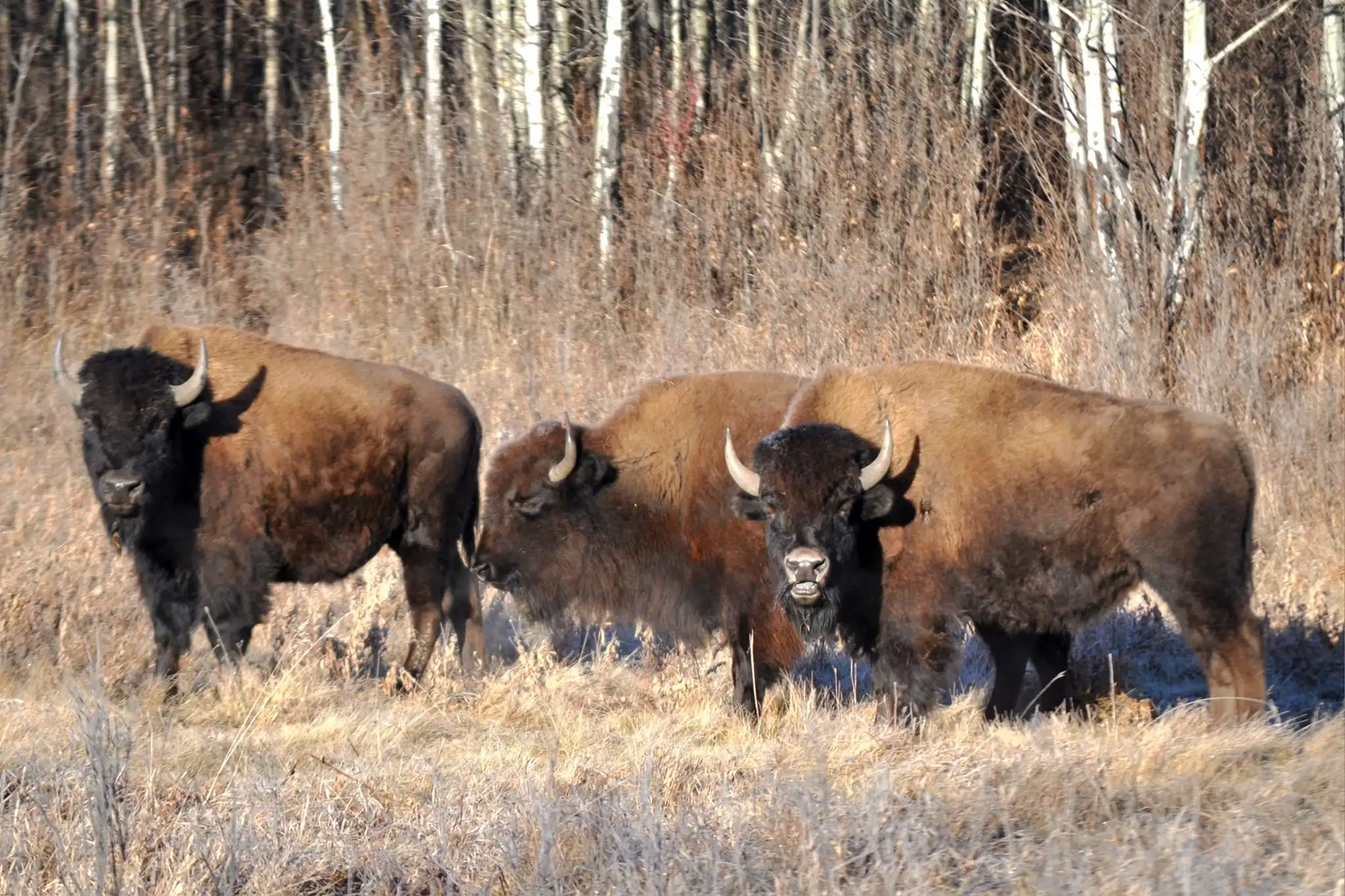
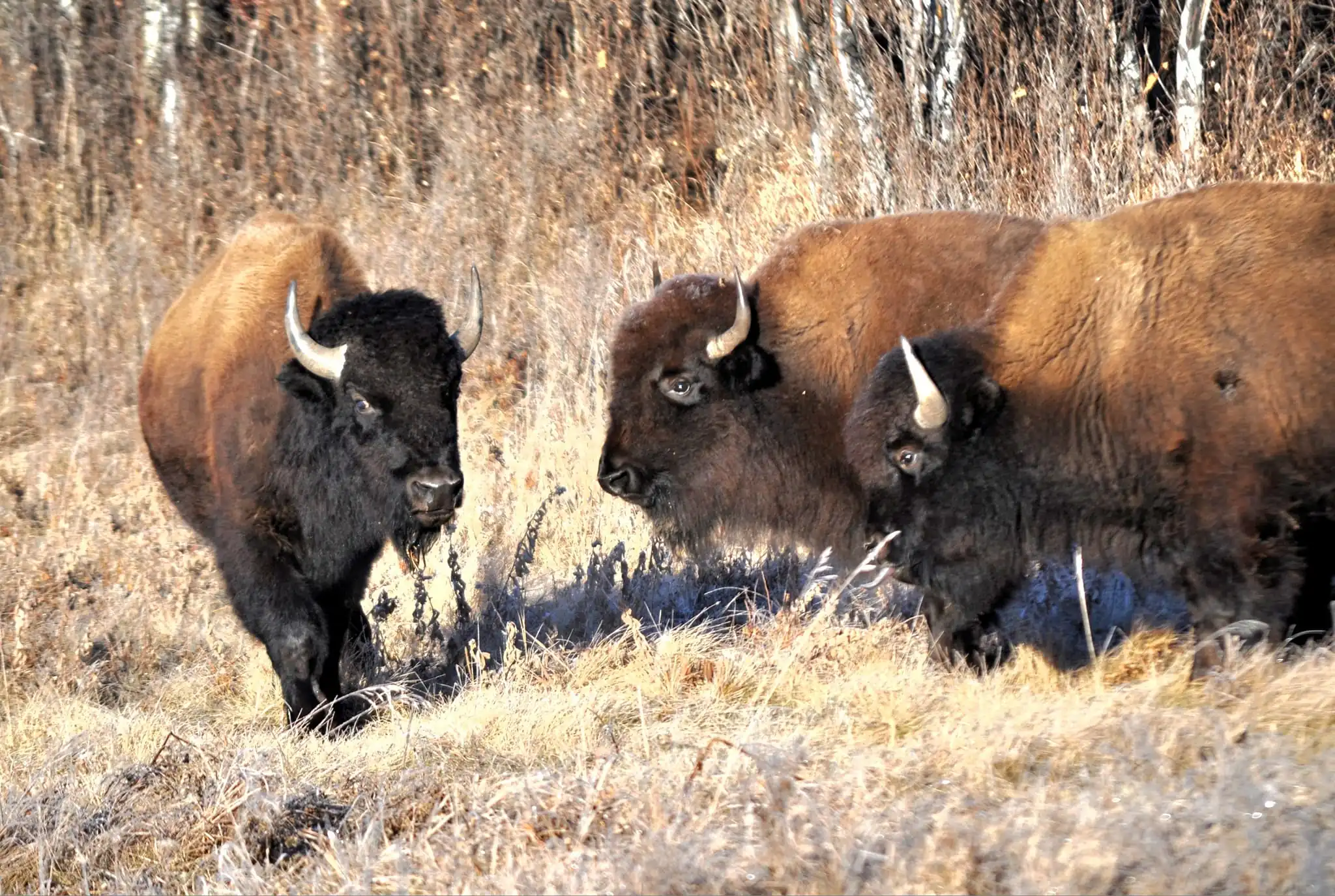
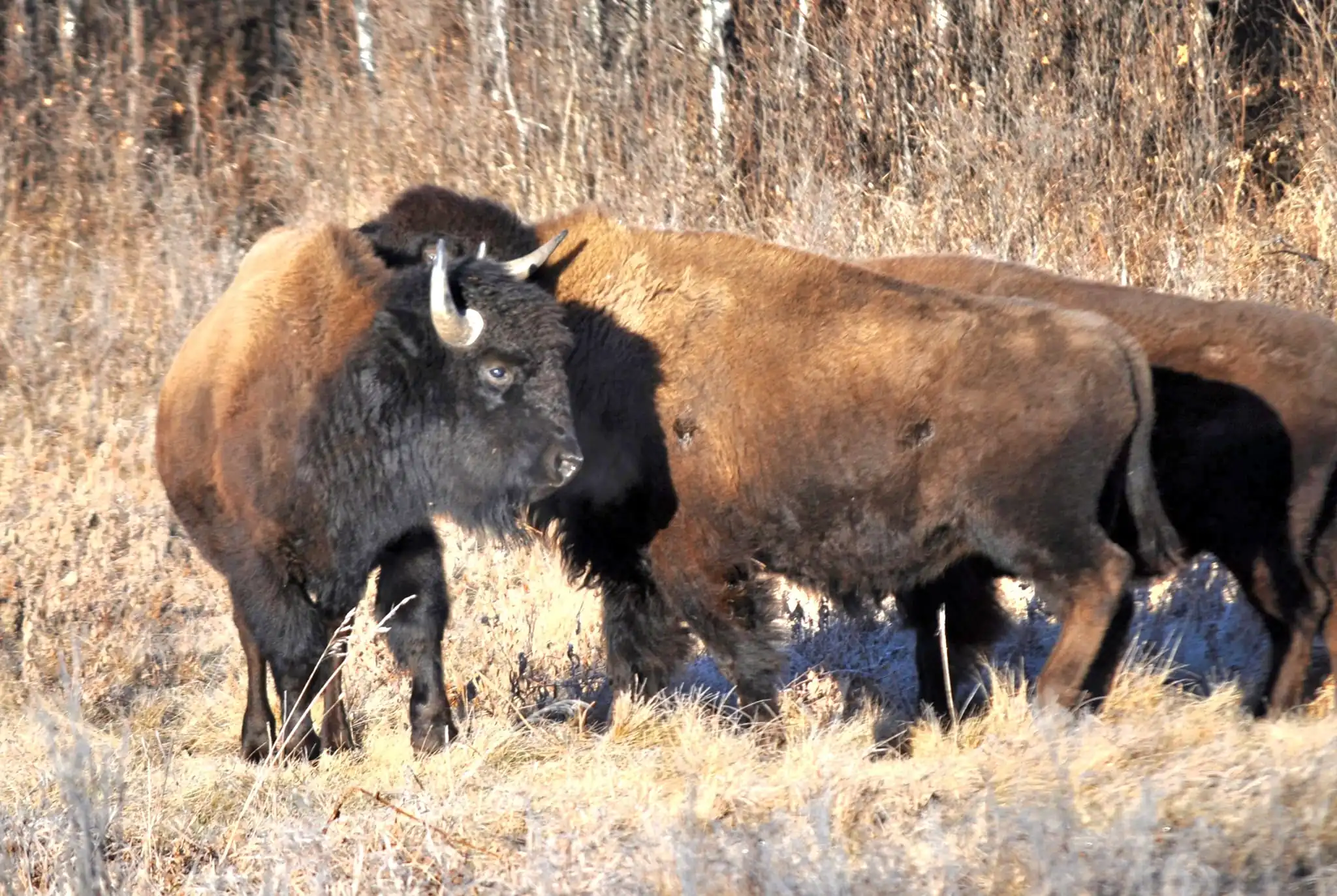
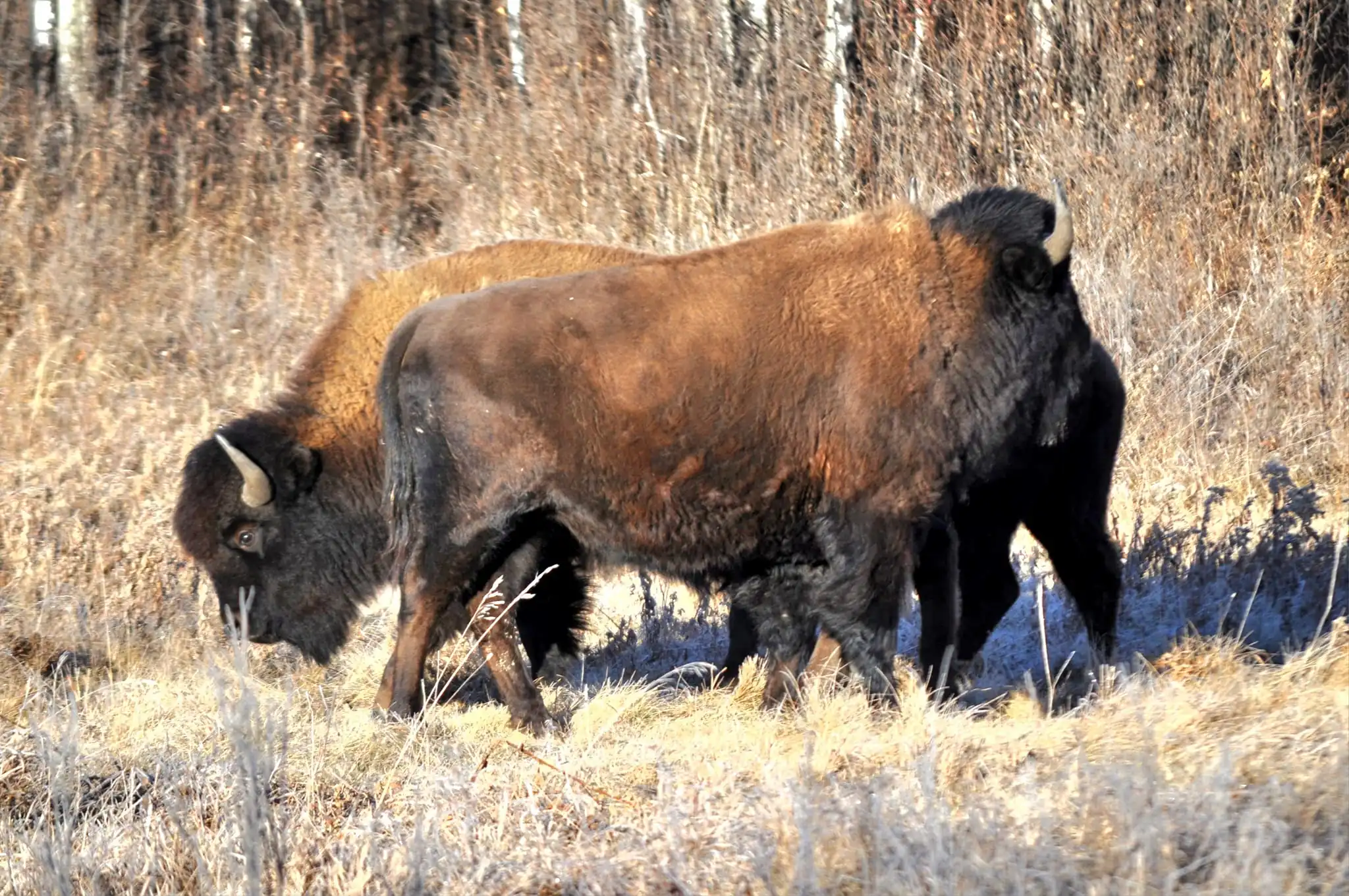
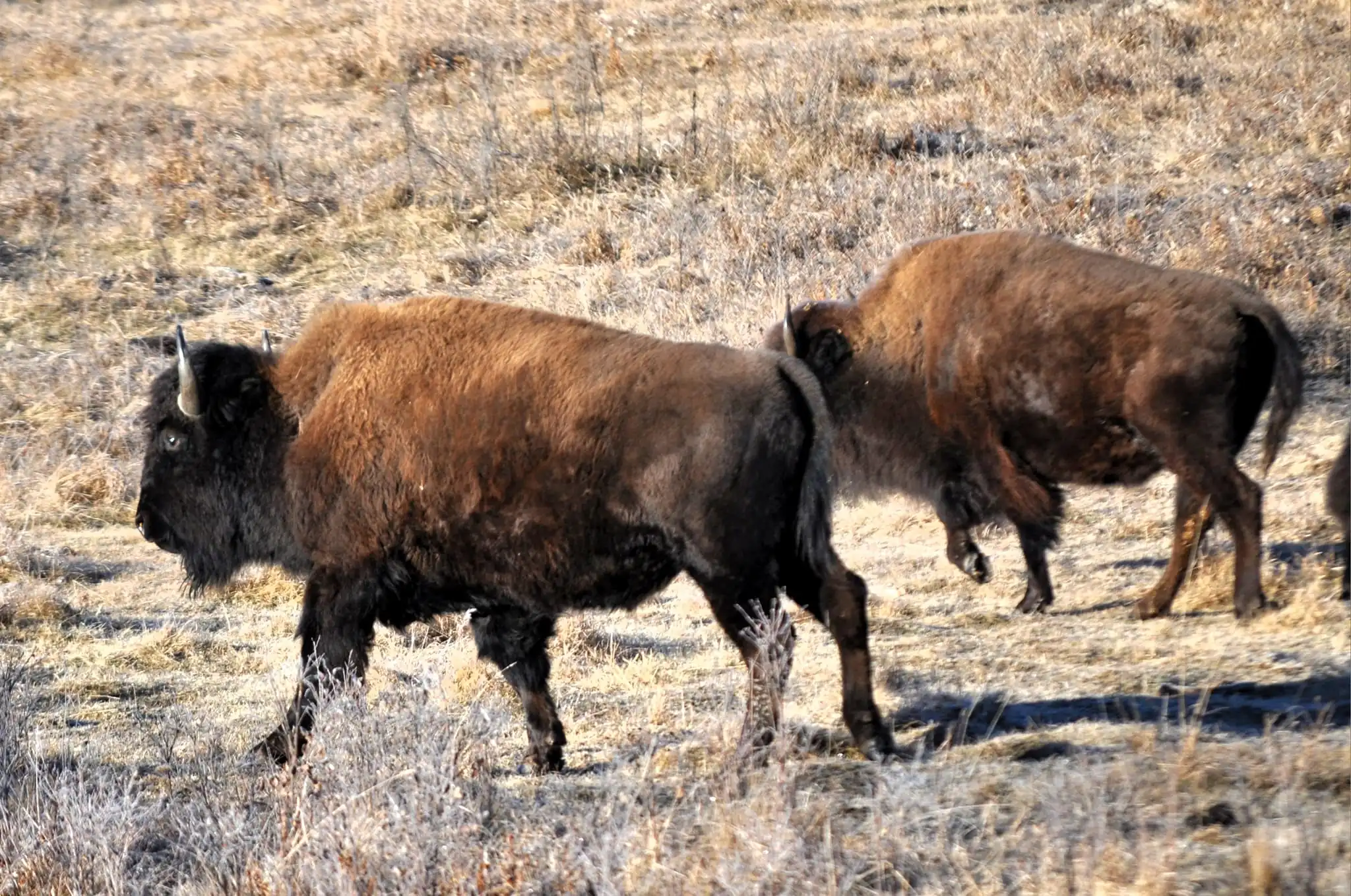
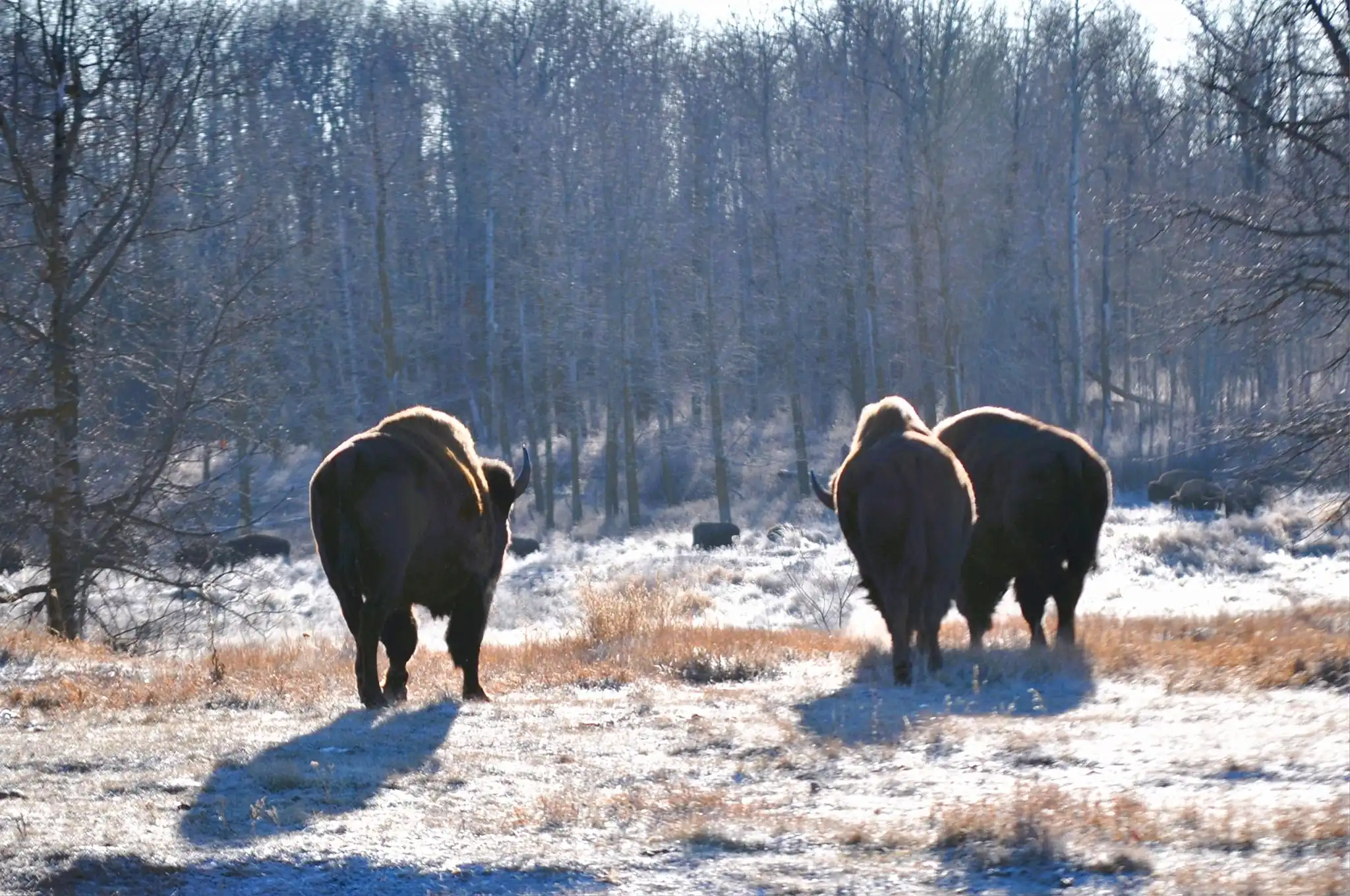


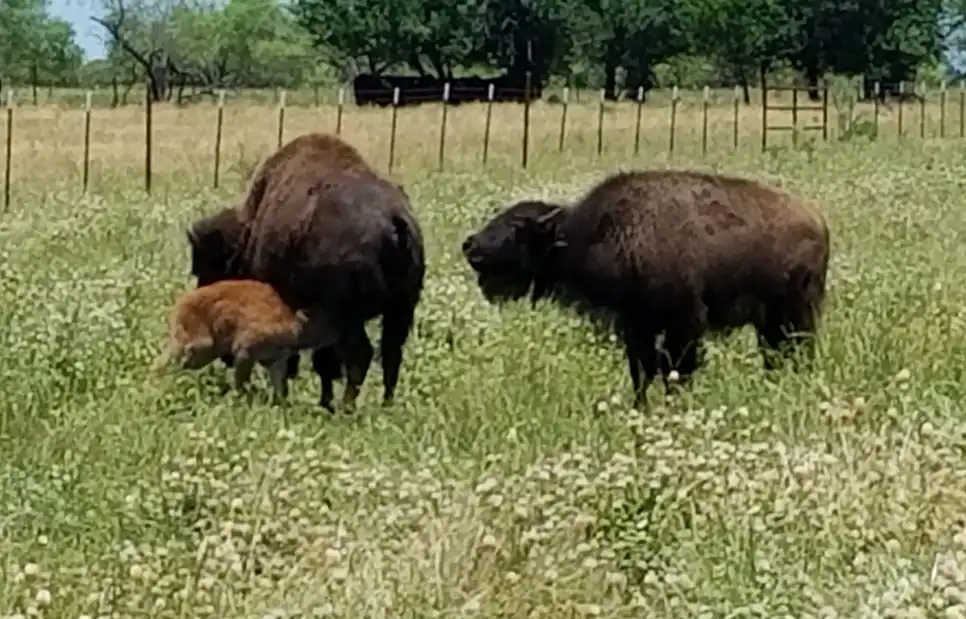

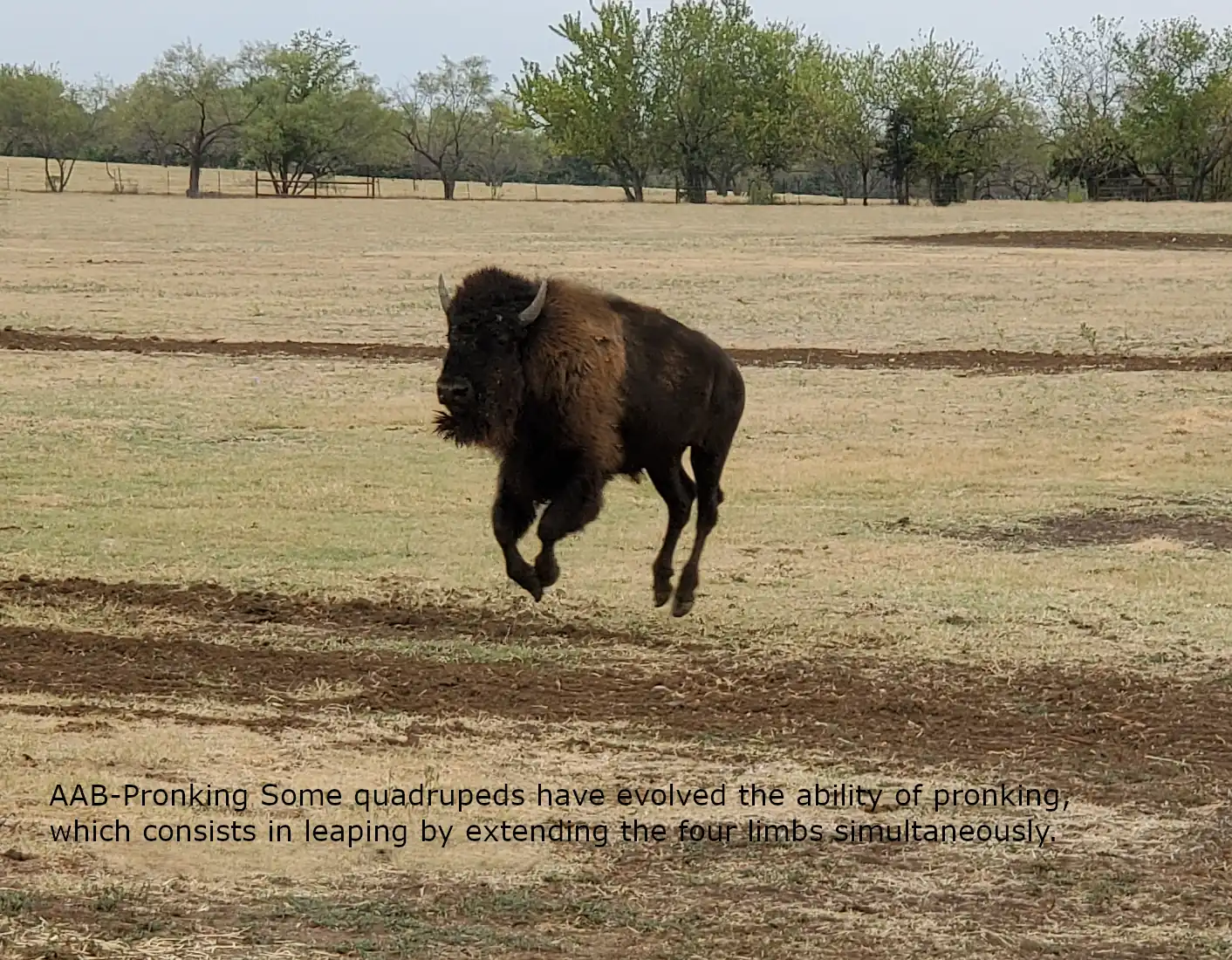
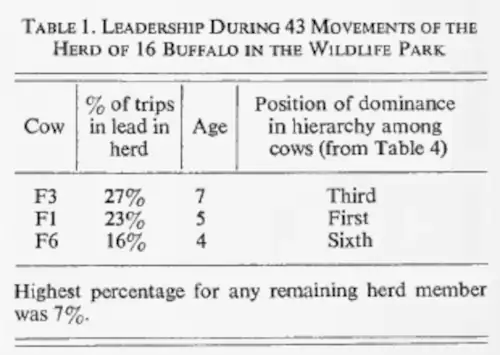

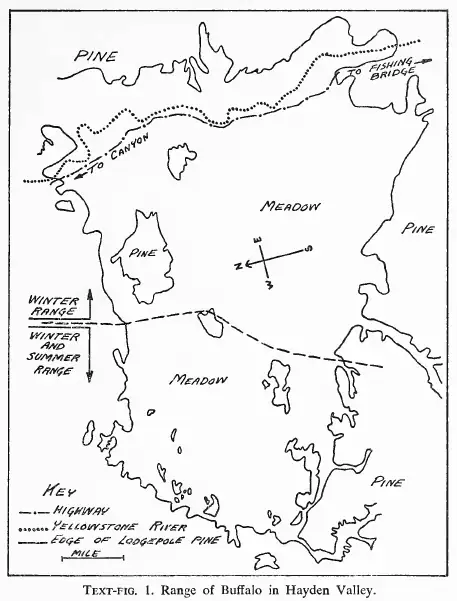
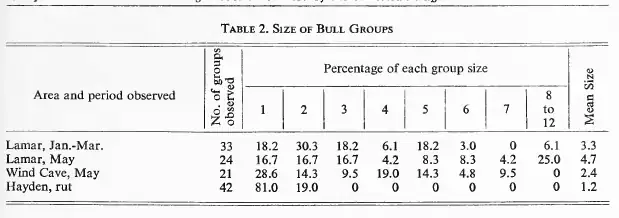
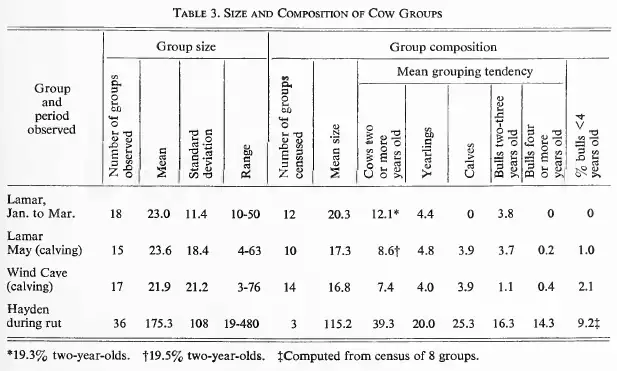
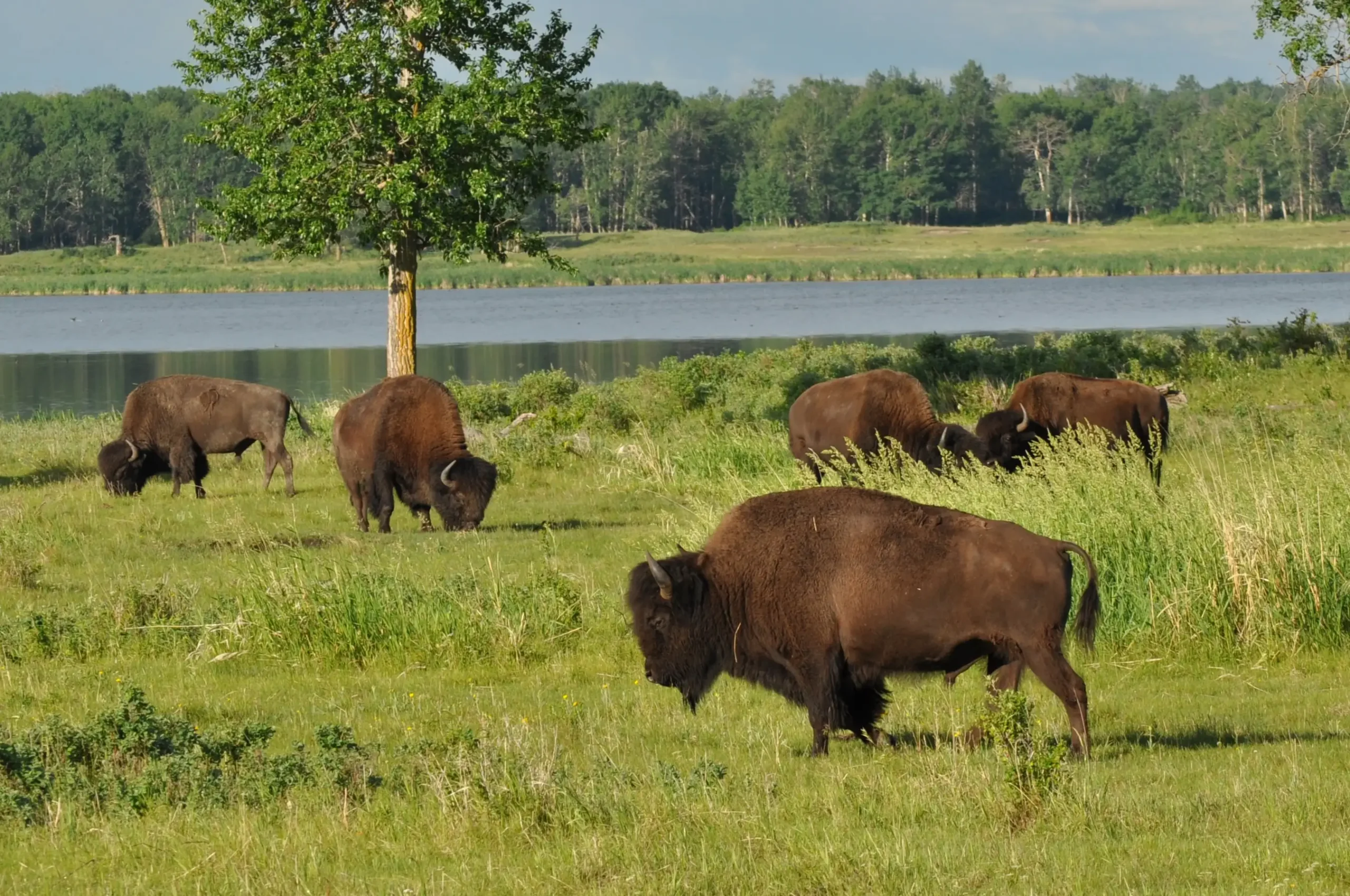
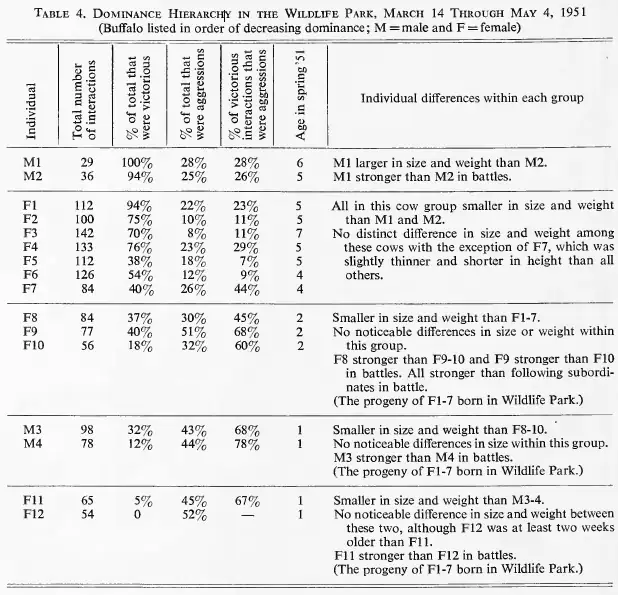
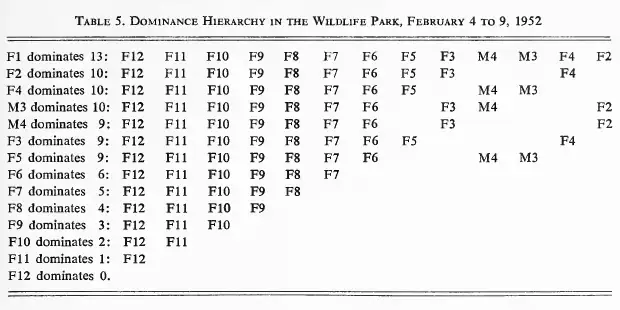
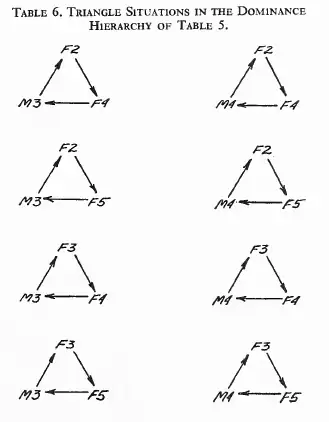
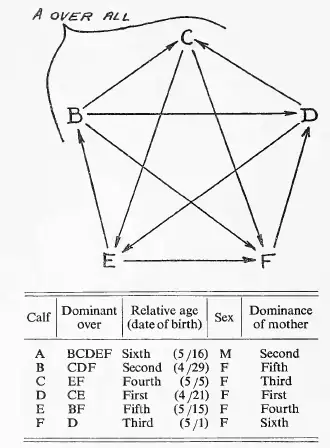
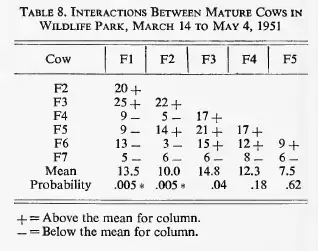 ing the afternoon feeding period, when the herd was not as hungry. This positive correlation between hunger and number of interactions was further verified on days when a surplus of hay remained from the previous day’s feeding. When fresh hay was put out under such conditions, there were fewer interactions than usual. In addition to hay, the herd was also fed concentrate on some days. The buffalo preferred the concentrate, as evidenced by their quick withdrawal from the hay to feed on it. Even though the concentrate was fed about one hour after the hay, the initial peak of interactions sometimes doubled the initial peak for hay on the same day. The interactions over concentrate were also more aggressive.